Wellbeing is so last year – Labour's 'no frills' budget points to an uninspiring NZ election
- Written by: Grant Duncan, Associate Professor, School of People, Environment and Planning, Massey University
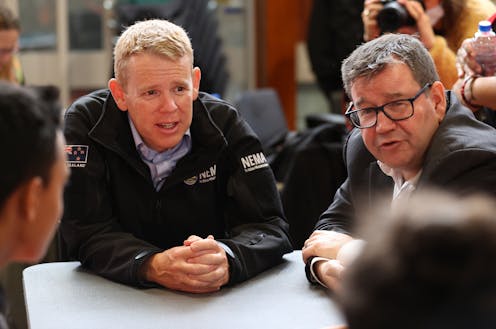
If the recent flood of sleep-inducing pre-budget speeches and commentary is any indication, New Zealand voters can expect largely unimaginative leadership that fails to prepare the country for an uncertain future, regardless of who wins October’s election.
Even so, when finance minister Grant Robertson reads his “no frills” budget speech on Thursday, he’ll implicitly be making the case for why he and his colleagues should be returned to office. Going by the most recent opinion poll[1], that’s far from a sure thing.
So while this week’s budget has plenty riding on it, Labour appears to be betting voters don’t want anything bold. As Prime Minister Chris Hipkins puts it[2], the government is merely “doing the basics” to fix flood-damaged infrastructure – not rebuilding to a standard fit for the future.
The sense of persistent social and environmental problems being managed by press release, rather than resolved, is undiminished. In thrall to credit rating agencies, bank economists and Treasury officials, political leaders have decided “basics” and “no frills” must represent our highest ambitions.
From Ecostore to Kmart
Last year saw the Labour government’s fourth “Wellbeing Budget[3]”, a concept begun in 2019 with mental health as its headline. In 2020, COVID-19 became the big issue. This year, however, Robertson is downplaying wellbeing[4], instead taking a “balanced” approach involving careful cost-cutting, saving and reprioritisation.
Not everyone is happy about the turning away[5] from wellbeing. But it was always questionable whether the word represented anything more than a trendy sticker on “government as usual”.
It’s doubtful any government would say it wasn’t concerned with people’s wellbeing. At the same time, every budget must do the boring job of planning public revenue, expenditure and borrowing with a view to the economic consequences.
By setting out the state’s aims and priorities, it’s an inherently political document. But there’s nothing in it that will necessarily make a voter feel better or more satisfied with their lot – unless perhaps they’re the direct beneficiary of a public lolly scramble.
This being election year, of course, budget largesse is something one might anticipate. But Thursday’s “orthodox no-frills budget[6]” sounds like Labour is switching from Ecostore to Kmart: never mind your wellbeing, this is about Labour’s political survival.
Not all about the economy
Late last year, the Reserve Bank governor apologised[7] for “trying to engineer a recession to bring down high inflation”. He might also have apologised to the government for making it that much harder to retain office.
It hasn’t quite gone that way, though. The December 2022 quarter registered negative 0.6% economic growth, but Massey University’s GDP tracker[8] is showing this hasn’t turned into a recession and the economy is actually growing again.
Robertson can boast that unemployment is low[9], jobs are being created and wages are rising. Yes, inflation and interest rates are high, which causes real stress, but inflation may have passed its peak[10]. As a whole, New Zealand is full steam ahead.
Read more: Strikes, protests and collective action: how fighting a cost-of-living crisis wasn’t always about tightening your own belt[11]
To labour the metaphor, then, what’s the iceberg?
Surveys show confidence in the government has been declining[12] since the highs of mid-2020. Last month, 55% said New Zealand was “heading in the wrong direction”, compared to 35% who said the opposite. Negative sentiment also outweighed positive in consumer confidence surveys.
A “no frills” budget may allay some fears about excessive spending and new taxes. But on its own that doesn’t win back disaffected voters. There has been more than discontent about the high price of avocados – non-material issues such as co-governance and even recognition of gender diversity have become culture wars.
As a simple political strategy, National and ACT now need only to scare those who are most likely to vote (middle class people over 45) with images of a Labour-Green coalition supported by the Māori Party taking the country further down a path that’s too radical for their liking.
An absence of vision
The government’s priorities are skills, science and technology, and infrastructure. The last involves massive projects and capital investment, estimated to cost[13] NZ$210 billion over the next 30 years – just to address the existing infrastructure deficit.
Given the tax burden of all this, we might expect taxation to be an issue. Especially so, considering the recent Inland Revenue report[14] showing “the effective tax rate paid by middle income New Zealanders is at least double that paid by our wealthiest citizens”.
But this budget will propose neither a wealth tax nor a capital gains tax (notwithstanding a group of wealthy New Zealanders openly agreeing[15] they should pay more tax). And there’ll be no cyclone recovery levy[16], either.
Read more: Proving the wealthiest New Zealanders pay low tax rates is a good start – now comes the hard part[17]
So Robertson will also have one eye on the National and Act parties’ pledges to cut taxes[18], paid for by eliminating “wasteful” spending. Robertson calls this the “fiscal Bermuda Triangle” and rejects the idea[19] of “unfunded inflationary tax cuts”.
We can see the outlines of a fairly conventional pre-election policy debate. National will call Labour profligate and ineffectual, Labour will be able to point to “doing the basics” with a “no frills” approach.
But neither major party appears willing to deal with the full extent of social and infrastructural investment necessary to bring the country up to speed with other developed nations. And neither now talks honestly about the tax revenues needed to do that.
They seem to have given up on building a better nation. Is this lack of vision and courage the kind of leadership voters are looking for? The fact that neither of the major parties is getting ahead in the polls may be all the answer we need.
References
- ^ opinion poll (www.newshub.co.nz)
- ^ Chris Hipkins puts it (www.rnz.co.nz)
- ^ Wellbeing Budget (www.treasury.govt.nz)
- ^ downplaying wellbeing (www.rnz.co.nz)
- ^ turning away (www.newsroom.co.nz)
- ^ orthodox no-frills budget (www.beehive.govt.nz)
- ^ apologised (www.rnz.co.nz)
- ^ GDP tracker (www.gdplive.net)
- ^ unemployment is low (www.beehive.govt.nz)
- ^ passed its peak (www.treasury.govt.nz)
- ^ Strikes, protests and collective action: how fighting a cost-of-living crisis wasn’t always about tightening your own belt (theconversation.com)
- ^ been declining (www.roymorgan.com)
- ^ estimated to cost (www.stuff.co.nz)
- ^ Inland Revenue report (www.beehive.govt.nz)
- ^ openly agreeing (www.stuff.co.nz)
- ^ no cyclone recovery levy (www.beehive.govt.nz)
- ^ Proving the wealthiest New Zealanders pay low tax rates is a good start – now comes the hard part (theconversation.com)
- ^ pledges to cut taxes (www.rnz.co.nz)
- ^ rejects the idea (www.stuff.co.nz)