Australia’s ties with Vietnam are important in their own right – not just in relation to the US and China
- Written by: Liam Byrne, Honorary Fellow, School of Historical and Philosophical Studies, The University of Melbourne
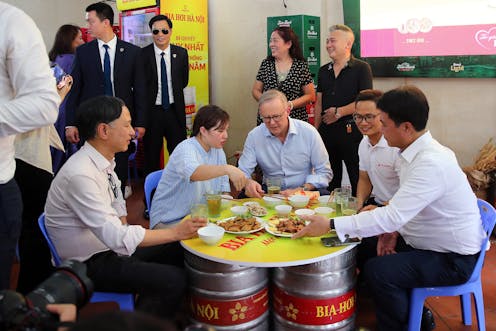
Prime Minister Anthony Albanese’s recent trip to Vietnam is a recognition that Australia’s relationship with the Southeast Asian nation is important on its own terms – not just in how it relates our broader relationships with the United States and China.
As such, it was surprising to see that a nicely executed state visit to a mid-power in the region, which resulted in the mooted upgrading[1] of a “strategic partnership” to a “comprehensive strategic partnership”, had failed to generate substantive headlines, or capture the public imagination.
Australians need to see the enhancement of regional partnerships such as the one with Vietnam as having significant interest to us all, with implications for our future.
Decades of rebuilding relations
This is not the first bilateral visit of an Australian prime minister to Vietnam. The most recent was Scott Morrison’s visit[2] in 2019. But there was a particular resonance to this occasion.
This year marks the 50th anniversary of the establishment of diplomatic relations between Australia and Vietnam. This was, of course, a particularly potent moment due to Australia’s involvement in the war in Vietnam (known there as the “American War”).
Over the course of the war, more than 60,000 Australians[3] were deployed to the country and 523 died. The war and the means of its prosecution – particularly conscription – became heated points of polarisation domestically.
The cost of the war to Vietnam itself was incalculable.
Australian commitment to the war began to wind down from late 1970, with the last Australian troops returning in December 1972, soon after the election of the Whitlam government. Our involvement formally ended a month later.
The decades following the war were devastatingly difficult for Vietnam as it rebuilt itself amid international isolation, especially from the United States. A large number of refugees fled the authoritarianism of the new Communist regime[4], with many establishing strong and vibrant communities in Australia.
Read more: 50 years on, the Vietnam moratorium campaigns remind us of a different kind of politics[5]
In 1986, the Vietnamese Communist Party announced its Đổi Mới reforms[6] to transition the country from a highly centralised economy based on state ownership to a form of market socialism. This began a process of opening Vietnam up economically and politically to the world.
In subsequent years, there has been a bipartisan effort in Australia to consolidate the relationship with Vietnam in both economic and defence agreements.
During the visit of Vietnamese Communist Party General Secretary Nong Duc Manh to Australia in 2009[7], the countries upgraded their relationship to one of “comprehensive partnership”. In 2018, to mark the 45th anniversary of diplomatic relations, this was upgraded further to a “strategic partnership”.
There are obvious economic and diplomatic benefits to enhancing the connections between the countries. According to the Department of Foreign Affairs and Trade, trade between the countries[8] has grown on average by 8.6% per year over the past two decades.
But the attitude of the Morrison government to Vietnam was overtly inflected by its hardening hostility towards China.
Morrison trumpeted the growth in trade during his visit, but within the framework of his government’s foreign policy it was clear that such relationships were, relatively speaking, a sideshow to the main game: Australia’s future was bound[9] to the United States.
Read more: With AUKUS, Australia has wedded itself to a risky US policy on China – and turned a deaf ear to the region[10]
Why Vietnam matters
Since its election, the Albanese government has demonstrated its determination to rebuild and repair regional relationships. While this has included taking the heat out of the recent tensions with China, it also included enhancing collaborations[11] with countries such as Vietnam, Malaysia, Indonesia[12] and others.
The government’s approach has not been a repudiation of Australia’s ongoing defence and political ties with the United States, and is far from a passive stance towards China’s positioning in the region. The staunch commitment of the Albanese government to AUKUS makes this abundantly clear.
But it was a recognition that the overwhelming emphasis of Australian foreign policy in recent years had diminished the significance of our relationships with these middle-sized regional countries that were similarly seeking to adapt to the changing relationships and balance of power in the Asia-Pacific region.
As a recent prime ministerial statement[13] outlined,
Stepping-up Australia’s relations with Vietnam is an important part of the government’s determination to rebuild Australia’s links with the countries of Southeast Asia.
Vietnam has experienced its own economic woes of late. It has a notable reliance on Australian coal[14] for its power generation, and this is likely to remain the case in the short term. Its government is authoritarian. This should not be obscured in discussions of our relationship.
During Prime Minister Anthony Albanese’s official trip to Hanoi, Australia and Vietnam inked a $105 million decarbonisation agreement.But Vietnam[15] is a dynamic country with an economy that has been on the upswing. It also has a young population that is increasingly skilled and has demonstrated itself to be globally connected.
On our side, Australia is a country increasingly integrating itself into the region and exploring new economic opportunities in renewable energy. Among the agreements Albanese signed in Hanoi was a $105 million package to help Vietnam decarbonise its economy.
Australia also has a large population of citizens with Vietnamese heritage[16] with enduring ties – both familial and economic – to Vietnam. Current exchanges in trade and education are mutually beneficial, and growing.
And all this is happening between two countries who, within living memory, were at war.
The experience of the Vietnam War should remind all Australians of the dangers of following our American ally in pursuing its foreign policy ambitions without regard for our own. And the current relationship with Vietnam demonstrates how we can do it our way.
Read more: Penny Wong said this week national power comes from 'our people'. Are we ignoring this most vital resource?[17]
References
- ^ upgrading (www.abc.net.au)
- ^ Scott Morrison’s visit (www.dailymail.co.uk)
- ^ 60,000 Australians (anzacportal.dva.gov.au)
- ^ authoritarianism of the new Communist regime (www.nma.gov.au)
- ^ 50 years on, the Vietnam moratorium campaigns remind us of a different kind of politics (theconversation.com)
- ^ Đổi Mới reforms (www.globalasia.org)
- ^ Nong Duc Manh to Australia in 2009 (www.theage.com.au)
- ^ trade between the countries (www.dfat.gov.au)
- ^ future was bound (www.nytimes.com)
- ^ With AUKUS, Australia has wedded itself to a risky US policy on China – and turned a deaf ear to the region (theconversation.com)
- ^ enhancing collaborations (www.abc.net.au)
- ^ Vietnam, Malaysia, Indonesia (www.smh.com.au)
- ^ prime ministerial statement (www.pm.gov.au)
- ^ Australian coal (www.afr.com)
- ^ Vietnam (www.austrade.gov.au)
- ^ Vietnamese heritage (www.dfat.gov.au)
- ^ Penny Wong said this week national power comes from 'our people'. Are we ignoring this most vital resource? (theconversation.com)