Pope Francis is recovering from hernia surgery. But what exactly is a hernia?
- Written by: Vincent Ho, Associate Professor and clinical academic gastroenterologist, Western Sydney University
Pope Francis has had an operation this week to remove a hernia, which his surgeon said[1] had been causing him increasingly frequent pain.
This planned surgery was to remove a type of hernia caused by scarring from previous operations, known as an incisional hernia.
Hernias are common and there are many different types. Not all need surgery. But what actually is a hernia? And if you do need surgery, what can you expect?
Read more: Health Check: why can you feel groggy days after an operation?[2]
What is a hernia? Am I at risk?
Your abdomen has a number of layers of muscle that help protect and wrap around your internal organs. A hernia[3] occurs when tissues or organs bulge through a weak point in that muscular wall.
Hernias can be present at birth but can also arise later in life when the abdomen is under a lot of pressure[4].
Pregnant women are prone to developing hernias, as are people who are overweight, those lifting heavy weights (either at work or in the gym), and people with chronic health conditions that increase abdominal pressure, such as constipation.
Read more: Health Check: what causes constipation?[5]
Types of hernias
There are different types of hernia.
1. Inguinal hernias
These occur when fatty tissue or a bit of the small bowel pokes through a weak area in the lower abdominal wall. They tend to develop on one side of the groin.
Inguinal hernias are the most common type of hernia and account for almost three-quarters[6] of all abdominal wall hernias.
Some[7] 27% men and 3% of women will develop an inguinal hernia at some point in their lives. The risk[8] increases with age.
2. Femoral hernias
Fatty tissue or a bit of the small bowel can also poke into two deeper passages in the groin called the femoral canals. Hernias through these passages are known as femoral hernias. They’re far less common than inguinal hernias and are much more common[10] in women than in men.
3. Umbilical hernias
These occur when fatty tissue or a bit of the small bowel bulges through the opening of the abdominal muscles close to the belly button.
They are most common[11] in newborns and infants younger than six months. They result from the abdominal opening that the umbilical cord passes through not sealing properly after birth.
The vast majority of these hernias don’t cause any issues and will disappear by the time the child is five years old.
Adults can get umbilical hernias too. Risk factors[12] include being overweight and having a chronic condition that increases abdominal pressure, such as a chronic cough or fluid in the abdomen (called ascites) that often arises from liver disease.
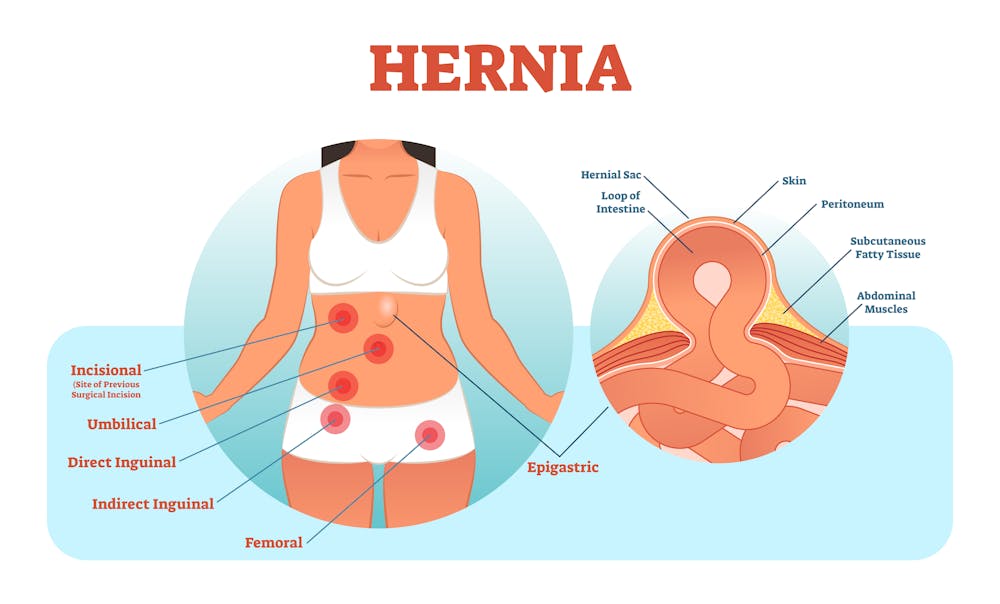 There are different types of hernia, some more common than others.
Shutterstock[13]
There are different types of hernia, some more common than others.
Shutterstock[13]
4. Hiatus hernias
These occur when the upper part of the stomach bulges through the large muscle separating the abdomen and chest (the diaphragm). You’re more likely[14] to develop these if you are older or overweight.
Many people with small hiatus hernias will have no symptoms. But in some people, large ones can be associated with reflux symptoms, such as heartburn and regurgitation.
Read more: Explainer: what is gastric reflux?[15]
5. Incisional hernias
These hernias can occur after surgery, which is what happened with Pope Francis.
These arise when there is a weakness in the abdominal wall located at the site of a cut made during a previous operation. Pope Francis’ incisional hernia was repaired because the loops of small bowel in that hernia were getting partially blocked and causing pain.
 Surgery may be needed to remove a hernia.
Shutterstock[16]
Surgery may be needed to remove a hernia.
Shutterstock[16]
6. Others
There are several other types of hernias. These include muscle hernias[17] where part of the muscle can poke through surrounding tissue. These are most common in leg muscles after an injury.
What to do about a hernia?
The first sign of an inguinal or femoral hernia may be a painful or noticeable bulge in your groin. This bulge will generally become more noticeable when you stand up, cough or strain during a bowel movement. For umbilical or incisional hernias, you may notice a bulge on the abdomen.
You should seek urgent medical attention if you have a hernia and experience severe abdominal pain, nausea and vomiting, difficulty in passing wind or if the hernia becomes very firm and tender. This could signify[18] the blood supply to the bit of bowel inside the hernia is cut off or the bowel has become twisted and is fully blocked.
Fortunately, the vast majority[19] of abdominal hernias can be repaired with surgery.
In many cases, such as with Pope Francis, this surgery is carried out with the assistance of a surgical mesh. This is a medical device that supports damaged tissue around hernias as it heals. Mesh helps to reduce the risk[20] of a hernia returning.
Most people are able to go home the same day or the day after surgery, with a full recovery expected within a few weeks.
Read more: Surgery rates are rising in over-85s but the decision to operate isn't always easy[21]
References
- ^ surgeon said (www.vaticannews.va)
- ^ Health Check: why can you feel groggy days after an operation? (theconversation.com)
- ^ hernia (www.cancer.gov)
- ^ lot of pressure (www.ncbi.nlm.nih.gov)
- ^ Health Check: what causes constipation? (theconversation.com)
- ^ three-quarters (journals.sagepub.com)
- ^ Some (academic.oup.com)
- ^ risk (academic.oup.com)
- ^ Shutterstock (www.shutterstock.com)
- ^ much more common (pubmed.ncbi.nlm.nih.gov)
- ^ most common (www.ncbi.nlm.nih.gov)
- ^ Risk factors (www.ncbi.nlm.nih.gov)
- ^ Shutterstock (www.shutterstock.com)
- ^ more likely (pubmed.ncbi.nlm.nih.gov)
- ^ Explainer: what is gastric reflux? (theconversation.com)
- ^ Shutterstock (www.shutterstock.com)
- ^ muscle hernias (www.ncbi.nlm.nih.gov)
- ^ signify (www.ncbi.nlm.nih.gov)
- ^ vast majority (www.sciencedirect.com)
- ^ reduce the risk (www.ncbi.nlm.nih.gov)
- ^ Surgery rates are rising in over-85s but the decision to operate isn't always easy (theconversation.com)