can the FIFA World Cup help level the playing field for all women footballers?
- Written by: Julie E. Brice, Assistant Professor, Department of Kinesiology, California State University, Fullerton
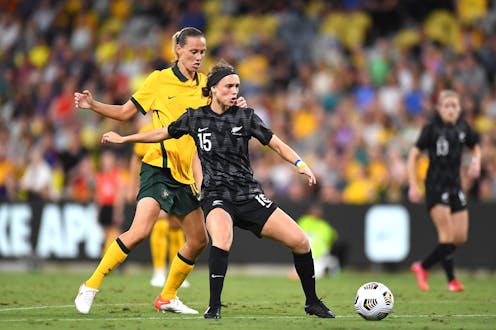
There’s little doubt the FIFA Women’s World Cup will deliver spectacle and significant financial rewards when it kicks off in a fortnight. The longer-term rewards, however, are harder to predict.
Tens of thousands of visitors will spend hundreds of millions of dollars to follow the matches across Australia and New Zealand – the first FIFA women’s football tournament to be hosted across two countries and two football confederations.
Following the recent success of the Women’s Rugby World Cup[1], the financial benefits of co-hosting this tournament have been estimated to be worth NZ$200 million[2] to New Zealand and A$460 million[3] to Australia.
But the event’s legacy can’t be measured in dollars alone. The trans-Tasman bid to co-host the Cup – dubbed “As One” – emphasised its potential to supercharge football in the region and promote women and girls in the sport.
The bid drew heavily on the Sport New Zealand Strategy for Women and Girls in Sport and Active Recreation[4], a government-led initiative[5] to improve opportunities for girls and women to participate in sport, active recreation and play, and to improve conditions for women as athletes and leaders.
All noble goals, but research[6] has repeatedly shown it isn’t possible to draw a straight line between major sporting events and wider societal benefits. And there is clear evidence of longstanding inequities in women’s football, both in New Zealand[7] and around the world[8].
Making up for these historic inequalities in opportunity, pay, and representation will require sustained focus and investment. The challenge, therefore, is to genuinely leverage interest in the Women’s World Cup to effect real, measurable, and positive change.
Promise versus reality
Politically, the “As One” bid aligned well with FIFA’s own recent goals and objectives, including its FIFA 2.0[9] initiative and women’s football strategy[10].
In response to recent claims of major corruption[11], FIFA has been working to rebrand its image[12] and reform the federation. Part of this has seen a commitment to support and grow the women’s game[13] at both professional and recreational levels.
Just how much mega-events, like World Cups and Olympics, contribute to real social and economic legacies, however, has long been questioned[14]. In fact, many of the promises made during bids and later promotion of the events – increased participation, more investment in leagues – go unrealised[15].
Read more: World Cup 2023 will be a massive boost for women's sport – but does it make financial sense?[16]
This is particularly so when short-term event strategies aren’t matched by longer-term investment planning. There is little evidence to support claims of trickle-down[17] or “inspiration[18]” effects, whereby people are motivated to participate in a sport or physical activity simply by watching a major event.
The so-called “legacies” of football tournaments, more specifically, have also been found wanting[19], particularly where improving gender equity has been a focus. One study[20] of the UEFA Women’s Euro 2005 Championship found that:
Despite record crowds and unprecedented media attention, an increase in participation by women after the event was neither significant, nor sustained.
Similarly, despite FIFA’s promises of equality, there remain vast disparities[21] within sporting organisations. There has also been a lack of sustained commitment[22] to end gender inequalities and sexism across the sport. The “As One” bid itself has also been criticised[23] for its superficial engagement with gender equality.
Read more: ‘The moment needs to carry on’ – why the Black Ferns’ success must be a game-changer for women’s sport in NZ[24]
Leveraging the World Cup
Sporting bodies in New Zealand are aware of these issues. Across government and sporting agencies, there are a range of strategic steps being made towards achieving a genuine social legacy from the FIFA Women’s World Cup.
Beyond increased media attention[25] and FIFA-sponsored “fan festivals[26]” in the host cities, the Ministry for Women[27] and Ministry of Business, Innovation and Employment[28] have developed grants and funding for organisations committed to empowering young girls and women, and increasing physical activity levels.
New Zealand Football (NZF[29]) has addressed the challenge head on, tagging its “Aotearoa United[30]” initiative with the byline “Legacy Starts Now”. It aims for an “enduring impact on our game and diverse communities in the years that follow the tournament”.
Read more: Women's football: record crowds and soaring popularity – here's how to keep it this way[31]
To that end, NZF’s FanTails[32] programme capitalises on World Cup excitement to introduce the game in a fun way to girls aged 4-12. NZF has also partnered with Māori Football Aotearoa and Sport New Zealand to develop the Kōtuitui[33] nationwide school programme, with a focus on supporting[34] participation by girls and young women from diverse socio-cultural backgrounds.
But while such programmes should be applauded, they may not address the larger systemic issues within football. Recently, players from Auckland’s Western Springs AFC[35] expressed concerns about alleged gender inequities and feeling “disrespected” by club leadership[36], resulting in many players threatening to leave the club.
With long histories of male dominance[37] in football clubs and organisations, changing a sporting culture does not happen overnight[38].
Playing the long game
On the other hand, great strides are being made for women’s football across New Zealand and internationally.
Participation rates for women and girls have increased over 35% since 2011, according to NZF[39]. At the same time, the profile of the women’s game has grown globally[40].
Clearly, the two are related. With the significant investment in the FIFA Women’s World Cup, and the efforts being made to inspire and connect with girls, women and families across the country, a further surge in participation rates is on the cards.
How long this interest lasts, however, depends on longer term investment strategies. And that means building opportunities for girls and young women to participate in safe, supportive, and truly inclusive sporting environments.
References
- ^ Women’s Rugby World Cup (www.rnz.co.nz)
- ^ NZ$200 million (www.stuff.co.nz)
- ^ A$460 million (www.abc.net.au)
- ^ Strategy for Women and Girls in Sport and Active Recreation (www.tandfonline.com)
- ^ government-led initiative (sportnz.org.nz)
- ^ research (www.tandfonline.com)
- ^ New Zealand (researchcommons.waikato.ac.nz)
- ^ world (books.emeraldinsight.com)
- ^ FIFA 2.0 (www.fifa.com)
- ^ women’s football strategy (www.fifa.com)
- ^ claims of major corruption (www.bbc.com)
- ^ rebrand its image (www.tandfonline.com)
- ^ grow the women’s game (papers.ssrn.com)
- ^ long been questioned (www.tandfonline.com)
- ^ go unrealised (www.tandfonline.com)
- ^ World Cup 2023 will be a massive boost for women's sport – but does it make financial sense? (theconversation.com)
- ^ trickle-down (experts.illinois.edu)
- ^ inspiration (www.emerald.com)
- ^ found wanting (www.tandfonline.com)
- ^ study (www.tandfonline.com)
- ^ vast disparities (journals.humankinetics.com)
- ^ lack of sustained commitment (link.springer.com)
- ^ criticised (journals.sagepub.com)
- ^ ‘The moment needs to carry on’ – why the Black Ferns’ success must be a game-changer for women’s sport in NZ (theconversation.com)
- ^ media attention (sportnz.org.nz)
- ^ fan festivals (www.fifa.com)
- ^ Ministry for Women (women.govt.nz)
- ^ Ministry of Business, Innovation and Employment (www.mbie.govt.nz)
- ^ NZF (www.nzfootball.co.nz)
- ^ Aotearoa United (www.nzfootball.co.nz)
- ^ Women's football: record crowds and soaring popularity – here's how to keep it this way (theconversation.com)
- ^ FanTails (www.nzfootball.co.nz)
- ^ Kōtuitui (www.stuff.co.nz)
- ^ focus on supporting (www.stuff.co.nz)
- ^ Western Springs AFC (www.newsroom.co.nz)
- ^ “disrespected” by club leadership (www.nzherald.co.nz)
- ^ male dominance (www.tandfonline.com)
- ^ overnight (www.taylorfrancis.com)
- ^ according to NZF (www.nzfootball.co.nz)
- ^ grown globally (abcnews.go.com)