attending the 150th Latvian Song and Dance Festival as the daughter of refugees
- Written by: Brigita Ozolins, Adjunct Senior Lecturer, Fine Arts, University of Tasmania
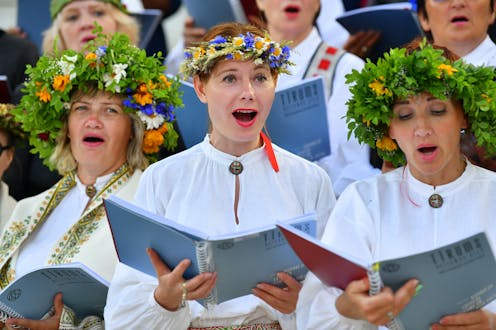
“With song we have achieved freedom. With song we have gone to war. With song we have been victorious.”
These were the words of the newly elected president of Latvia, Edgars Rinkēvičs[1], at the closing ceremony of the 150th Latvian Song and Dance festival, held from June 30 to July 9.
Rinkēvičs was greeted by an audience of 50,000 members of the public and 21,000 performers who cheered and waved Latvian flags. He spoke about the power of song to unite and give hope to the Latvian people and to reinforce its centuries old cultural traditions.
Upward Together, the five-hour finale of this ten-day festival, was held in Silver Grove: an enormous, brand new, crescent-shaped arena amid tall pines in Mežaparks forest on the outskirts of Latvia’s capital, Rīga.
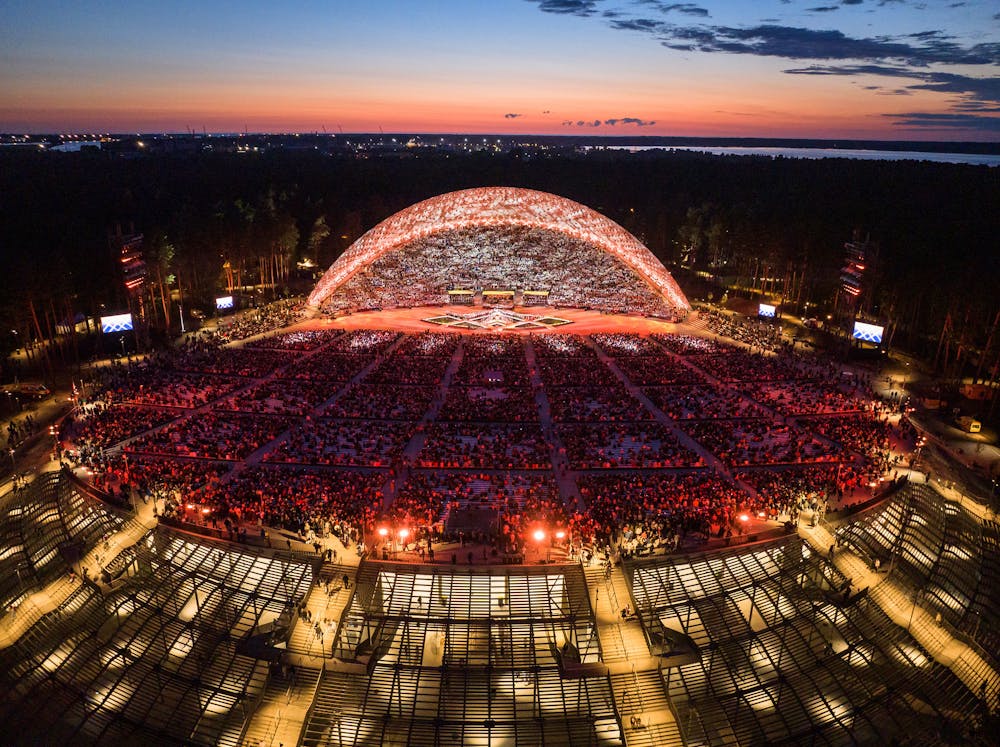
Upward Together was not just a celebration of Latvia’s rich culture: it was an emotional outpouring of both individual and collective national pride and sorrow. It reflected Latvia’s strong pagan roots and its deep love of nature which features in most of its folk songs[2]. Here, the gods reside in trees, rivers, the sun, the moon and the stars.
But more significantly, the festival asserted the power of song as a peaceful form of protest against a long history[3] of occupation by Germans, Poles, Swedes and Russians, culminating last century in almost 45 years of Soviet rule.
Joy about culture; sadness about history
As the daughter of refugees who escaped the Soviet occupation of Latvia during the second world war, I fought back tears as I listened to a choir of 17,000 champion the sun, the Daugava river and thunder – Latvia’s guardians against evil and oppression.
Next to me, two Ukrainian journalists wept as the orchestra played their national anthem. In the televised replays of the festival, cameras zoomed in on teary singers, dancers and musicians of all ages.
“Why does everyone cry?” I asked one of the participants.
“Because we feel great joy about our culture,” she said, “but also great sadness about our history.”
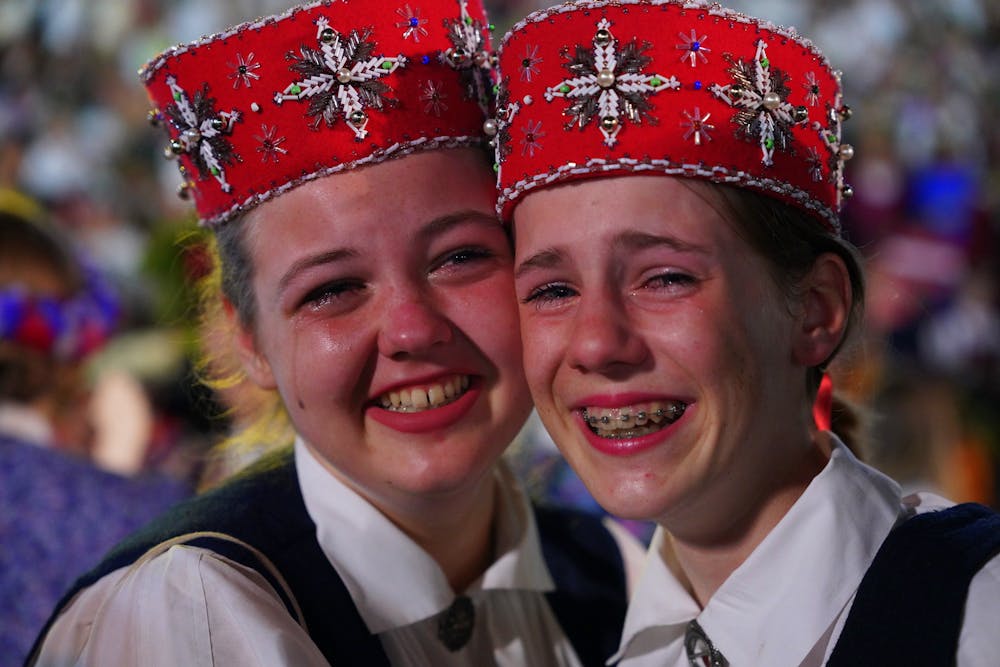 Many tears were shed across the festival.
Juris Pavlovs/The Latvian Centre of National Culture
Many tears were shed across the festival.
Juris Pavlovs/The Latvian Centre of National Culture
With the war in Ukraine on Latvia’s doorstep echoing its own battle with Russia during the second world war, the performances I saw over the ten day festival took on an added poignancy, offering a reminder of the Singing Revolution[4] of 1987-91, when the three Baltic States raised their voices in song against their Soviet occupiers.
On August 23 1989, two million people from Latvia, Lithuania and Estonia formed a human[5] chain over 600 kilometres long to join their capital cities. They held hands, sang folk songs and waved flowers, in a peaceful demonstration of solidarity that saw each state finally gain independence in the early 1990s.
Read more: Ukraine war prompts Baltic states to remove Soviet memorials[6]
A free Latvia
Latvia’s Song and Dance festival was first held in 1873 with 1,000 performers, and was recognised by UNESCO[7] in 2003.
After the second world war, when Latvia was part of the USSR, the festival was used to promote Soviet ideology. Certain songs particularly dear to Latvians could not be performed because they proclaimed the nation’s longing for independence. Gaismas Pils (The Castle of Light), composed in 1899 by Jāzeps Vītols, tells of a sunken castle that rises to announce the rebirth of a free Latvia. Despite being banned from the program, it was sung with defiance at the 1985 festival.
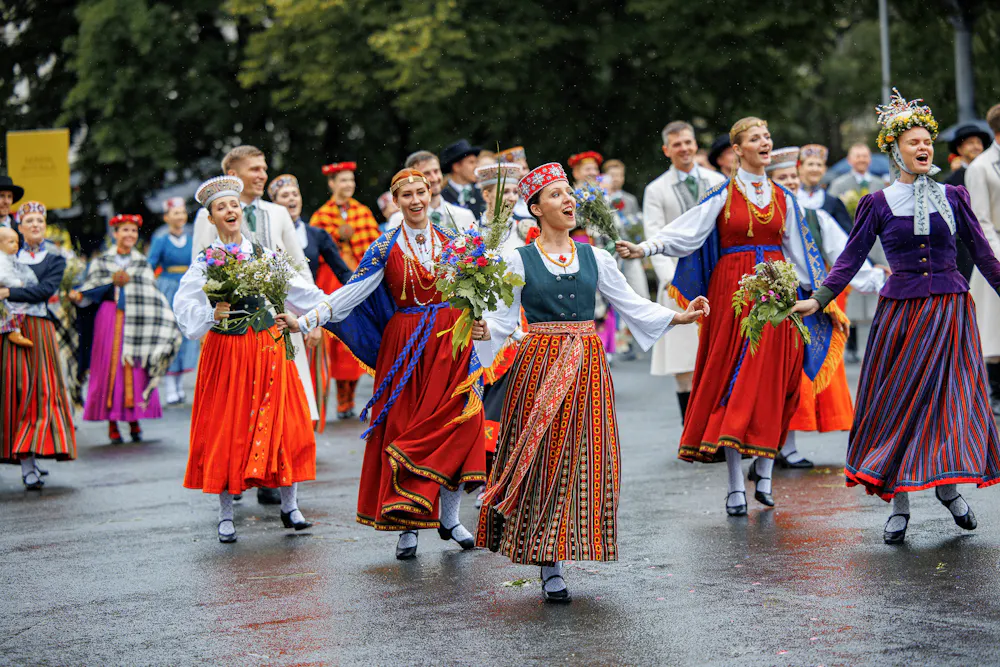 Attendees embraced Latvia’s centuries old cultural traditions.
Kaspars Teilāns/The Latvian Centre of National Culture
Attendees embraced Latvia’s centuries old cultural traditions.
Kaspars Teilāns/The Latvian Centre of National Culture
This year, 32 years after Latvia’s independence, the festival boasted over 40,000 participants including almost 3,000 from Latvia’s diaspora.
Participants from Latvia and from abroad paraded in national costume along Freedom Boulevard, cheered on by enthusiastic crowds and unfazed by downpours of rain. They performed in over 60 events in sport stadiums, theatres, churches and parks as well as the new arena in Mezaparks. They sang, danced and played the kokle[8], a traditional wooden instrument.
Ethnic groups from Ukraine, Russia, Belarus, Germany, Poland, the Jewish community and smaller regions of Latvia were featured in a special concert in the beautiful Chekhov Theatre; seniors gave a moving performance in the circus; 17,000 dancers formed constantly moving patterns of traditional Latvian symbols in a football stadium.
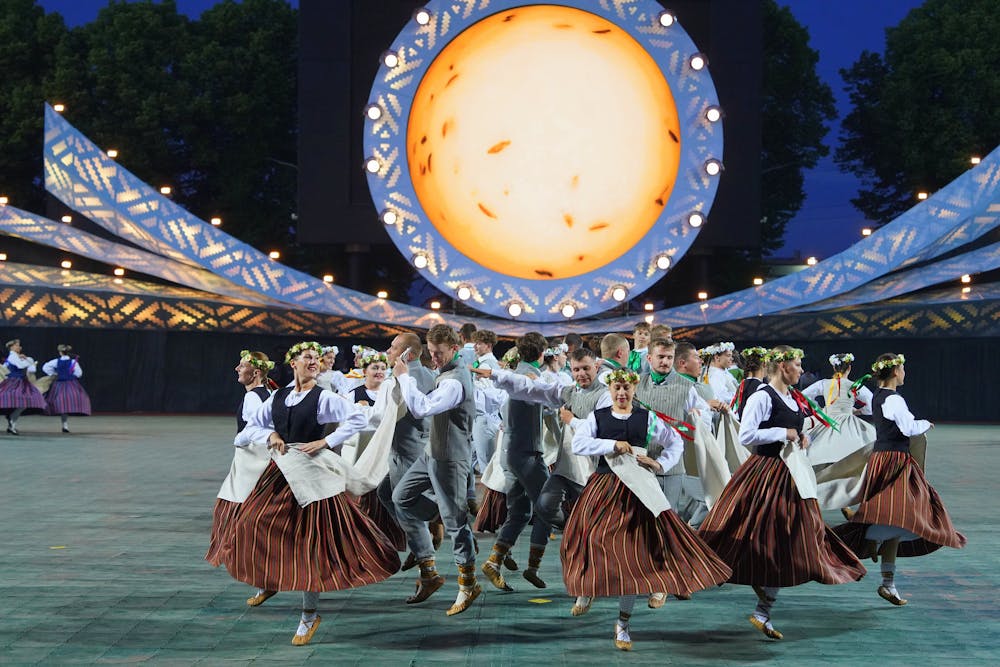 Dancers formed constantly moving patterns of traditional Latvian symbols.
Jānis Pipars/The Latvian Centre of National Culture
Dancers formed constantly moving patterns of traditional Latvian symbols.
Jānis Pipars/The Latvian Centre of National Culture
Riga’s central parks were transformed into art and craft markets selling silver, bronze and amber jewellery, hand-woven textiles, woodcarving, ceramics and leatherwork. Food stalls sold rye bread, sauerkraut and traditional pastries. Choirs, bands and theatre groups performed well into the night on outdoor stages and two giant traditional skirts spun continuously in the Esplanade as if unable to stop dancing.
The whole of Riga was alive.
Although I have been to Latvia many times, this was my very first experience of the Song and Dance Festival. I cried at every performance because every performance manifested the joy and the sorrow of what it is to be Latvian. When I was there, I truly understood the festival’s motto, Kopā būt, kopā just. Being together, feeling together.
Read more: Remembering minorities amid eastern Europe's nation-state centenary celebrations[9]
References
- ^ Edgars Rinkēvičs (www.bbc.com)
- ^ folk songs (kulturaskanons.lv)
- ^ long history (en.wikipedia.org)
- ^ Singing Revolution (en.wikipedia.org)
- ^ formed a human (www.thebalticway.eu)
- ^ Ukraine war prompts Baltic states to remove Soviet memorials (theconversation.com)
- ^ recognised by UNESCO (ich.unesco.org)
- ^ kokle (eaff.eu)
- ^ Remembering minorities amid eastern Europe's nation-state centenary celebrations (theconversation.com)