Can't afford a gym membership or fitness class? 3 things to include in a DIY exercise program
- Written by: Lewis Ingram, Lecturer in Physiotherapy, University of South Australia
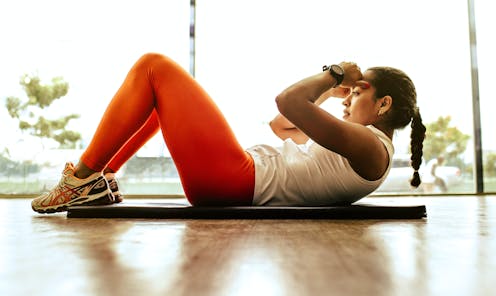
With the rising cost of living, gyms memberships and fitness classes are becoming increasingly unaffordable. But the good news is you can make just as much progress at home[1].
Cardiovascular endurance, muscle strength and flexibility are the most important[2] components of fitness. And each can be trained with little or no equipment. Let’s look at why – and how – to fit them into your DIY exercise program.
1. Cardiovascular endurance
Cardiovascular endurance exercise (or “cardio”) forces the heart and lungs to increase the supply of oxygen to the working muscles. Heart disease is a leading cause of death[3] and cardiovascular endurance exercise helps keep the heart healthy.
The best thing about cardio is you don’t need any fancy equipment to do it. Walking, jogging and running are great options, as are cycling, skipping rope and swimming.
There are two approaches to maximise cardiovascular endurance:
high-intensity interval training[5] (HIIT) – short bouts of hard exercise (around 80% to 95% of your maximum heart rate) interspersed with lower intensity recovery periods (around 40% to 50% of your maximum heart rate)
low-intensity steady-state[6] (LISS) exercise – aerobic activity performed continuously at a low-to-moderate intensity (around 50% to 65% of your maximum heart rate) for an extended duration.
Both are great options. While high-intensity interval training can be more time efficient, low-intensity steady-state training might be more enjoyable and easier to sustain long-term.
No matter what you choose, aim for[7] a minimum of 150 minutes of moderate-intensity or 75 minutes of vigorous-intensity cardiovascular exercise each week. For example, you could try 30 minutes, five days per week of low intensity cardio, or 25 minutes, three days per week of high-intensity activity, or a combination of the two.
Read more: Don't have time to exercise? Here's a regimen everyone can squeeze in[8]
How do you know if you’re exercising at the right intensity?
Smart watches that measure heart rate can help to monitor intensity. Or you can rely on the good old-fashioned talk test[9]. During low-intensity activity, you should be able to speak in full sentences. Conversely, short phrases (initially) or single words (towards the end) should be all that’s manageable during high-intensity exercise.
2. Muscle strength
Next is muscle strength, which we train through resistance exercise. This is important for bone health, balance and metabolic health, especially as we age and our muscle mass and strength declines[10].
Aim for two days per week of whole-body resistance exercise performed at a moderate or greater intensity[11]. Try to build two weekly sessions that target the major muscle groups. This could include:
- squats – lower to the ground from standing by bending the hips, knees, and ankles while keeping the chest up tall before returning to standing by straightening the hips, knees and ankles
hinges[13] – fold forward at the hips by pushing your bottom back to the wall behind you, keeping your back straight. A slight bend in the knees is fine but aim to keep your shins vertical
push-ups[14] – if a full push-up is too difficult, you can place your hands on a raised surface such as a step or a chair
horizontal and vertical pull ups – using something like a portable chin up bar, which you can buy from sports supply stores
vertical pushes – pushing an object (or weight) vertically from the top of your chest to an overhead position.
Once you have selected your exercises, perform[16] 2–3 sets of 8–12 repetitions at a moderate to greater intensity, with about 90 seconds rest between each set.
As you progress, continue to challenge your muscles by adding an extra set to each exercise, or including dumbbells, changing body position or wearing a backpack with weights. The goal should be to progress slightly each session.
However, if you have any underlying health conditions, disabilities, or are unsure how best to do this, see an exercise physiologist or physiotherapist.
Read more: Why weightlifting is beneficial before and after the menopause[17]
3. Flexibility
Improved flexibility can increase your range of motion[18] and improve your ability to manage daily life.
While we don’t know the best means of increasing flexibility[19], the most basic and readily accessible is static stretching[20]. Here, we lengthen the muscle – for example, the hamstrings, until we feel a “stretching” sensation. Hold that position for 15–30 seconds.
While the precise intensity of this stretching sensation remains elusive[22], around 5–10 minutes[23] per week per muscle group[24], spread across five days, seems to provide the best results.
How to stick with it?
The best exercise is the one that gets done. So, whatever you choose, make sure you enjoy it. After all, it’s about creating an ongoing commitment to exercise that will deliver long-term health benefits.
It’s also important to ensure you’re ready to exercise, especially if you have any underlying health issues, have been previously inactive, or are unsure how to start. A pre-exercise screening[25] can help you to determine whether you should see a doctor or allied health professional before starting an exercise program and for guidance on the next steps.
Read more: New study: much of what we're told about gym exercises and resistance training is from studies of males, by men[26]
References
- ^ just as much progress at home (pubmed.ncbi.nlm.nih.gov)
- ^ most important (www.acsm.org)
- ^ leading cause of death (www.who.int)
- ^ Shutterstock (www.shutterstock.com)
- ^ high-intensity interval training (pubmed.ncbi.nlm.nih.gov)
- ^ low-intensity steady-state (pubmed.ncbi.nlm.nih.gov)
- ^ aim for (www.who.int)
- ^ Don't have time to exercise? Here's a regimen everyone can squeeze in (theconversation.com)
- ^ talk test (pubmed.ncbi.nlm.nih.gov)
- ^ muscle mass and strength declines (pubmed.ncbi.nlm.nih.gov)
- ^ greater intensity (www.who.int)
- ^ Shutterstock (www.shutterstock.com)
- ^ hinges (www.physio-pedia.com)
- ^ push-ups (www.ncbi.nlm.nih.gov)
- ^ Shutterstock (www.shutterstock.com)
- ^ perform (pubmed.ncbi.nlm.nih.gov)
- ^ Why weightlifting is beneficial before and after the menopause (theconversation.com)
- ^ increase your range of motion (www.ncbi.nlm.nih.gov)
- ^ best means of increasing flexibility (www.ncbi.nlm.nih.gov)
- ^ stretching (www.topendsports.com)
- ^ Shutterstock (www.shutterstock.com)
- ^ remains elusive (pubmed.ncbi.nlm.nih.gov)
- ^ around 5–10 minutes (pubmed.ncbi.nlm.nih.gov)
- ^ muscle group (exrx.net)
- ^ pre-exercise screening (www.ausactive.org.au)
- ^ New study: much of what we're told about gym exercises and resistance training is from studies of males, by men (theconversation.com)