Why can't we just tow stranded whales and dolphins back out to sea?
- Written by: Vanessa Pirotta, Postdoctoral Researcher and Wildlife Scientist, Macquarie University
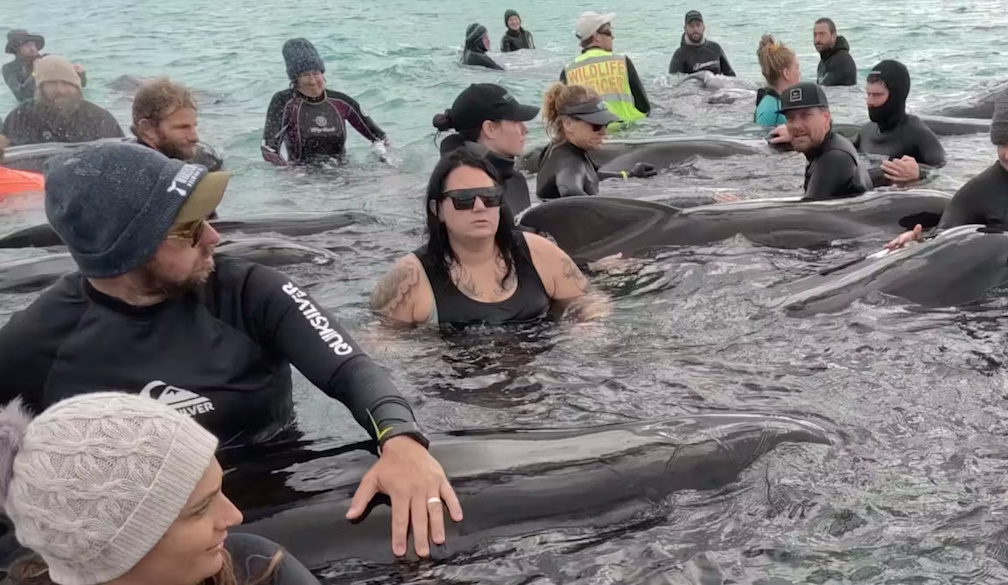
On Tuesday night, a pod of almost 100 long-finned pilot whales stranded itself on a beach on Western Australia’s south coast. Over the course of Wednesday, more than 100 parks and wildlife staff and 250 registered volunteers worked tirelessly to try to keep alive the 45 animals surviving the night.
They used small boats and surf skis to try to get the pilot whales into deeper water. Volunteers helped keep the animals’ blowholes above water to prevent them drowning, and poured water on them to cool them down.
Our rescue efforts were, sadly, unsuccessful. The animals (actually large ocean-going dolphins) able to be towed or helped out to deeper water turned around and stranded themselves again, further down the beach[1]. Sadly, they had to be euthanised.
Unfortunately, towing whales and dolphins is not simple. It can work and work well, as we saw in Tasmania last year, when dozens of pilot whales were rescued. But rescuers have to have good conditions and a fair dash of luck for it to succeed.
Rescuing beached whales is hard
When we try to rescue stranded whales and dolphins, the goal is to get them off the sandbars or beach, and back into deep water.
Why is it so difficult? Consider the problem. First, you have to know that a pod has beached itself. Then, you have to be able to get there in time, with people skilled in wildlife rescue.
These animals are generally too big and heavy to rely on muscle power alone. To get them out far enough, you need boats and sometimes tractors. That means the sea conditions and the slope of the beach have to be suitable.
Often, one of the first things rescuers might do is look for those individuals who might be good candidates to be refloated. Generally, these are individuals still alive, and not completely exhausted.
Read more: An expert explains the stranding of 97 pilot whales in WA and their mysterious 'huddling' before the tragedy[2]
If rescuers have boats and good conditions, they may use slings. The boats need to be able to tow the animals well out to sea.
Trained people must always be there to oversee the operation. That’s because these large, stressed animals could seriously injure humans just by moving their bodies on the beach.
There are extra challenges. Dolphins and whales are slippery and extremely heavy. Long-finned pilot whales can weigh up to 2.3 tonnes. They may have never seen humans before and won’t necessarily know humans are there to help.
They’re out of their element, under the sun and extremely stressed. Out of the water, their sheer weight begins to crush their organs. They can also become sunburnt. Because they are so efficient at keeping a comfortable temperature in the sea, they can overheat and die on land. Often, as we saw yesterday, they can’t always keep themselves upright in the shallow water.
And to add to the problem, pilot whales are highly social. They want to be with each other. If you tow a single animal back out to sea, it may try to get back to its family and friends or remain disorientated and strand once again.
Because of these reasons – and probably others – it wasn’t possible to save the pilot whales yesterday. Those that didn’t die naturally were euthanised to minimise their suffering.
A rescuer tends to a pilot whale at the mass stranding in Western Australia. DBCA/APSuccessful rescues do happen
Despite the remarkable effort from authorities and local communities, we couldn’t save this pod. Every single person working around the clock to help these animals did an amazing job, from experts to volunteers in the cold water to those making cups of tea.
But sometimes, we get luckier. Last year, 230 pilot whales beached themselves at Macquarie Harbour, on Tasmania’s west coast. By the time rescuers could get there, most were dead[3]. But dozens were still alive. This time, conditions were different and towing worked.
Rescuers were able to bring boats close to shore. Surviving pilot whales were helped into a sling, and then the boat took them far out to sea. Taking them to the same location prevented them from beaching again.
Towing can work – if we can get there in time to rescue enough animals, as in this successful effort in 2022 in Tasmania’s Macquarie Harbour. DNRE Tasmania/AAPEvery stranding lets us learn more
Unfortunately, we don’t really know why whales and dolphins strand at all. Has something gone wrong with how toothed whales and dolphins navigate? Are they following a sick leader? Are human-made undersea sounds making it too loud? Are they avoiding predators such as killer whales? We don’t know.
We do know there are stranding hotspots. Macquarie Harbour is one. In 2020, it was the site of one of the worst-ever strandings, with up to 470 pilot whales stranded. Authorities were able to save 94, drawing on trained rescue experts[4].
We will need more research to find out why they do this. What we do know suggests navigational problems play a role.
That’s because we can divide whales and dolphins into two types: toothed and toothless. Whales and dolphins with teeth – such as pilot whales – appear to beach a lot more. These animals use echolocation (biological sonar) to find prey with high-pitched clicks bouncing off objects. But toothless baleen whales like humpbacks (there are no dolphins with baleen) don’t use this technique. They use low-frequency sounds, but to communicate, not hunt.
So – it is possible to save beached whales and dolphins. But it’s not as easy as towing them straight back to sea, alas.
Read more: About 200 dead whales have been towed out to sea off Tasmania – and what happens next is a true marvel of nature[5]
The Conversation thanks 10-year-old reader Grace Thornton from Canberra for suggesting the question that gave rise to this article.
References
- ^ further down the beach (www.facebook.com)
- ^ An expert explains the stranding of 97 pilot whales in WA and their mysterious 'huddling' before the tragedy (theconversation.com)
- ^ most were dead (www.theguardian.com)
- ^ rescue experts (www.theguardian.com)
- ^ About 200 dead whales have been towed out to sea off Tasmania – and what happens next is a true marvel of nature (theconversation.com)
Read more https://theconversation.com/why-cant-we-just-tow-stranded-whales-and-dolphins-back-out-to-sea-210544