'Is the doggy angry?' Research hints children under 5 can easily confuse dog emotions
- Written by: Melissa Starling, Postdoctoral researcher, University of Sydney
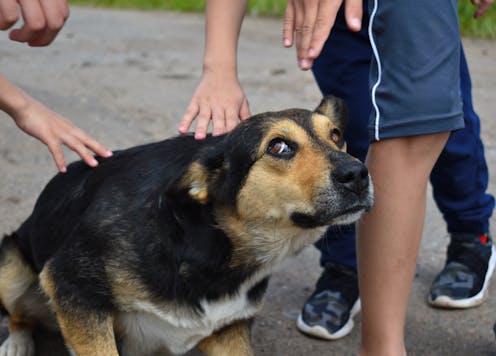
To most of us, a dog showing its teeth is a pretty clear signal of threat. In 1872, Charles Darwin first suggested[1] animals showed emotions similar to ours in their body language, and we might be able to use this to better understand their behaviour and motivations.
There is perhaps no better species for investigating this idea than the domestic dog. We live alongside them, yet they have teeth that can inflict significant damage on a human. So we ought to be invested in knowing when they are happy, neutral or angry, at the very least.
Adult humans are good at identifying an angry dog visually or by sound, regardless of how much experience they have with dogs[2]. However, young children do not show the same skill, and in fact may mistake a fierce dog for a happy dog[3].
A new study published in PLOS ONE[4], by University of Helsinki animal cognition researcher Heini Törnqvist and colleagues, has sought to identify when children start to develop dog-reading skills and what role their experience with dogs may play in this.
Rating dog faces
It is certainly useful to know when children become as good as an adult at reading dog body language. It helps us to make decisions about the level of supervision children need around dogs. It can also help to anticipate them making choices that we as adults would think are an obviously terrible idea when interacting with a dog.
However, dogs are also special. They have been with us for so long, we have influenced their evolution, and maybe they have influenced ours as well. This co-domestication hypothesis raises the possibility our long association with dogs may have led to both species being particularly quick to bridge the species divide and manage to communicate effectively with each other[6].
In the new study, 34 adults, 34 four-year-olds and 31 six-year-olds were presented with a series of photos of dog faces and human faces. They were asked to report how excited each dog or person was, how good or bad their mood was, and whether they were happy, neutral or angry.
The results revealed that four-year-old children rated angry dogs to be in a more positive mood than the older children and adults did, even if these youngest kids were experienced with dogs. The six-year-olds, if experienced with dogs, were as good as adults at identifying dog emotions from photos.
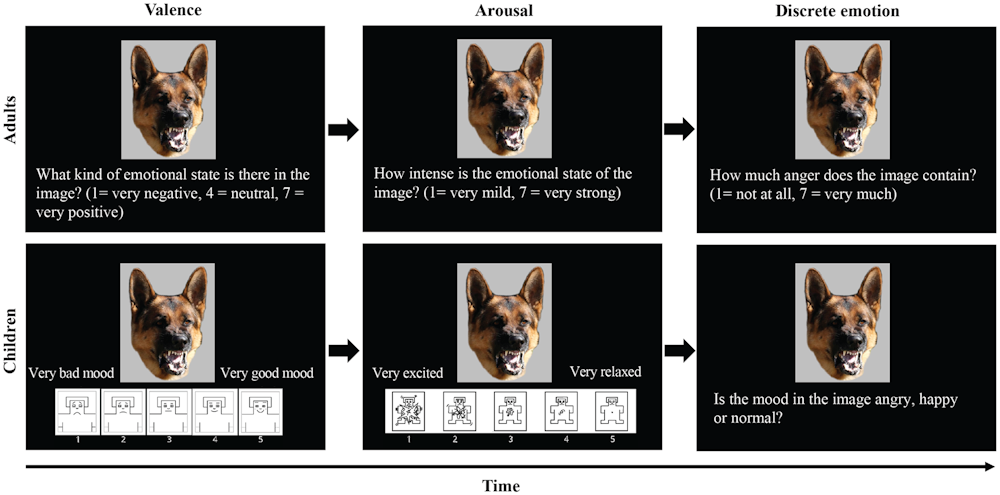 An example of the test stimulus presented to the adults and children participating in the study.
PLOS ONE, CC BY[7][8]
An example of the test stimulus presented to the adults and children participating in the study.
PLOS ONE, CC BY[7][8]
Adults were equally likely to correctly identify dog emotions whether they were experienced or inexperienced with dogs. Meanwhile, children were equally good at identifying human emotions from photos regardless of age.
These results show that age may indeed affect how accurately children can identify dog emotions from the animals’ facial expressions, with experience factoring into how early they develop these skills.
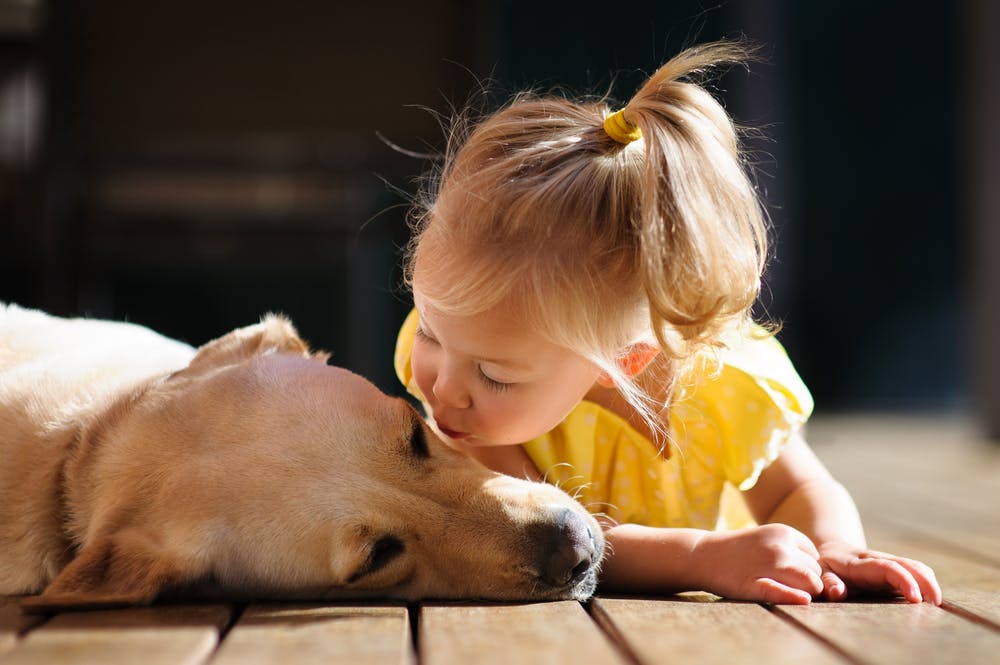
Children under the age of five are likely to interpret dog expressions by looking for similarities to human expressions. This is particularly troublesome when angry dogs show their teeth, as children may interpret this as a friendly smile.
By the age of six, children who have lived with a dog may have learned exposed teeth are an angry expression in dogs, whereas children who haven’t spent much time around dogs may continue to make interpretation errors.
Read more: Is your dog happy? Ten common misconceptions about dog behaviour[9]
Supervision is key
This highlights how important it is to closely supervise young children when they are around dogs.
According to a study from 2001, children 0-4 years in age are the most likely age group to suffer severe dog bites in Australia[10]. Some of those bites may occur as a result of children misunderstanding dog threat displays, and their tendency to lean into dogs when interacting with them[11].
The results may have been influenced by a few additional factors. This study only presented images of dogs, whereas young children may be more attuned to auditory signals[12], such as a deep growl or bark.
Additionally, participants were considered “experienced” with dogs only if they had lived with one, whereas “inexperienced” individuals may have spent a lot of time with dogs in other contexts that was not captured.
What does this mean for the co-domestication hypothesis? The jury is still out. The results suggest children learn to read dogs through experience, but this is occurring at a young age. It’s difficult to tell whether children are primed to learn to read dogs, or if it is simply a species they have the most experience with from an early age.
But you likely do want to watch closely when your children interact with the family dog, even if they grew up together. Older children can make mistakes with dogs as well, and we shouldn’t rely on our dogs to always be highly tolerant of provocative things children may do.
Read more: Genetic research confirms your dog's breed influences its personality — but so do you[13]
References
- ^ first suggested (darwin-online.org.uk)
- ^ how much experience they have with dogs (pubmed.ncbi.nlm.nih.gov)
- ^ may mistake a fierce dog for a happy dog (dx.doi.org)
- ^ published in PLOS ONE (doi.org)
- ^ Shutterstock (www.shutterstock.com)
- ^ manage to communicate effectively with each other (www.science.org)
- ^ PLOS ONE (journals.plos.org)
- ^ CC BY (creativecommons.org)
- ^ Is your dog happy? Ten common misconceptions about dog behaviour (theconversation.com)
- ^ most likely age group to suffer severe dog bites in Australia (www.ncbi.nlm.nih.gov)
- ^ lean into dogs when interacting with them (injuryprevention.bmj.com)
- ^ young children may be more attuned to auditory signals (pubmed.ncbi.nlm.nih.gov)
- ^ Genetic research confirms your dog's breed influences its personality — but so do you (theconversation.com)