Viral room-temperature superconductor claims spark excitement – and skepticism
- Written by: Mahboobeh Shahbazi, Senior Research Fellow, Materials Science, Queensland University of Technology
Last week, a group of South Korean physicists made a startling claim. In two[1] papers[2] uploaded to the arXiv preprint server, they say they have created a material that “opens a new era for humankind”.
LK-99, a lead-based compound, is purportedly a room-temperature, ambient-pressure superconductor. Such a material, which conducts electricity without any resistance under normal conditions, could have huge implications for energy generation and transmission, transport, computing and other areas of technology.
The papers have sparked wild enthusiasm online, and several efforts to replicate the work[3]. At the same time, there are reports[4] of disputes among the Korean researchers over whether the research should have been released at all.
Why superconductors are so super
When an electric current flows through an ordinary conductor like a copper wire, the electrons bump into atoms as they jostle along. As a result, the electrons lose some energy and the wire heats up.
In a superconductor, electrons move without any resistance. Superconducting wires can transmit electricity without losing energy, and superconducting magnets are powerful enough to levitate trains and contain the fierce plasmas in fusion reactors.
Read more: Room-temperature superconductors could revolutionize electronics – an electrical engineer explains the materials' potential[5]
However, all known superconductors require very low temperatures (typically lower than –100 ℃) or extremely high pressures (more than 100,000 times ordinary atmospheric pressure). These restrictions make superconductors expensive and impractical for many applications.
Several teams of researchers have claimed to detect room-temperature superconductivity in various substances in the past, but none of the claims have withstood scrutiny. As recently as last week, a superconductivity paper by American physicist Ranga Dias was retracted[6] amid suspicions of data fabrication.
So while a room-temperature superconductor would be an amazing discovery, we should meet the new claims with some skepticism.
Bold claims
The South Korean researchers say LK-99 can be made in a baking process that combines the minerals lanarkite (Pb₂SO₅) and copper phosphide (Cu₃P). They say the resulting material shows two key signs of superconductivity at normal air pressure and at temperatures up to 127 ℃: zero resistance and magnetic levitation.
They propose a plausible theory of how LK-99 might display room-temperature superconductivity, but have not provided definite experimental evidence. The data presented in the papers appear inconclusive.
One of the signatures of a superconductor is the Meissner effect, which causes it to levitate when placed above a magnet.
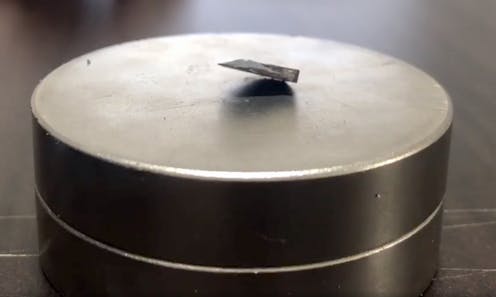
In a video demonstration[7], the researchers position a piece of LK-99 over a magnet. One edge of the flat disk of LK-99 rises, but the other edge appears to maintain contact with the magnet.
We would expect a superconductor to display full levitation and also “quantum locking” which keeps it in a fixed position relative to the magnet. In a charitable interpretation, the behaviour we see in the video may be due to imperfections in the sample, meaning only part of the sample becomes superconductive.
So it is too early to say we have been presented with compelling evidence for room-temperature superconductivity.
What’s next
At present, all we know about LK-99 comes from the two arXiv papers, which have not been peer-reviewed. Both papers present similar measurements, though the presentation is unconventional. However, there are some differences in the content, and also in authorship, which does not inspire confidence.
So what happens now? The processes of science swing into action.
Experts will closely review the papers. Researchers at other laboratories will attempt to reproduce the experiments described in the papers, and see whether they end up with a room-temperature superconductor.
These crucial steps are necessary to establish the validity and reliability of the LK-99 claims. If the claims are validated and confirmed, it could mark one of the most groundbreaking advancements in physics and materials engineering in the past few decades.
However, until the research undergoes rigorous review and testing, we should approach the claims with caution. We will all be awaiting the outcome of the verification process with great interest.
References
- ^ two (arxiv.org)
- ^ papers (arxiv.org)
- ^ replicate the work (www.science.org)
- ^ reports (www.asiafinancial.com)
- ^ Room-temperature superconductors could revolutionize electronics – an electrical engineer explains the materials' potential (theconversation.com)
- ^ retracted (www.nature.com)
- ^ video demonstration (sciencecast.org)