


Many people hate wasps, but they're smarter than you might think – and ecologically important
- Written by: Scarlett Howard, Lecturer, School of Biological Sciences, Monash University
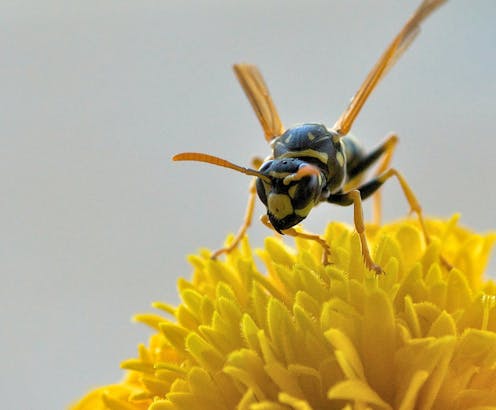
Everybody loves bees, but their cousins the wasps often provoke a far less friendly reaction. The much-maligned insects often inspire fear, disgust or even the “kill it with fire[1]” response.
The stereotypical wasp is the angular, angry-looking vespid with black and yellow stripes known as the European wasp (Vespula vulgaris). It has a reputation for aggression, stinging multiple times and contributing little[2] to society. But that’s just one of more than 100,000 known wasp species with a wide range of appearances, many of which don’t even sting.
In our work with wasps, we have found these innocent insects have done little to deserve our scorn. In fact, they have surprisingly complex minds and can play important ecological roles.
Our latest study, published in Behavioral Ecology and Sociobiology[4], shows European wasps have impressive abilities to learn visual tasks in different ways depending on how we train them. It adds to a growing body of research about what wasp’s minds can do – including recognising human faces and learning other complex tasks.
Read more: Are they watching you? The tiny brains of bees and wasps can recognise faces[5]
How to train a wasp
European wasps are central-place foragers, which means they will remember and return to a profitable food source – be that sugar, meat or your soft drink at a BBQ. This behaviour allows us to train individual wasps to return to our experiment throughout a day.
We offer the wasps sugar water, and then place an identification dot on each individual. A wasp will then continue returning to participate in experiments as long as we are offering a sugary reward.
The wasps in our study were enthusiastic volunteers who would fly some distance to participate. In our experiments, wasps needed to undergo ten trials to learn a visual task, and then a further ten trials without reward to test if they had learnt.
Wasps received sugar water for correct choices in learning, and continually returned to the experiment to finish all the trials.
What did the wasps learn?
We trained wasps to discriminate between two different hues of blue cards. The colours are quite similar to wasp vision, so it is a tricky task.
We evaluated three ways of training wasps to determine how they learned best.
First, we used absolute conditioning to train the wasps to discriminate between the colours. In this method, wasps were given sugar on the card of the correct colour without seeing the other colour. We introduced cards of the other colour as well to test whether the wasps could discriminate between the two.
The second training method was appetitive differential conditioning. In this approach, both colours of card were present during training. Wasps were rewarded for landing on the correct colour and received no outcome if they landed on the incorrect colour.
The third training framework was appetitive-aversive differential conditioning, where wasps were provided with a sugar reward for landing on the correct colour and tasted a bitter liquid when they landed on the incorrect colour. Again, both colours were present during learning.
With absolute conditioning, the wasps failed to successfully identify the correct colour in tests. However, when trained with either the appetitive or appetitive-aversive differential conditioning, they did pass the colour test.
This result tells us it was important for wasps to view and compare both colours simultaneously to enable learning. Their learning was actually best when there was a sweet reward on one colour and a bitter liquid on the other.
What else do we know about wasp intelligence?
Scientists are becoming increasingly interested in wasp intelligence.
One recent study showed two species of hornets[6] (a kind of wasp) could learn to discriminate between two colours when one colour was associated with sugar water. The hornets could then reverse that learning when the rewarding colour was switched. This reverse learning task is challenging for small brains to solve.
Other studies have shown paper wasps have evolved specialised abilities for learning faces. One species of paper wasp[8] can differentiate among normal wasp face images more rapidly and accurately than non-face images or manipulated faces. This allows for a comparison between how facial recognition may have evolved in small insect brains compared to larger primate brains.
Researchers have also shown that wasps (and bees) can learn to discriminate between images of human faces[9].
The role of wasps in pollination and pest control
Wasps play an important role in many ecosystems by controlling pests and pollinating flowers[10]. Many Australian orchids[11], for example, rely on wasps for pollination – as do hundreds[12] of other plant species.
However, wasp pollination has been relatively poorly studied. While the economic value of pollination by bees and other insects has been well researched, the extent of wasp contributions to crop production is currently unknown.
Many wasps eat critters we consider pests, such as bugs, spiders, cockroaches and flies. Indeed, some species of wasp are sold commercially as pest control[13] agents.

Why we respect wasps
Despite their poor public image, wasps display intelligence, and can be useful in agriculture if well managed.
We hope our new work will allow people to appreciate the complexity, intelligence, and value of these misunderstood animals and the importance they can have in the environment. Additionally, as wasps can learn to recognise faces, perhaps being nice to them is a good strategy.
References
- ^ kill it with fire (www.wired.com)
- ^ contributing little (resjournals.onlinelibrary.wiley.com)
- ^ CC BY-SA (creativecommons.org)
- ^ Behavioral Ecology and Sociobiology (link.springer.com)
- ^ Are they watching you? The tiny brains of bees and wasps can recognise faces (theconversation.com)
- ^ two species of hornets (link.springer.com)
- ^ CC BY (creativecommons.org)
- ^ species of paper wasp (www.science.org)
- ^ human faces (theconversation.com)
- ^ pollinating flowers (australian.museum)
- ^ Australian orchids (www.publish.csiro.au)
- ^ hundreds (theconversation.com)
- ^ pest control (theconversation.com)
- ^ Wikimedia Commons (commons.wikimedia.org)
- ^ CC BY (creativecommons.org)










