Climate change will affect solar power and grid stability across Australia – here's how
- Written by: Shukla Poddar, Senior Research Fellow, School of Photovoltaics and Renewable Energy Engineering, UNSW Sydney
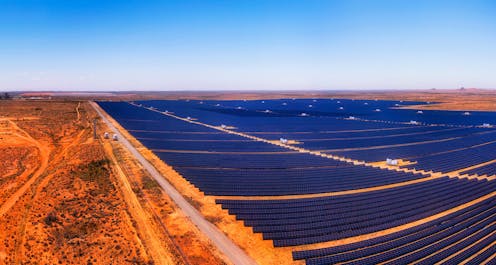
Renewable electricity generation is at record levels in Australia. Renewables produced 36% of the nation’s electricity[1] in 2022. Solar photovoltaics (PV) had the highest renewable contribution (about 15%) and are expected to keep growing in coming years.
But the increase in the share of grid-connected renewables adds to the challenge of maintaining a stable electricity grid, given the impact of weather conditions on their output.
An increasingly important question is what impact will climate change have on weather-induced inconsistencies in solar generation? Our newly published research[2] is the first to quantify climate change’s impact on solar resource reliability in Australia over the next century.
We find that as the climate warms, in some regions of Australia there will be more weather-induced variability than in others. In particular, the eastern parts of Australia can expect fewer intermittent or lull periods of solar power generation by the end of the century. By contrast, some regions in the west will face prolonged periods of minimum-to-no power generation in the future.
Despite the changing climate, the good news is the future of solar power looks promising in most of Australia. Our research suggests solar resource reliability will increase in the regions where we have our existing solar farms.
Read more: A successful energy transition depends on managing when people use power. So how do we make demand more flexible?[3]
How does solar growth affect grid stability?
The grid distributes electricity generated from coal and gas-fired power stations, large solar and wind farms, rooftop solar, hydropower and so on.
Unlike coal or gas-fired stations, the power renewables generate is not constant. It varies depending on the local weather. For example, the amount of solar power generated depends on the amount of irradiance[4] (intensity of sunlight) and, most importantly, cloud cover at that location.
So, any changes in the weather affect the amount of energy supplied to the grid. These variable outputs can not only cause an imbalance between electricity supply and demand, but also lead to voltage fluctuations and blackouts.
Electrical equipment is designed to function at a specific frequency and voltage. If the voltage exceeds the threshold it can damage the equipment. At a larger scale, voltage changes or frequency instability can trigger safety mechanisms that take parts of the grid offline, leading to blackouts[5].
How does climate change affect solar output?
Using regional climate model projections, our results[6] predict that under a higher emissions scenario known as RCP8.5[7], often described as “business as usual”, the availability of solar resources will increase in most of Australia by up to 1% by 2099. We predict minor decreases of 0.25–0.5% near the west.
Similarly, the duration of extractable solar power (called “episode lengths”) will increase in the east by up to 30 minutes per year. We predict minor decreases in the west. This means the resource will be more reliable in the east and we can expect a more stable electricity supply from solar PV generation. This doesn’t take into account higher temperatures, which can decrease the PV yield[8].
We also predict the times with no-to-minimum power generation (called “lulls”) will reduce in eastern Australia by about 25 minutes per year. We expect minor increases in lulls in the west. These changes are mainly due to an increase in the number of clear-sky days in the east.
A less sunny outlook for world’s largest solar farm
Sun Cable[9] is developing the largest solar farm in the world in the Northern Territory. It will have a generation capacity of at least 14 gigawatts. Sun Cable plans to supply electricity to Darwin and Singapore.
Based on our simulations, we predict a 2% reduction in radiation at the Sun Cable solar farm by 2099. This could lead to a loss of about 280 megawatts in its total generation capacity by then.
We also predict reduced episode lengths for the Sun Cable farm. This points to shorter periods of reliable power output. Likewise, the power generated is predicted to be highly variable throughout the day due to an increase in lull periods.
Sun Cable will likely need to consider having energy storage systems and strategies to control voltage fluctuations to tackle intermittency.
What else does Australia need to consider?
The latest Intergovernmental Panel on Climate Change (IPCC) report[10] stresses the urgent need to prepare for extreme climate change and greatly reduce carbon emissions. One of the most efficient ways to do this is to develop more grid-connected renewable energy technologies world-wide.
Australia has an ambitious renewable energy target[11], and we expect more grid-connected solar farms in the future. This means grid operators and distributors will have to manage future periods of high demand and variable supply.
One of the most efficient solutions is to use storage facilities to soak up energy at times of high output. These can then supply energy when renewable output stops or is intermittent. Batteries are an obvious choice, and Australia will have several big battery storage plants[12] by 2025.
Before setting up large-scale solar plants, we should assess the impacts of climate change using a range of climate models and different future scenarios to minimise future risks. We should also consider installing hybrid renewable energy plants, such as solar and wind at the same site. This will help optimise the energy mix to reduce intermittency.
References
- ^ 36% of the nation’s electricity (assets.cleanenergycouncil.org.au)
- ^ Our newly published research (doi.org)
- ^ A successful energy transition depends on managing when people use power. So how do we make demand more flexible? (theconversation.com)
- ^ amount of irradiance (iopscience.iop.org)
- ^ leading to blackouts (www.nature.com)
- ^ our results (doi.org)
- ^ RCP8.5 (www.carbonbrief.org)
- ^ decrease the PV yield (iopscience.iop.org)
- ^ Sun Cable (www.suncable.energy)
- ^ report (www.ipcc.ch)
- ^ renewable energy target (www.cleanenergycouncil.org.au)
- ^ several big battery storage plants (www.power-technology.com)