Monolith considers the cultural and social implications of new technology, without overdoing it
- Written by: Ari Mattes, Lecturer in Communications and Media, University of Notre Dame Australia
This review may contain spoilers.
One of the socially redeeming features of mass media has always been its communal aspect, the fact people are drawn together into a shared experience based on network programming. Of course, this, in the English-speaking world at least, has been driven by the desire for profit through selling advertising space to corporations.
In the era of narrowcasting, smaller and smaller audiences can now be targeted online, on various social media sites and channels, on podcast and other apps, and on streaming services, so we feel like we are now able to consume what we want, when we want, even as megacorporations still control the content, and it’s still produced for profit. The result of this is greater social atomisation.
Monolith, the new Australian film from first-time feature director Matt Vesely and writer Lucy Campbell, is one of the first Australian films to critically navigate the ramifications of narrowcasting technology.
The film follows a podcast journalist, brilliantly played by Lily Sullivan, as she investigates a lead from an anonymous email for her latest show, “Beyond Believable: A Show that Unmasks the Mysteries.”
People around the world have been receiving mysterious black bricks – from Germany to the US to Australia – and this seems suitable fodder for an episode.
Her investigation takes her across the globe and back through time to the 1980s and the Cold War. We watch as she interviews people, often using ethically dubious practices, and assembles the material entirely from inside her home.

The show becomes rapidly successful – we, as well as the main character, recognise its ridiculousness, and this seems to be a dig at new media culture: the idea that this kind of sensationalist, alien-hunting garbage would capture the hearts and minds of the world is preposterous.
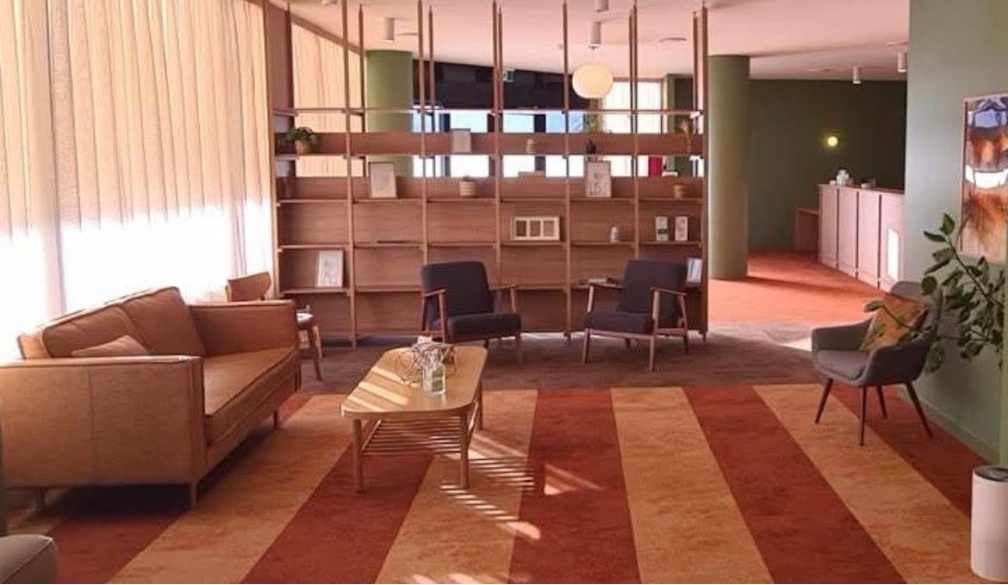
Her life, mirroring the investigation, becomes increasingly strange as her own repressed history begins to surface. The dark, moody interiors of her house begin to suggest the inside of a black brick. She starts looking sick, she smokes obsessively, she trembles with anxiety.
What is the monolith?
What is the brick, the monolith of the film’s title? We never definitively find out (which some viewers will surely find annoying). The bricks communicate with each recipient in a personal language related to their memory and history, reflecting their hopes, prejudices and – most pronouncedly – paranoid nightmares.
They may be some kind of alien artefacts that communicate with the recipient “from far, far away,” as Klaus, a German art collector and brick recipient says to the journalist. Or as a recipient from Ohio says, “It’s trying to tell me something and I’ve got to listen […] Something awful is coming.”
Maybe the bricks are an allegory for the contemporary world and the disappearance of social bonds, representing the alienation structured into personal (or narrowcast) communication systems. The obscurity with which the film represents the bricks seems to call for this kind of allegorical reading.
The portrayal of a single character’s descent into a living nightmare could easily become hammy, but Sullivan manages to keep the viewer entranced with her controlled, brilliantly understated performance. Joining Sullivan are the voices of some well-known Australian actors including Damon Herriman, Kate Box and Erik Thomson.
The strange solitude of interpersonal communication
The strange solitude of interpersonal communication in the global information economy underpins the whole thing, and the screen is replete with a plethora of different technologies reflecting this – talking head videos online, audio recording, editing and streaming, mobile phones, smart houses, close-ups of digital text.
We see, first hand, the sadness (and terror) of the journalist’s solitude and alienation – all she seems to do (alarmingly, perhaps, like many people in a post-COVID world) is talk to people on the phone and look stuff up on the internet. At the same time, we watch her go about the day-to-day business of living – making food in the kitchen, eating, showering at night – her deep solitude foregrounded throughout.
 The film just features one actor – and her pet turtle.
Ian Routledge
The film just features one actor – and her pet turtle.
Ian Routledge
The final section of the film is a touch underwhelming, with the whole thing resolving too neatly in a personal register (whereas what had driven the enigma of the bricks was their social aspect – the fact people all over the world had also received a brick).
Rather than developing into a full-on surreal nightmare (which would have made a better film, one suspects, in the vein of media horror thrillers like Lost Highway or The Ring, the ripples of which radiate throughout this) everything comes together in a way that seems a bit too neat.
There are carefully dispensed echoes of class critique thrown in, fitting the current strain of fantastic cinema that seems to think a film needs an explicitly polemical dimension to speak to the zeitgeist.
Similarly, the doomed, portentous tone becomes a little annoying in the final third – it feels like a space film, but without the necessary existential dread that space elicits – and there is a fair quotient of nonsense underpinning the narrative.
Despite this, Monolith remains an effective fantasy-thriller, remarkably engaging given its limitations – one location, one actor (well, two, including pet turtle Ian).
It’s also refreshing to see a high concept Australian film, as opposed to the usual social realist and period dramas.
Like an episode of Black Mirror - but without the heavy-handedness of many episodes of that show - Monolith thinks through the cultural and social implications of new technologies. It considers how we both reflect and are shaped by technology.
Monolith is a decidedly low-key film, but this should not be mistaken for dull. It is an arresting chiller, extremely tightly performed and made, low budget and, thankfully - and unlike virtually everything else playing in cinemas today - not overlong. Given its interest in contemporary audio-visual technologies, it will probably play best in the cinema, one of the last communal bastions against the blissful and anonymously smooth technological hell of narrowcasting.
Monolith is in cinemas from October 26.