Is Now and Then really a Beatles song? The fab four always used technology to create new music
- Written by: Jadey O'Regan, Lecturer in Contemporary Music, Sydney Conservatorium of Music. Co-author of "Hooks in Popular Music" (2022), University of Sydney
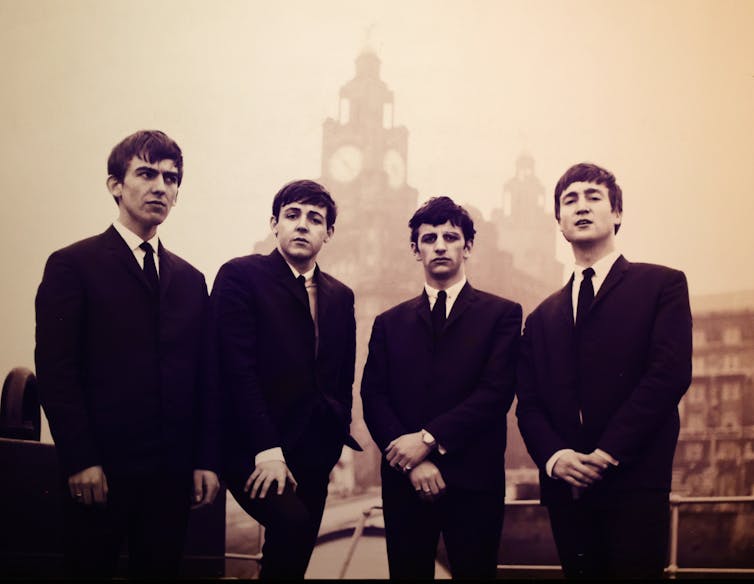
Over the past few weeks, Paul McCartney has been touring Australia to play through three hours of his musical legacy – from Beatles and Wings favourites to solo material, and some unexpected deep cuts.
A particularly moving pair of songs was the bookending of McCartney’s performance of In Spite of All the Danger[1] (the first song the band recorded as The Quarrymen) and the performance of The End[2] – one of the last songs the Beatles recorded together.
The encore featured I’ve Got a Feeling[3], in which McCartney and his late bandmate John Lennon “sang” together, performing alongside footage from the rooftop performance from the Get Back documentary[4]. Hearing McCartney’s current vocals alongside Lennon’s from the 1960s was poignant for both the crowd and McCartney.
These moments of connection over the decades between McCartney and Lennon are made stronger by the release of the new, and last, Beatles single, Now and Then.
Now and Then is one of four songs from a Lennon demo cassette provided by Yoko Ono and given to Paul McCartney in 1994, with a handwritten title: For Paul. The remaining Beatles finished Lennon’s demos for Free as a Bird[5] and Real Love[6] for the Anthology[7] release in 1995.
While these songs may have lacked a little of the original magic, with John’s voice sounding more distant and thin compared with Paul’s, the scarcity of new material allowed fans to embrace the songs, warts and all. At the time, Now and Then was deemed too tricky to complete, as John’s voice was buried in the mono mix of his home-recorded piano. It sat there for 28 years.
Fast forward to 2021 and a new AI tool developed by film-maker Peter Jackson to separate audio sources on Get Back could now be used on Lennon’s old demo. John’s voice is now clear, present, and free to be flown in seamlessly over any new arrangement.
It has a natural expression, captured in that not-overthought, early-demo moment.
George’s archived acoustic guitar take was added, with Paul providing updated piano, slide guitar and bass. Ringo added his distinctive feel remotely from Los Angeles.
Giles Martin, son of George, and keeper of the production flame, contributes a suitably Beatles-esque string arrangement that taps into many of his father’s well-loved stylistic traits.
There are insistent quarter-note pulsing rises, sitar-esque bends, and a final switch from four in a bar to three, reminiscent of The End from Abbey Road.
Due to the use of AI tools to finish Now and Then, and the song having been recorded without the Beatles in a room together, some may ask “is this really a Beatles song?”.
After the release of Get Back, audiences were able to experience what it felt like to be in the room with the band, watching their ideas form, seeing them joke and laugh, and also the tensions that happen with a group of creative people who have experienced a lot together.
Read more: The Beatles: Get Back review – Peter Jackson's TV series is a thrilling, funny (and long) treat for fans[8]
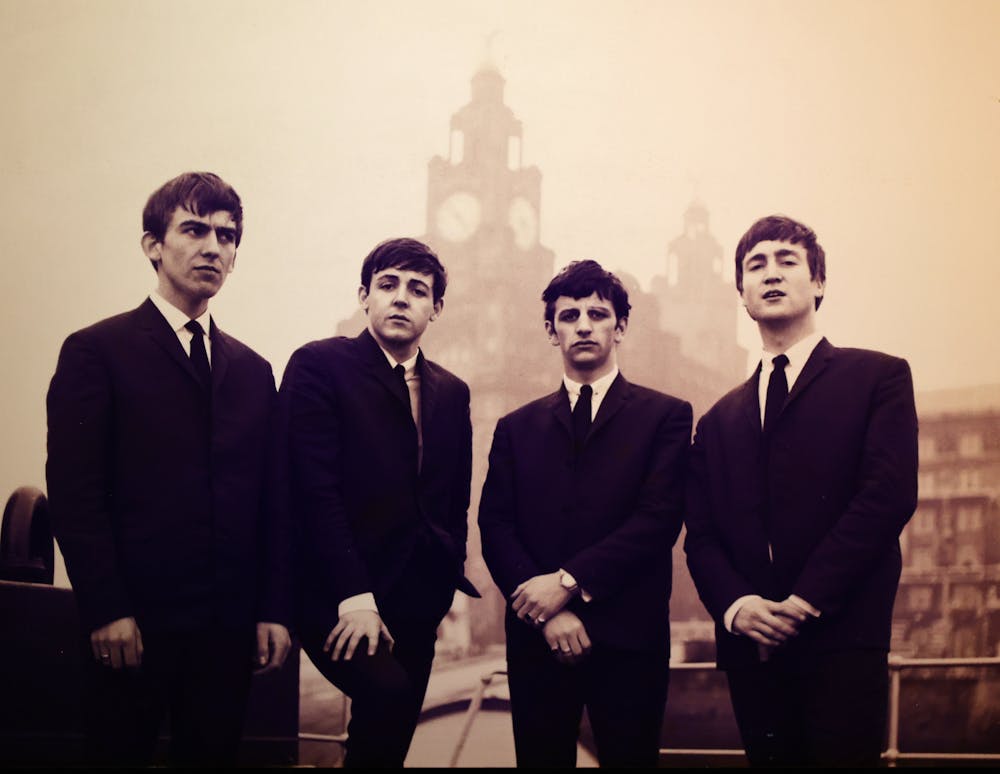
Get Back is relevant here for many reasons.
The first film version of this footage Let it Be[10] by director Michael Lindsay-Hogg was released briefly in 1970 with the album, and painted the last days of The Beatles as a dark, acrimonious time, and cemented Ono’s role as alleged “villain” in Beatles lore.
Jackson’s new version Get Back reframed fans’ perceptions of The Beatles’ breakup, the relationship of the surviving members, and their ongoing legacy. In the 1990s the Anthology film and albums captured a new generation of Britpop-loving Beatles fans, and the release of Get Back and Now and Then may do the same for another generation.
The fab four in a room, playing together, often seems essential to their sound. However, the Beatles were always fascinated by recording technology – from reversing tape loops in Taxman, to using Lennon’s voice through a Leslie speaker cabinet for Tomorrow Never Knows, to the musique-concrete Revolution 9, where the band cut a variety of tape loops and sounds together.
Using current music technology was always part of the band’s creativity, and with Now and Then, they are still engaging with technology to make new music, albeit in a slightly different way.
Will it be remembered as fondly as their other songs in the canon?
Perhaps – or perhaps not. But that is not the heart of this release.
John and George are gone, however, we still have Ringo and Paul with us to complete this new and final Beatles track.
Despite the time, distance and technology, Now and Then finishes a long and winding conversation that began in the early 1960s, and has now come to a thoughtful and musical end.
With time, it allows fans to reframe John’s love letter to Yoko as a message to Paul, the band, and even the fans.
Perhaps that will be its enduring value: “I know it’s true…And if I make it through, It’s all because of you”.
Read more: Sgt Pepper's at 50 – the greatest thing you ever heard or just another album?[11]
References
- ^ In Spite of All the Danger (www.youtube.com)
- ^ The End (www.youtube.com)
- ^ I’ve Got a Feeling (www.youtube.com)
- ^ Get Back documentary (theconversation.com)
- ^ Free as a Bird (www.youtube.com)
- ^ Real Love (www.youtube.com)
- ^ Anthology (en.wikipedia.org)
- ^ The Beatles: Get Back review – Peter Jackson's TV series is a thrilling, funny (and long) treat for fans (theconversation.com)
- ^ Shutterstock (www.shutterstock.com)
- ^ Let it Be (en.wikipedia.org)
- ^ Sgt Pepper's at 50 – the greatest thing you ever heard or just another album? (theconversation.com)