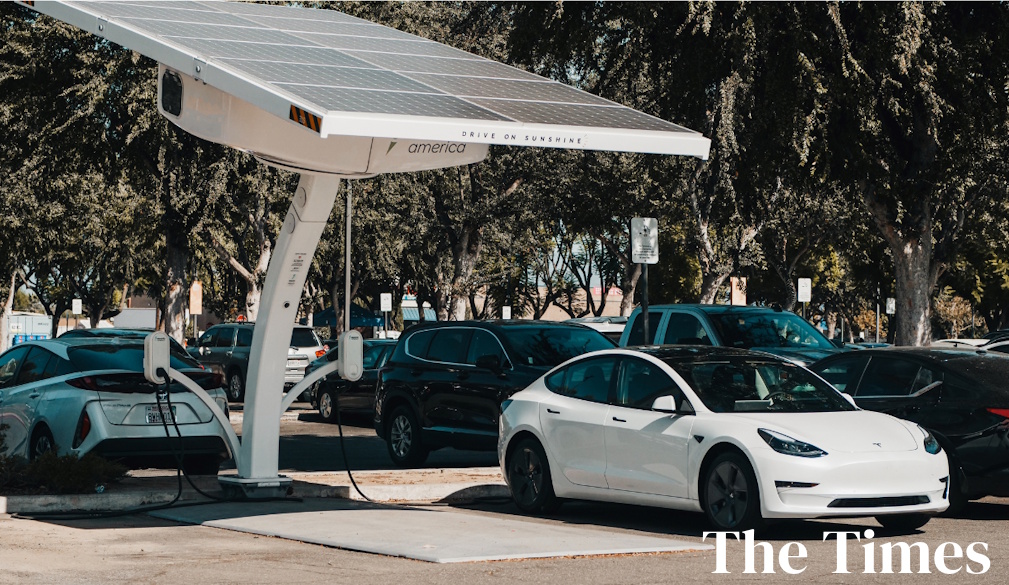
Turning the tap off slowly – why Australia's decision to end overseas fossil fuel finance matters
- Written by: Christian Downie, Associate Professor, Australian National University
Until recently, financing fossil fuel projects has been relatively easy.
But that is slowly changing. At the COP28 climate negotiations yesterday, Australia[1] announced it will sign the Glasgow Statement and will no longer finance international oil, gas and coal projects. Domestic projects are not part of the agreement.
Major Australian allies such as the United States and United Kingdom, as well as 32 other nations and five public banks, made this commitment[2] in 2021. It’s an agreement between governments and public financial agencies such as development banks and export credit agencies to end all new public financing for unabated fossil fuel projects.
By joining, Australia will make it harder to mobilise finance for fossil fuel projects that produce millions of tonnes of emissions, and make it easier to fund renewable energy projects that produce very little.
It’s the latest in a welcome series of signals that the international community is slowly turning off the tap for new fossil fuels.

Phasing down or phasing out?
Australia’s decision to join the agreement comes amid intense negotiations at COP28 in Dubai this week over whether governments will commit to “phasing out” or “phasing down”[3] fossil fuel use.
It might sound like quibbling, but this linguistic distinction carries major implications for global climate change. Phasing out means ending the routine burning of fossil fuels entirely. Phasing down means we will keep burning them but at a reduced rate – and that means some level of fossil fuel investment will continue.
Under the International Energy Agency’s 2050 net zero plan[4], there are no new oil, natural gas or coal projects beyond those already approved in 2021.
Even reduced levels of fossil fuel investment will derail the possibility of averting global warming’s worst consequences.
Read more: As disasters and heat intensify, can the world meet the urgency of the moment at the COP28 climate talks?[5]
Why does international public finance for energy matter?
If the world is to limit global average temperature rise to 2°C, we will need financial institutions on board. That’s because current estimates[6] suggest we need A$2.3 trillion every year to 2030 to meet existing targets to build low-carbon and climate-resilient infrastructure in low- and middle-income countries alone.
To source that kind of finance means we need all financial institutions – including state-backed banks which often favour new coal, gas or oil projects – to pull finance out of new fossil fuels and pump it into clean energy.
Australia is a relatively small player when it comes to public energy finance. Our research[7] shows Australia’s official export credit agency, Export Finance Australia, invested $11.45 billion in fossil fuel projects from 2009 to 2021. That sounds like a lot, but it’s peanuts compared with the US and Canadian equivalents, which shelled out A$348 billion and A$560 billion respectively over the same period. Japan, South Korea and China’s agencies each spent more than $100 billion in that period – and show no indication of ending their fossil fuel investments.
Even so, Australia’s commitment is significant because it adds to the growing number of public and private banks internationally that are reconsidering their investment in fossil fuel infrastructure such as new oil pipelines, gas platforms and coal-fired power plants. The move also places greater pressure on Japan and South Korea, the other wealthy democracies in the Asia-Pacific yet to sign the agreement.
Read more: COP28 president is wrong – science clearly shows fossil fuels must go (and fast)[8]
This is welcome – but long overdue
As climate change damage has intensified over the past two decades, export credit agencies and development banks have been busy pouring tens of billions of dollars a year[9] into fossil fuel projects. It’s not small change – from 2006 to 2022, these funds amount to more than $1.5 trillion[10]. That money has directly led to the construction of countless dirty energy projects around the globe.
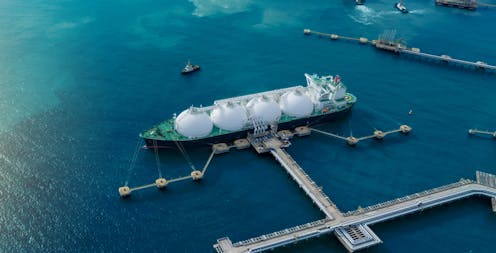
In 2020, for instance, the US, UK, Japan, Italy and other nations financially backed Total’s controversial multibillion-dollar liquefied natural gas project in Mozambique[11], including long-term infrastructure such as offshore drilling wells, offshore pipelines, and port facilities.
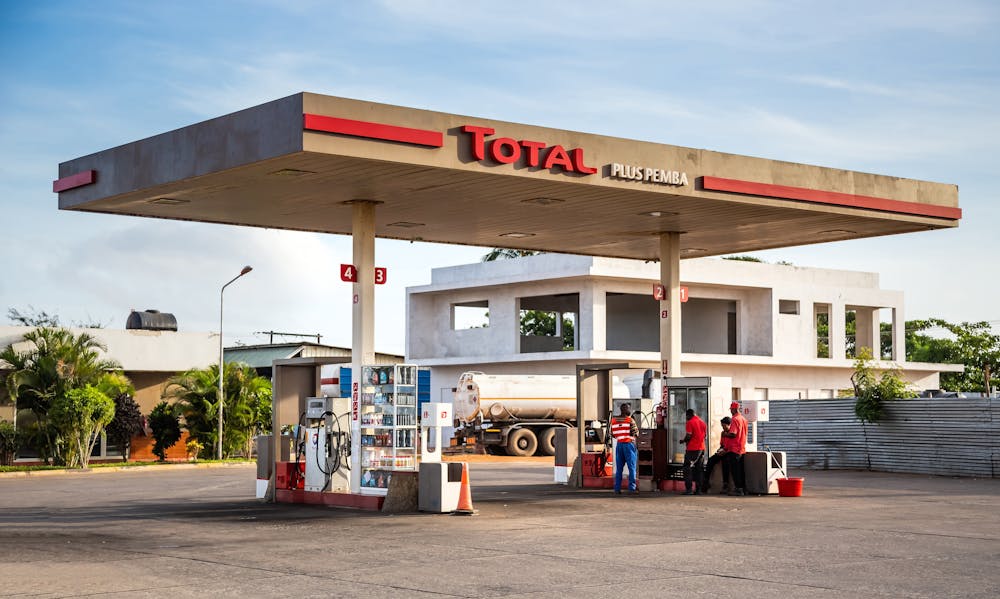 Total’s giant gas project in Mozambique relied on funds from public banks.
Shutterstock
Total’s giant gas project in Mozambique relied on funds from public banks.
Shutterstock
Once built, these fossil fuel infrastructure projects can lock in carbon-intensive futures for developing nations. As scientific research has shown[12], international public finance for coal-fired power plants early in a country’s energy development leads directly to a long-term reliance on fossil fuels.
Worse, as global population growth is heavily concentrated in less developed countries, these are the countries that will have to dramatically increase energy production to meet the needs of their societies. They cannot be locked in to fossil fuels.
To avoid this, green investment must accelerate and displace brown (fossil fuel) investment to avoid a rapid escalation of fossil fuel dependency across the Global South.
In better news, every dollar public banks turn away from fossil fuel projects is a dollar towards the trillions[13] we need invested every year to meet the world’s global clean energy infrastructure goals.
Publicly backed banks play a crucial role in attracting private investment by taking on riskier debts than the market will, especially in developing countries where risk insurance is often needed to help get projects across the line.
Australia’s commitment will be welcomed by our acutely climate-exposed neighbours in the Pacific and give us a stronger position to lead on climate in our region.
The next step will be much harder, but also more significant: making the same commitment at home and actually drying up the pipeline of new gas and coal projects.
Read more: Vast subsidies keeping the fossil fuel industry afloat should be put to better use[14]
References
- ^ Australia (www.smh.com.au)
- ^ made this commitment (webarchive.nationalarchives.gov.uk)
- ^ “phasing out” or “phasing down” (www.theguardian.com)
- ^ 2050 net zero plan (iea.blob.core.windows.net)
- ^ As disasters and heat intensify, can the world meet the urgency of the moment at the COP28 climate talks? (theconversation.com)
- ^ current estimates (blogs.worldbank.org)
- ^ Our research (www.tandfonline.com)
- ^ COP28 president is wrong – science clearly shows fossil fuels must go (and fast) (theconversation.com)
- ^ tens of billions of dollars a year (priceofoil.org)
- ^ more than $1.5 trillion (energyfinance.org)
- ^ liquefied natural gas project in Mozambique (totalenergies.com)
- ^ has shown (www.sciencedirect.com)
- ^ trillions (openknowledge.worldbank.org)
- ^ Vast subsidies keeping the fossil fuel industry afloat should be put to better use (theconversation.com)