how this weird and experimental side of TikTok is forging the future of horror
- Written by: Jessica Balanzategui, Senior Lecturer in Media, RMIT University
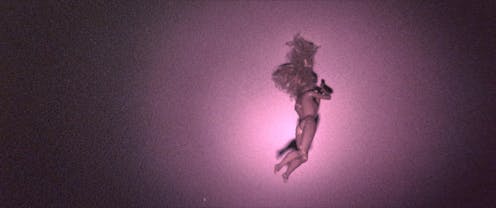
Director Kyle Edward Ball’s feature film debut, Skinamarink, achieved unexpected commercial success last year after going viral on TikTok[1].
Hailed by some critics as the best horror film of 2023[2], or even the scariest of all time[3], Skinamarink is a work of experimental slow cinema. The film’s ambiguous and grainy imagery exudes the aura of a degraded, possessed VHS tape.
These aesthetics might seem to conflict with TikTok’s torrent of short, attention-grabbing videos. Yet TikTok has cultivated a hive of creative energy at the intersection of art and horror. Alongside YouTube, the platform has also helped to create pathways to international horror-film careers.
Bite-sized nightmares
YouTube and TikTok provide spaces where horror filmmakers can hone their craft and develop distinct voices, in collaboration with a community of users who provide input, theories and feedback.
A unique form of horror storytelling emerges from such engaged online communities[4], as they cultivate environments where creators can test new ideas and develop creative ingenuity. This leads to a creative dynamic I call “participatory experimentation”. It’s expanding the boundaries of the horror genre[5].
Ball’s distinctive aesthetic was developed via his YouTube channel Bitesized Nightmares[6]. Here, he shared experimental videos based on his nightmares. He then invited viewers to share their own “nightmares” in the comments so he could depict them in subsequent videos.
One of these nightmare visions is shown in the short film Heck[7] (2020), the prototype for Skinamarink. Avant-garde in its approach, Heck is a work of art as well as horror. Its experimental beginnings on YouTube are key to its unsettling aesthetic power.
An upcoming cinema screening of Heck at RMIT’s Capitol Theatre, as part of an art/horror program I’ve co-organised with the Australian Centre of Contemporary Art[8], evidences the growing recognition of such digital horror content as “art” in spaces we may not normally expect. This is a significant cultural development.
The global horror hit Talk To Me (2023), one of Australia’s most successful films ever at the US box office[9], was also germinated via a YouTube channel. Directors Michael and Danny Philipou have more than 1 billion views and nearly 7 million subscribers on their channel, RackaRacka. It was here that they honed their unique blend of horror and zany, violent comedy.
YouTube has been home to boundary-pushing art-horror since its inception in 2005. Other notable examples include David Firth’s animated series Salad Fingers[10] (2004-), Becky Sloan and Joe Pelling’s Don’t Hug Me I’m Scared[11] (2011-) – which became a TV series[12] in 2022 – and Michelle Lyon’s Funnie Horsie[13] (2012-2016).
Read more: Salad Fingers wasn’t just strange, it was art. Here’s how it's still influencing the ‘weird part of YouTube’ 2 decades on[14]
From the ‘weird part’ of YouTube to TikTok
TikTok is now also emerging as an important site for this aesthetically rich “uncanny and weird” creative[15] content. It’s not surprising Skinamarink went viral on TikTok when you consider the app’s category of “analog horror” had 2.3 billion views[16] as of when this article was written. The closely related “liminal spaces” category had 4.9 billion views.
Although “analog” typically refers to pre-digital audiovisual technology, “analog horror” refers to horror content which may be produced digitally, but which has an eerily nostalgic technological quality. This content is often suffused with a hazy grain, reminiscent of Skinamarink’s cursed videotape aesthetic.
Analog horror videos may be depictions of creepy inhuman (but human-like) creatures, such as in this TikTok video[17].
Or they may depict mundane domestic spaces that become threatening once you realise the hallways have off-kilter corners, or the exits are impossible to access. Such imagery of everyday spaces evacuated of purpose, and instead injected with dread, produces the “uncanny[18]”: a feeling of the familiar merged with the unfamiliar.
The creepy house in Skinamarink is a compelling example of this. Throughout the film, the cosily familiar space of a childhood bedroom becomes deeply unfamiliar and unsettling as doors and windows disappear and the ceiling suddenly seems to become the floor.
TikTok’s user-friendly bag of special-effects tricks, such as retro-cam filters, green screens, body warping and face-morphing enable everyday users to experiment with these horror aesthetics with a community of like-minded enthusiasts.
But while analog horror is being driven in new directions on TikTok, it has long been a mainstay of YouTube. One influential example is Marble Hornets (2009), which depicts the “Slender Man[19]”, the internet’s most famous bogeyman.
The Mandela Catalogue[20] (2021) is a more recent example from YouTube. It has had a substantial influence on how the genre has crystallised on TikTok[21]. This eerie series by Alex Kister depicts an alternative reality in which “alternates” (malevolent doppelgangers of real people) have overrun Wisconsin. Doppelgangers are another element of the uncanny[22].
The future of experimental art-horror
Participatory art-horror experimentation on social media is having a global cultural moment. Last year, prestige film studio A24 (which also distributed Talk To Me) contracted 16-year-old Kane Parsons to direct his first feature based on his eerie YouTube video The Backrooms[23].
Director Jane Schoenbrun’s films also harness the themes and aesthetics of analog horror. Like Skinamarink, their debut feature, We’re All Going To the World’s Fair[24] (2021), is an unapologetically creepy work of experimental slow cinema. The film unfolds largely through the vlog of an isolated teen YouTuber as she embarks on a (possibly deadly) online “challenge”, narrating her experience to her followers from her bedroom.
Schoenbrun’s upcoming second feature, I Saw the TV Glow (2024), another product of A24, similarly refracts aesthetics and themes of online horror genres such as analog horror and liminal spaces. It has been described as a “surreal coming-of-age horror film[25]”, a “masterpiece[26]” and Sundance’s hottest movie[27].
The careers of Ball, Parsons, Schoenbrun and the Philipous showcase how experimental horror trends on TikTok and YouTube have successfully crossed into the mainstream. As emerging filmmakers harness social media to build their creative visions, we can expect participatory experimentation to keep expanding the frontiers of the horror genre.
References
- ^ viral on TikTok (medium.com)
- ^ best horror film of 2023 (variety.com)
- ^ scariest of all time (www.inverse.com)
- ^ engaged online communities (stars.library.ucf.edu)
- ^ of the horror genre (researchrepository.rmit.edu.au)
- ^ Bitesized Nightmares (www.youtube.com)
- ^ Heck (www.youtube.com)
- ^ Australian Centre of Contemporary Art (acca.melbourne)
- ^ films ever at the US box office (www.theguardian.com)
- ^ Salad Fingers (www.youtube.com)
- ^ Don’t Hug Me I’m Scared (www.youtube.com)
- ^ became a TV series (www.imdb.com)
- ^ Funnie Horsie (www.youtube.com)
- ^ Salad Fingers wasn’t just strange, it was art. Here’s how it's still influencing the ‘weird part of YouTube’ 2 decades on (theconversation.com)
- ^ aesthetically rich “uncanny and weird” creative (journals.sagepub.com)
- ^ had 2.3 billion views (www.tiktok.com)
- ^ this TikTok video (www.tiktok.com)
- ^ uncanny (journals.sagepub.com)
- ^ Slender Man (techcrunch.com)
- ^ Mandela Catalogue (www.youtube.com)
- ^ has crystallised on TikTok (www.tiktok.com)
- ^ element of the uncanny (courses.washington.edu)
- ^ The Backrooms (www.youtube.com)
- ^ We’re All Going To the World’s Fair (en.wikipedia.org)
- ^ surreal coming-of-age horror film (www.rollingstone.com)
- ^ masterpiece (www.independent.co.uk)
- ^ hottest movie (www.rollingstone.com)