Almost a third of Australia’s plant species may have to migrate south if we hit 3 degrees of warming
- Written by: Julian Schrader, Lecturer in Plant Ecology, Macquarie University
For ecologists, one of the most pressing questions is to understand how ecosystems will change or adapt as the climate changes rapidly. We are already seeing many species of plant and animal moving uphill and towards the poles in response to higher temperatures. It’s very likely most species will move to track their preferred temperature niche.
But what’s strange is that many species can survive in much broader temperature ranges than their current distribution suggests. We don’t yet fully understand why temperature affects ecosystems so strongly.
To shed light on this puzzle, our new research[1] used the current range of Australian plants and calculated each species’ minimum and maximum temperature preferences. These data told us how many and what percentage of species are lost or gained when transitioning from, say, a 15°C to a 16°C average annual temperature.
The results were astonishing. In Australia’s wetter east coast, you gain on average 19% more species and lose 14% of species when moving up the temperature gradient by 1°C. In the dry centre, you gain 18% of species and lose 21% of species for every extra degree.
That’s at in our current climate. What will happen if the world warms by 3°C, which we are still heading towards[2]?
If we assume the whole flora is trying to track their current climate niche, we would likely see 30% of our plant species in Australia moving south. That would be an enormous shift. Almost one in every three species would change in the natural vegetation around us.
What does this mean?
What our data show is that even slight natural changes in temperature have an effect on the species occurring in different regions.
Why do most plant species only occur in a narrow band within the wider range in which they can survive? A long-held theory, dating back to the work of Charles Darwin, is that species ranges are determined more by competition as you head towards warmer temperatures.
Read more: As seas get warmer, tropical species are moving further from the equator[5]
In this theory, some species are simply better at finding and using resources than others. These competitive traits are thought to be fine-tuned to work best at specific temperatures. These species outcompete those with lower growth rates or fitness at these temperatures[6].
Why wouldn’t superior competitors spread everywhere? Their traits are likely only functional under specific, often narrow, temperature bands. As soon as it gets too cold, they can’t grow as efficiently and other species can compete.
This means the southern limit of an Australian species is determined by its tolerance of cooler temperatures. If you were on a road trip from Cape York to Tasmania, you would see new species appearing and tropical species becoming less common and disappearing as you drove south towards the pole.
Some species can adapt rapidly to changes in their climate, while others cannot.When the heat is on, do plants have to move?
Australia’s plant species – especially in the wetter east – tend to be very old. Species with long histories have likely found their ideal temperature niche.
But the climate is heating up rapidly. 2023 was the first full year Earth was 1.5°C hotter than the pre-industrial era[7].
As temperatures rise, staying put may no longer be possible. More and more species will find themselves out of their preferred temperature niche[8]. They either adapt, move or go locally extinct.
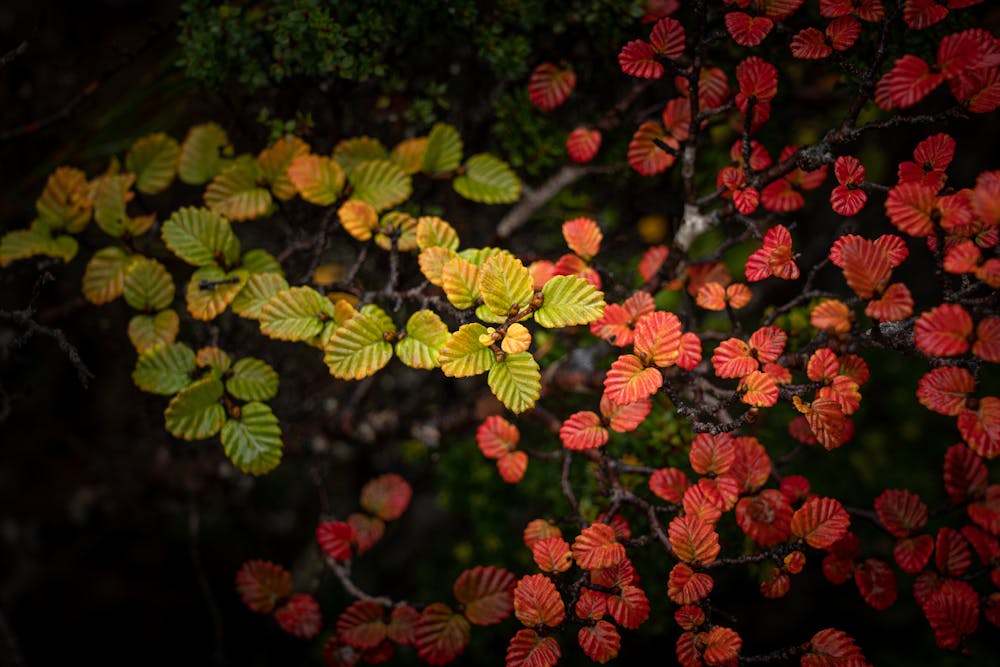 The cold-loving deciduous beech (Nothofagus gunnii) is part of the ancient Antarctic beech family of trees and one of Australia’s only deciduous trees.
Wirestock Creators/Shutterstock[9]
The cold-loving deciduous beech (Nothofagus gunnii) is part of the ancient Antarctic beech family of trees and one of Australia’s only deciduous trees.
Wirestock Creators/Shutterstock[9]
But the evidence[10] so far suggests species will move – if they can.
When species do move, the ecosystems they leave behind and the new ones they move into will change.
We don’t know if all species will be able to move freely down the east coast. Our industrious efforts to make farms, homes, roads and cities have heavily fragmented the natural vegetation. We have converted once-continuous spans of habitats into island-like remnants.
Some species can disperse better and over longer distances between habitat fragments than others. For instance, species with winged or windborne seeds are better dispersers than species with large seeds, which include many of our rainforest species.
The more dispersive species may win the race to secure new climate niches. To avoid some species becoming overly dominant, should we help plant species that don’t spread their seeds well by transplanting seedlings or sowing their seeds? This is an important question for the future to which we don’t yet have an answer.
Our plant species have found their climate niches over millions of years. What our research suggests is that climate change may force a surprising amount of our plants to move.
Read more: Climate explained: will the tropics eventually become uninhabitable?[11]
References
- ^ new research (nsojournals.onlinelibrary.wiley.com)
- ^ still heading towards (www.ipcc.ch)
- ^ Julian Schrader (www.julianschrader.wordpress.com)
- ^ CC BY (creativecommons.org)
- ^ As seas get warmer, tropical species are moving further from the equator (theconversation.com)
- ^ at these temperatures (onlinelibrary.wiley.com)
- ^ than the pre-industrial era (climate.copernicus.eu)
- ^ out of their preferred temperature niche (www.cell.com)
- ^ Wirestock Creators/Shutterstock (www.shutterstock.com)
- ^ evidence (www.nature.com)
- ^ Climate explained: will the tropics eventually become uninhabitable? (theconversation.com)