Summer’s over, so how much sun can (and should) I get?
- Written by: Katie Lee, PhD Candidate, Dermatology Research Centre, The University of Queensland
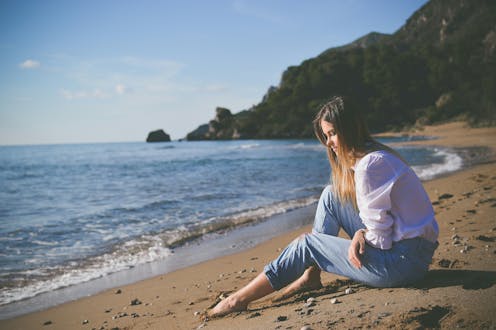
As we slide of out summer, you might be wondering how careful you need to be about sun exposure. Excessive exposure causes skin cancer[1], but sun exposure also has benefits[2]. How do you balance the two?
A new position statement[3] from cancer, bone health and other experts aims to help[4] Australians balance the good and bad effects of sun exposure by taking into account their skin colour, risk of skin cancer, and where they live.
What are the benefits of sunlight?
Ultraviolet (UV) radiation (the wavelengths in sunlight that cause skin cancer) also leads to vitamin D production. Vitamin D[5] is very important for maintaining strong bones, and is likely to have multiple other health benefits[6].
But vitamin D probably isn’t the whole story. Sunshine, including UV radiation, is thought to affect health in other ways[7] such as improving our mood and reducing the risk of autoimmune diseases and infections. So for many people, avoiding the sun and taking a vitamin D supplement may not be the best approach.
Read more: Vitamin D supplements can keep bones strong – but they may also have other benefits to your health[8]
How much time does it take to make vitamin D?
It’s complicated, but for most people and most of the year across most of Australia, it’s a lot less than you think.
The amount of time needed[9] depends on the amount of skin covered by clothing and the intensity of UV radiation (indicated by the UV index). More skin exposed and higher UV index equate to less time needed.
Both the UV index and the amount of the year that UV radiation is high increase as you get closer to the equator. In summer, all of Australia is bathed in sunshine. But in winter, opposite ends of the country have very different exposures[10].
In summer, everybody except those with deeply pigmented skin can make enough vitamin D in just five minutes[11] between 9am and 3pm, anywhere in Australia, provided they are wearing shorts and a T-shirt.
In winter it’s a different story. In Darwin and Brisbane[12], 5–10 minutes between 10am and 3pm will do the trick, but in Hobart[13], factoring in winter clothing, it will take nearly an hour in the middle of the day.
Hover your mouse over the lines below to see the length of exposure needed at specific times of day.
Staying out for longer than needed doesn’t necessarily make more vitamin D, but it does cause skin damage[14].
Hang on, what about those with darker skin?
People with deeply pigmented, brown to black skin accumulate both vitamin D and DNA damage at a much slower rate than people with lighter skin tones.
When UV radiation hits a DNA strand, it causes the DNA to become distorted. If the distortion isn’t fixed, it will cause a mistake when the DNA is copied for a new cell, causing a permanent mutation that sometimes leads to cancer.
Melanin, the brown pigment in the skin, absorbs UV photons before that can happen, and the high melanin content in the darkest skin tones provides 60 times[15] as much UV protection as the small amount in very fair skin.
The flip side is the risk of vitamin D deficiency is much higher than the risk of skin cancer.
The new statement accounts for this by putting people into three groups[16] based on their risk of skin cancer, with specialised advice for each group.
Highest skin cancer risk
This includes people with very pale skin that burns easily and tans minimally, but also people with darker white or olive skin who can tan easily but have extra skin cancer risk factors because they:
- have had skin cancer before
- have a family history of melanomas
- have many moles
- are taking immunosuppressant medications.
For these people, the harms of sun exposure almost certainly outweigh the benefits[18].
These people should wear sunscreen every day the UV index[19] is forecast to get to three or more[20], and use the five sunsmart steps[21] whenever the UV index is above three:
- slip on clothing covering as much of the body as possible
- slop on SPF30+ sunscreen on areas that can’t be covered up
- slap on a hat
- seek shade
- slide on sunglasses.
They shouldn’t spend time outdoors deliberately to make vitamin D, but should discuss vitamin D supplements with their doctor.
Intermediate skin cancer risk
This means people with dark white/olive skin that sometimes burns but tans easily, and who don’t have other skin cancer risk factors.
These people should still apply sunscreen as part of their usual routine on all days when the UV index is forecast to get to three or more[23], but they can spend enough time outdoors to get a “dose” of vitamin D on most days of the week.
Read more: Curious Kids: how does the Sun help your body make vitamin D?[24]
Once the time needed for their vitamin D dose is up, they should also use the slip-slop-slap-seek-slide[25] steps to avoid accumulating DNA damage.
If they’re unable to do this because of health or lifestyle factors, like being housebound, working night shifts, or always covering up with clothing, they should see their doctor about whether they need vitamin D supplements.
Lowest skin cancer risk
This covers people with deeply pigmented brown to black skin that rarely or never burns.
These people can safely spend enough time outdoors[27] to make vitamin D and get the other benefits of sunshine. But because more time is needed, it can be difficult, particularly when the weather is cold. Vitamin D supplements might be needed.
They don’t need to routinely protect their skin, but might need to slip-slop-slap-seek-slide[28] if they are outdoors for more than two hours.
How do I get the feel-good effects of sunshine?
Spending time outdoors in the early morning is the best way to get the feel-good effects[29] of sunshine. An early morning walk is a great idea for all of us, but it won’t make vitamin D.
Read more: Should I be getting my vitamin D levels checked?[30]
References
- ^ skin cancer (www.cancer.org.au)
- ^ benefits (www.ncbi.nlm.nih.gov)
- ^ position statement (www.sciencedirect.com)
- ^ aims to help (www.assc.org.au)
- ^ Vitamin D (dermnetnz.org)
- ^ multiple other health benefits (www.ncbi.nlm.nih.gov)
- ^ other ways (www.ncbi.nlm.nih.gov)
- ^ Vitamin D supplements can keep bones strong – but they may also have other benefits to your health (theconversation.com)
- ^ amount of time needed (onlinelibrary.wiley.com)
- ^ very different exposures (onlinelibrary.wiley.com)
- ^ just five minutes (www.sciencedirect.com)
- ^ Darwin and Brisbane (www.sciencedirect.com)
- ^ Hobart (www.sciencedirect.com)
- ^ does cause skin damage (www.sciencedirect.com)
- ^ 60 times (faseb.onlinelibrary.wiley.com)
- ^ three groups (www.sciencedirect.com)
- ^ Luriko Yamaguchi/Pexels (www.pexels.com)
- ^ outweigh the benefits (www.sciencedirect.com)
- ^ UV index (www.arpansa.gov.au)
- ^ three or more (www.assc.org.au)
- ^ five sunsmart steps (www.cancer.org.au)
- ^ Jarritos/Unsplash (unsplash.com)
- ^ three or more (www.assc.org.au)
- ^ Curious Kids: how does the Sun help your body make vitamin D? (theconversation.com)
- ^ slip-slop-slap-seek-slide (www.cancer.org.au)
- ^ Eye for Ebony/Unsplash (unsplash.com)
- ^ safely spend enough time outdoors (www.sciencedirect.com)
- ^ slip-slop-slap-seek-slide (www.cancer.org.au)
- ^ feel-good effects (www.ncbi.nlm.nih.gov)
- ^ Should I be getting my vitamin D levels checked? (theconversation.com)
Read more https://theconversation.com/summers-over-so-how-much-sun-can-and-should-i-get-224144
-i-get&media=https://www.thetimes.com.au/https://images.theconversation.com/files/583381/original/file-20240321-22-89ys3l.jpg?ixlib=rb-1.1.0&rect=0%2C0%2C6016%2C3998&q=45&auto=format&w=496&fit=clip&description=Summer’s%20over,%20so%20how%20much%20sun%20can%20(and%20should)%20I%20get? "Pin It")