Have New Zealanders really been ‘misled’ about AUKUS, or is involvement now a foregone conclusion?
- Written by: Marco de Jong, Lecturer, Law School, Auckland University of Technology
When former prime minister Helen Clark spoke out[1] against New Zealand potentially compromising its independent foreign policy by joining pillar two of the AUKUS security pact, foreign minister Winston Peters responded bluntly[2]:
On what could she have possibly based that statement? […] And I’m saying to people, including Helen Clark, please don’t mislead New Zealanders with your suspicions without any facts – let us find out find out what we’re talking about.
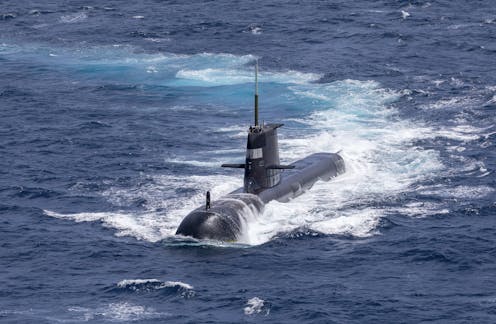
Pillar one of AUKUS involves the delivery of nuclear submarines to Australia, making New Zealand membership impossible under its nuclear-free policy.
But pillar two envisages the development of advanced military technology in areas such as artificial intelligence, hypersonic missiles and cyber warfare. By some reckonings, New Zealand could benefit from joining at that level.
Peters denies the National-led coalition government has committed to joining pillar two. He says exploratory talks with AUKUS members are “to find out all the facts, all the aspects of what we’re talking about and then as a country to make a decision.”
But while the previous Labour government expressed a willingness to explore pillar two membership, the current government appears to view it as integral to its broader foreign policy objective of aligning New Zealand more closely[3] with “traditional partners”.
Official enthusiasm
During his visit to Washington last week, Peters said[4] New Zealand and the Biden administration had pledged “to work ever more closely together in support of shared values and interests” in a strategic environment “considerably more challenging now than even a decade ago”.
In particular, he and US Secretary of State Antony Blinken agreed there were “powerful reasons” for New Zealand to engage practically with arrangements like AUKUS “as and when all parties deem it appropriate”.
Read more: Joining AUKUS could boost NZ’s poor research and technology spending – but at what cost?[5]
Declassified documents reveal the official enthusiasm behind such statements and the tightly-curated public messaging it has produced.
A series of joint-agency briefings[6] provided to the New Zealand government characterise AUKUS pillar two as a “non-nuclear” technology-sharing partnership that would elevate New Zealand’s longstanding cooperation with traditional partners and bring opportunities for the aerospace and tech sectors.
But any assessment of New Zealand’s strategic interests must be clear-eyed and not clouded by partial truths or wishful thinking.
Beyond great power rivalry
First, the current government inherited strong bilateral relations with traditional security partners Australia, the US and UK, as well as a consistent and cooperative relationship with China.
Second, while the contemporary global security environment poses threats to New Zealand’s interests, these challenges extend beyond great power rivalry between the US and China.
The multilateral system, on which New Zealand relies, is paralysed by the weakening of institutions[7] such as the United Nations Security Council, Russian expansionism in Ukraine and a growing array of problems which do not respect borders.
Read more: Is Japan joining AUKUS? Not formally – its cooperation will remain limited for now[8]
Those include climate change, pandemics and wealth inequality – problems that cannot be fixed unilaterally by great powers.
Third, it is evident New Zealand sometimes disagrees with its traditional partners over respect for international law.
In 2003, for example, New Zealand broke ranks with the US (and the UK and Australia) over the invasion of Iraq. More recently, it was the only member of the Five Eyes network to vote in the UN General Assembly[9] for an immediate humanitarian truce in Gaza.
Role of the US
In a robust speech[10] to the UN General Assembly on April 7, Peters said the world must halt the “utter catastrophe” in Gaza.
He said the use of the veto – which New Zealand had always opposed – prevented the Security Council from fulfilling its primary function of maintaining global peace and security.
However, the government has been unwilling to publicly admit a crucial point: it was a traditional ally – the US – whose security council veto and unconditional support of Israel have led to systematic and plausibly genocidal violations of international law[11] in Gaza, and a strategic windfall for rival states China, Russia and Iran.
Rather than being a consistent voice for justice and de-escalation, the New Zealand government has joined the US in countering Houthi rebels, which have been targeting commercial shipping in the Red Sea.
Read more: New Zealand is reviving the ANZAC alliance – joining AUKUS is a logical next step[12]
A done deal?
The world has become a more complex and conflicted place for New Zealand. But it would be naive to believe the US has played no part in this and that salvation lies in aligning with AUKUS, which lacks a coherent strategy for addressing multifaceted challenges.
There are alternatives to pillar two of AUKUS more consistent with a principled, independent foreign policy, centred in the Pacific, and which deserve to be seriously considered.
On balance, New Zealand involvement in pillar two of AUKUS would represent a seismic shift in the country’s geopolitical stance. The current government seems bullish about this prospect, which has fuelled concerns membership may be almost a done deal.
If true, it would be the government facing questions about transparency.
References
- ^ spoke out (www.1news.co.nz)
- ^ responded bluntly (www.newshub.co.nz)
- ^ aligning New Zealand more closely (www.beehive.govt.nz)
- ^ Peters said (www.beehive.govt.nz)
- ^ Joining AUKUS could boost NZ’s poor research and technology spending – but at what cost? (theconversation.com)
- ^ joint-agency briefings (www.defence.govt.nz)
- ^ weakening of institutions (newsroom.co.nz)
- ^ Is Japan joining AUKUS? Not formally – its cooperation will remain limited for now (theconversation.com)
- ^ vote in the UN General Assembly (www.rnz.co.nz)
- ^ robust speech (www.1news.co.nz)
- ^ violations of international law (www.theguardian.com)
- ^ New Zealand is reviving the ANZAC alliance – joining AUKUS is a logical next step (theconversation.com)