Our tall, wet forests were not open and park-like when colonists arrived – and we shouldn’t be burning them
- Written by: David Lindenmayer, Professor, Fenner School of Environment and Society, Australian National University
Some reports[1] and popular books, such as Bill Gammage’s Biggest Estate on Earth[2], have argued that extensive areas of Australia’s forests were kept open through frequent burning by First Nations people. Advocates for widespread thinning and burning of these forests have relied on this belief. They argue[3] fire is needed to return these forests to their “pre-invasion” state.
A key question then is: what does the evidence say about what tall, wet forests actually looked like 250 years ago? The answer matters because it influences how these forests are managed. It’s also needed to guide efforts to restore them to their natural state.
In a new scientific paper[4], we looked carefully at the body of evidence on the natural pre-invasion state of Australian forests, such as those dominated by majestic mountain ash (Eucalyptus regnans), the world’s tallest flowering plant. We analysed historical documents, First Nations Peoples’ recorded testimonies and the scientific evidence.
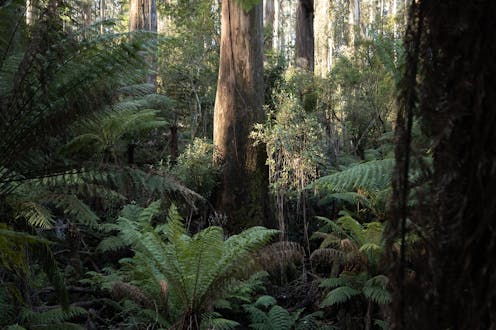
Our analysis shows most areas of mainland mountain ash forests were likely to have been dense and wet at the time of British invasion. The large overstorey eucalypt trees were relatively widely spaced, but there was a dense understorey of broad-leaved shrubs, tree ferns and mid-storey trees, including elements of cool temperate rainforest[5].
Read more: Book Review: Country is an urgent call to learn from Indigenous knowledges to care for the land[6]
What was the evidence?
We looked at many sources of historical evidence. We read colonial expeditioners’ diaries. We reviewed colonial paintings and photographs. We sought out recorded and published testimonies from First Nations People. We compiled evidence from studies such as those that used carbon dating, tree rings and pollen cores.
We also examined the basic ecology of how the forests grow and develop, the plants’ level of fire sensitivity and different animals’ habitat needs.
As an example of the many accounts we found, 19th-century civil servant and mining engineer Robert Brough Smyth wrote[7] about:
[…] heavily timbered ranges lying between Hoddle’s Creek and Wilson’s Promontory. The higher parts and the flanks of these ranges are covered with dense scrubs, and in the rich alluviums bordering the creeks and rivers the trees are lofty, and the undergrowth luxuriant; indeed in some parts so dense as to be impenetrable without an axe and bill-hook.
Similarly, in 1824, colonial explorers Hamilton Hume and William Hovell described[8] their encounter with mountain ash forests at Mount Disappointment in Victoria:
Here […] they find themselves completely at a stand, without clue or guide as to the direction in which they are to proceed; the brush wood so thick that it was impossible to see before them in any direction ten yards.
The ecological and other scientific evidence suggests mountain ash forests evolved under conditions where high-severity bushfires were rare. As a result, mature forests of eucalypt trees of multiple ages dominated these landscapes. There was no evidence of active and widespread use of recurrent low-severity fire or thinning.
Our key conclusion is that these forests were not open or park-like – as was the case in some other vegetation types in Australia.
Read more: Why Victoria needs a Giant Forest National Park[10]
First Nations People knew not all Country needs fire
Importantly, tall wet forests were not wilderness. Rather, they were places of significance for First Nations People. They used these forests seasonally to access important sites and resources and as pathways to visit others in neighbouring Countries.
There is no doubt parts of Australia were subject to recurrent cultural burning for many diverse and important reasons before the British invasion. However, our discussions with Traditional Custodians in the Central Highlands of Victoria, including Elders, indicate cultural burning was not widely practised in most of the mountain ash forests there. Nor were these forests actively thinned.
Many First Nations People advocate the need to consider ecological responses to fire. The right fire (or not) for the right Country is a guiding principle of traditional fire management. In the words[11] of Elder and cultural fire practitioner Victor Steffensen:
Aboriginal fire knowledge is based on Country that needs fire, and also Country that doesn’t need fire. Even Country we don’t burn is an important part of fire management knowledge and must be within the expertise of a fire practitioner.
Repeated burning, and even low-severity fire, is unsuited to the ecology of tall, wet forests. It can lead to their collapse and replacement[12] by entirely different vegetation such as wattle scrub.
Similarly, thinning these forests can make them more fire-prone[13], not less, by creating a drier forest[14], and generate huge amounts of carbon emissions[15].
Thinning and burning will also destroy habitat for a wide range of species. They include critically endangered ones such as Leadbeater’s possum[16]. Indeed, mountain ash forests are themselves recognised as a critically endangered ecosystem[17].
Read more: It's not just Victoria's iconic mountain ash trees at risk – it's every species in their community[18]
Let forests mature to restore what’s been lost
The compelling evidence we compiled all indicates mountain ash forests were dense, wet environments, not open and park-like, at the time of British invasion.
The use of scientific evidence is essential for managing Australia’s natural environments. Based on this evidence, we should not be deliberately burning or thinning these forests, which will have adverse impacts.
Rather, restoration should involve letting these forests mature. We should aim to expand the size of the old-growth forest estate to precolonial levels. Where regeneration has failed, practices such as planting and reseeding will be important to restore ecological values.
References
- ^ reports (catalogue.nla.gov.au)
- ^ Biggest Estate on Earth (www.allenandunwin.com)
- ^ argue (thamesandhudson.com.au)
- ^ scientific paper (onlinelibrary.wiley.com)
- ^ cool temperate rainforest (www.environment.vic.gov.au)
- ^ Book Review: Country is an urgent call to learn from Indigenous knowledges to care for the land (theconversation.com)
- ^ wrote (wellcomecollection.org)
- ^ described (gutenberg.net.au)
- ^ Google Arts & Culture/National Gallery of Victoria (artsandculture.google.com)
- ^ Why Victoria needs a Giant Forest National Park (theconversation.com)
- ^ the words (www.hardiegrant.com)
- ^ collapse and replacement (www.sciencedirect.com)
- ^ more fire-prone (onlinelibrary.wiley.com)
- ^ creating a drier forest (conbio.onlinelibrary.wiley.com)
- ^ carbon emissions (doi.org)
- ^ Leadbeater’s possum (www.wildlife.vic.gov.au)
- ^ critically endangered ecosystem (theconversation.com)
- ^ It's not just Victoria's iconic mountain ash trees at risk – it's every species in their community (theconversation.com)