A Dancing Girl is soul-stirring dance theatre
- Written by: Vanita Yadav, Senior Research Fellow, Urban Transformations Research Centre, Western Sydney University
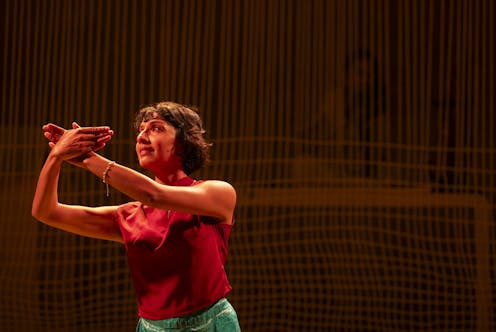
The complex and grappling issue of violence against women takes centre stage in the soul-stirring solo dance drama Nayika: A Dancing Girl.
During a dinner conversation in Sydney with her high school friend, The Dancing Girl (Vaishnavi Suryaprakash) reminisces about her early teenage years. She recollects feeling thrilled about learning the classical Indian dance form Bharatanatyam[1] in Chennai, which she calls the mecca for learning dance in South India.
A new student, living by herself while her parents are in the Middle East, The Dancing Girl finds herself falling in love. The upbeat music and performance take the audience on a journey of innocence, first love and the roller-coaster of a teenage romance.
But later unfolds a shocking depiction of a 13-year-old girl experiencing abuse. Suryaprakash’s performance and the surreal, stark music (composed by Marco Cher-Gibard) create an immersive experience for the audience to feel the trauma of a child who doesn’t understand what coercive control or sexual violence is. She doesn’t know what to do or who to ask for help.
Suryaprakash beautifully plays The Dancing Girl and narrates her coming-of-age story by juggling between her present identity as an adult and her early teenage experiences of violence in her first relationship.
From creators and directors Nithya Nagarajan and Liv Satchell, the play oscillates between The Dancing Girl’s current state of mind in Sydney and her 13-year-old self in Chennai. Her bottled memories are triggered when a high school friend visits her in Sydney. Their conversations take The Dancing Girl back to her teenage self.
The soulful music and Suryaprakash’s performance reveal how distressed The Dancing Girl felt, and the apprehension and loss of words in articulating her experiences with her mother. The directors show the sociocultural nuances that inhibit openly discussing love and dating in South Asian cultures where it is largely a taboo[2].

The solo performance blends music, dance and drama using a neo-classical version of Bharatanatyam dance. Bharatanatyam[3] is one of the oldest classical dance forms of South India. The contemporary version adopted in the play is minimalistic yet extremely powerful. The live music performance by Cher-Gibard with Bhairavi Raman creates a sensory, soul-stirring acoustic experience.
The Dancing Girl vividly remembers her guru teaching the eight forms of Nayikas: the heroines of Bharatanatyam dance. These forms are drawn from the ancient Indian treatise called Natya Shastra[4].
The eight heroines of Bharatanatyam dance all have stories revolving around a male figure (King or God), and each represent a specific emotion.
The first Nayika, Vasakasajja is excited about being dressed up for her lover. Virahotkanthita is worried, expressing the pains of separation. The confident Svadhinabhartruka has a faithful lover. The disappointed Kalahantarita has quarrels with her lover.
The distressed Khandita is hurt by infidelity. The quarrelsome Vipralabdha is aware of infidelity and confronts her lover. The skilful Abhisarika pursues what and who she wants without secrecy. Finally, the eighth Nayika, Proshitapatika, mourns her lover, who has gone to a faraway land.
 Vaishnavi Suryaprakash beautifully plays The Dancing Girl.
Brett Boardman/Belvoir
Vaishnavi Suryaprakash beautifully plays The Dancing Girl.
Brett Boardman/Belvoir
But The Dancing Girl raises a pertinent question: where is the “overwhelmed” heroine – the heroine who portrays how to deal with a dangerous lover?
Her dance guru tells her that to face her overwhelming feelings she needs to embrace her power, and real power comes with control over one’s body and one’s emotions. The Dancing Girl can achieve this control through the power of dance. The play ends with The Dancing Girl identifying this power as the missing ninth heroine of Bharatanatyam: a heroine who can reclaim control of time, space and body.
Upon revisiting her past, The Dancing Girl is able to confront her trauma, acknowledge the need for help, and reclaim control. It is a powerful message about the lasting impact of gender-based violence on young girls and the inability of language to fully express such experiences.
Nayika: A Dancing Girl is at Belvoir, Sydney, until May 19.
References
- ^ Bharatanatyam (indianculture.gov.in)
- ^ largely a taboo (plantsghar.com)
- ^ Bharatanatyam (indianculture.gov.in)
- ^ Natya Shastra (indianculture.gov.in)