How a filmmaker, a pile of old shells and a bunch of amateurs are bringing our oyster reefs back
- Written by: Dominic McAfee, Postdoctoral researcher, marine ecology, University of Adelaide
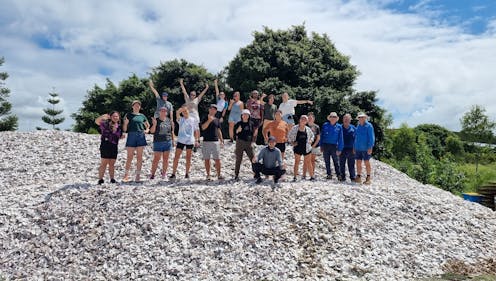
Around Australia, hundreds of people are coming together to help a once-prized, but decimated and largely forgotten marine ecosystem. They’re busy restoring Australia’s native oyster and mussel reefs.
Alongside the high-profile national Reef Builder campaign[1], community groups have become inspired to do their bit, in their own backyards.
Fortunately there’s more than one way to rebuild a reef. And you don’t have to think small.
From humble beginnings, a community-driven project in Queensland’s Moreton Bay has grown into an ambitious plan to restore 100 hectares of oyster reef over the next ten years[2]. This would make it the largest oyster reef restoration project in the Southern Hemisphere.
Introducing the Moreton Bay Shellfish Reef Restoration Project (OzFish Unlimited)Why are we bringing back shellfish reefs?
Just 200 years ago, Australia’s coastline was home to billions upon billions of oysters and mussels[3], forming reefs that stretched thousands of kilometres. They filled the sheltered waters of bays and estuaries from the southern Great Barrier Reef to Tasmania and all the way around to Perth. These thriving marine ecosystems provided food, shelter and water filtration, as well as coastline protection from stormy seas.
But today, our shellfish reefs are near extinct. Oyster dredges scraped reef after reef from the seafloor throughout the 19th century. Oysters and mussels were harvested for food. Their shells were ground up to make roads and cement. Now only degraded remnants and individual oysters remain from what was once a continent-wide marine empire.
Fortunately, Australia’s shellfish ecosystems were rediscovered this century[4]. Researchers used historical records including newspaper clippings to work out how many oysters were taken and where from.
Community interest grew as the scale of the loss became clear. Coastal communities could see the benefits of shellfish[5] and wanted to bring them back.
It turns out the baby oysters are still there, bobbing around in the ocean, just looking for a place to live.
How do you build a shellfish reef?
There’s more than one way to rebuild shellfish reefs.
If you have earth-moving equipment and lots of money, you can start from the ground up.
Limestone rubble can provide the firm foundation for baby oysters to settle and grow.
That’s how Australia’s largest oyster reef restorations are built. Construction began in 2015.
Windara Reef[6] now spans 20 hectares in the coastal waters of Gulf St Vincent, near Ardrossan on the Yorke Peninsula in South Australia.
Through a national campaign led by The Nature Conservancy, reefs have been built at 23 locations this way. They plan to hit a target of 60 reef ecosystems by 2030.
But if you don’t have cranes, trucks and the money it costs to build reefs from stone, there is another way. Baby oysters can simply settle and grow on the shells of old oysters, if they’re clumped together.
Fishing filmmaker’s bright idea
When former filmmaker Robbie Porter of Wynnum in Queensland heard about a small reef restoration project in the Noosa River, he wanted to do something closer to home. He approached fish conservation non-profit OzFish Unlimited with an idea for a smaller-scale, hands-on approach to reef building.
He devised a structure people could use to build their own reefs – one that’s light enough to be carried to a boat and dropped over the side.
These wire mesh cages, called “robust oyster baskets”, are filled with sterile, recycled oyster shells. The structure ensures the shell to be held together for a few years, until the reef is established.
Once the baby oysters find a good place to settle, they cement themselves to it. As they grow, they fuse with other oysters. After two or three years, the wire cage rusts away and you’re left with an “oyster bommie”, which looks like some of the few remaining reefs that still exist in undeveloped areas.
The Moreton Bay project established a major recycling facility to collect used oyster shells from local restaurants and oyster shucking facilities. The shells are then sterilised in the sun, washed and sorted before being placed into the baskets.
As knowledge and support has grown, so has the ambition of these projects. Now reconstruction is taking place on an industrial scale. And Porter is now employed full time as OzFish Shellfish Revolution Senior Special Projects Officer[7].
After six years, the project has amassed more than 23,000 volunteer hours, collected more than 800,000kg of shell for processing and placed more than 7,000 oyster bommies into Moreton Bay. These can be found mainly around the Port of Brisbane but also at 11 other locations in Southeast Queensland.
The idea has caught on. Community and OzFish groups in Queensland, South Australia and Victoria have all started their own projects growing oysters in baskets[8]. Two projects are also planned for New South Wales.
A test bed for research
Academics and research students from various Australian universities have also been involved along the way. They have established scientific monitoring programs and laboratory experiments to examine progress[9]. This knowledge helps validate restoration activities while allowing researchers to make new discoveries.
Researchers are monitoring shellfish health, dissecting the biodiversity of the baskets, studying how fish use these reefs, and working towards understanding the reef’s capacity to filter water[10].
Research in Victoria has also shown shell recycling[11] is an effective way not only to collect material for restoring shellfish reefs, but also to reduce the amount of waste going to landfill – and even published a step-by-step guide to establishing shell recycling.
Shellfish restoration at scale
Australians love the coast and millions of people fish along it every year. This is a potential army of conservation volunteers. But many people don’t know these projects exist, or how to get involved.
The Moreton Bay Shellfish Reef Restoration project has enabled more than 600 people to engage in nature repair, while building a sense of community. This was a first of its type in the world and it won’t be the last. Projects are popping up all around Australia.
The model replicates the success of the Landcare movement, with local groups delivering local outcomes supported by expert advisers and academic researchers.
Bringing people together around a shared vision for a healthier future also has welcome side effects. Many of our volunteers have discovered a new sense of purpose and optimism.
By recreating our long-lost and almost forgotten shellfish reefs, we have rediscovered ourselves.
This story is part of Making a Difference, a new series on community efforts to restore nature. Read the other stories here[12].
References
- ^ national Reef Builder campaign (www.natureaustralia.org.au)
- ^ restore 100 hectares of oyster reef over the next ten years (ozfish.org.au)
- ^ oysters and mussels (journals.plos.org)
- ^ rediscovered this century (conbio.onlinelibrary.wiley.com)
- ^ benefits of shellfish (theconversation.com)
- ^ Windara Reef (www.pir.sa.gov.au)
- ^ OzFish Shellfish Revolution Senior Special Projects Officer (ozfish.org.au)
- ^ growing oysters in baskets (onlinelibrary.wiley.com)
- ^ examine progress (ozfish.org.au)
- ^ capacity to filter water (ecoevorxiv.org)
- ^ shell recycling (onlinelibrary.wiley.com)
- ^ here (theconversation.com)