Mattel’s new athlete Barbies might seem like a win for feminists and young girls – but they’re not
- Written by: Lauren Gurrieri, Associate Professor in Marketing, RMIT University
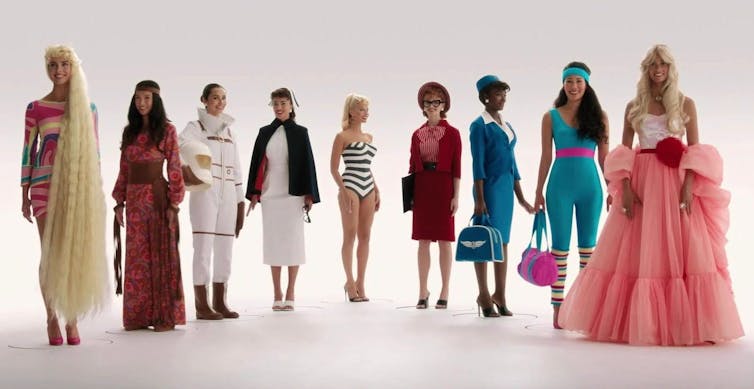
Mattel released a new range[1] of Barbie dolls this week honouring nine trailblazing women in sport. The recognised athletes include Matildas soccer star Mary Fowler, tennis champion Venus Williams and seven other record-breaking and world champion sports stars from across the globe.
Mattel’s Krista Berger said the brand[2] wishes to acknowledge “the impact of sports in fostering self-confidence, ambition and empowerment among the next generation”.
But is this a genuine effort by a corporation to be gender progressive, or is it a marketing ploy that co-opts feminism in the pursuit of profit?
Dolls and ‘learning’ gender
Discussions about Mattel’s revamping of its Barbie range matter, as research has long recognised that “play” is foundational to children’s development[3].
Dolls matter in all kinds of ways: they connect us to our younger selves and are transitional objects that provide us with an early sense of comfort and security.
However, doll play has historically been marketed as “for girls”, while promoting gendered norms of domesticity and ideals of physical attractiveness.
Feminists have long raised concerns about the impacts of such stereotypical portrayals[4] – and especially their potential to socialise children in ways that both highlight and exaggerate gender differences.
Barbie in particular has often been accused[5] of spreading narrow ideals of femininity, girlhood and womanhood into the lives of young girls.
Does this latest range promise something different? Part of answering this question requires us to trace Barbie’s origins.
A chequered history
Barbie was originally a West German doll named Bild Lilli[6], which was crafted for an adult consumer. Ruth Handler’s discovery of this German figurine led to her adaptation for an American marketplace, which included a name change and wardrobe update.
Significantly, Barbie was first marketed as a “teenage fashion model[7]” whose anatomically impossible curves and dimensions proved to be a marketing triumph. Ever since, Barbie’s unrealistic body has generated body image and appearance-focused anxieties[8]. The long-term cultural repercussions still resonate today.
The doll also communicates a narrow set of beauty ideals that conflate blondness and whiteness with physical attractiveness. In response to growing backlash, Mattel has introduced more “diverse Barbies[9]” in recent times.
The founder of psychoanalysis, Sigmund Freud, said there is[10] something uncanny about dolls, in that they mediate between reality and fantasy — a tension sustained by a fear and wish they could somehow come alive.
The question is, does this new range of Barbies modelled on real pioneering athletes fall within the realm of reality or fantasy? Is it a genuine attempt to make Barbie more relatable?
Broadening and narrowing representation
On face value, Mattel’s recent efforts to diversify its range of Barbies through embracing and promoting women’s sporting is positive. After all, women’s visibility in sport is a longstanding problem, plagued by issues of unequal pay, representation and participation. And you can’t be what you can’t see.
But what exactly are we seeing in the new Barbies? While the range promotes diversity in terms of skin colour and abilities, we’re once again confronted with a sameness of bodies. Each of the Barbies conforms to a prescriptive thin ideal and doesn’t convey the athleticism of their likeness.
For instance, Venus Williams’s muscularity – a feature that makes her a powerful tennis player – is missing in her replica.

A corporate hijacking of feminism
By portraying Barbie viz a viz these pioneering women athletes as strong, capable and accomplished, the doll appears to challenge gender stereotypes.
Yet, in popular culture, the contemporary woman is increasingly being represented by notions of autonomy, agency and choice. This sensibility, that women can “have it all” (known as post-feminism) positions women as individually responsible for their own wellbeing, care and liberation.
When taken up by brands that promote this kind of “girl power”, a new type of corporate feminism is created. The result is a watering down of feminism. Women’s empowerment is reduced to a marketable commodity rather than a genuine engagement with feminist politics.
The dolls in Barbie’s new range embody a combination of physical perfection and sporting prowess. As such, they communicate new levels of expectation and standards for young girls to “aspire” to.
Realistic Barbie?
Mattel’s new range suggests the company is willing to go only so far in its efforts to be “inclusive” – unable to break away from the rigid plastic mould of Barbie’s unrealistic contours.
Evidence shows[11] that girls who play with a doll with a more realistic body exhibit less body dissatisfaction than those who play with Barbie. Could Barbie be realistic? Could she ever represent the countless women in the world who might be “ordinary”, unremarkable and even flawed?
If Mattel really wants to join the inclusive revolution, it ought to rethink the rigid ideals that Barbie continues to promote.
References
- ^ released a new range (www.cbsnews.com)
- ^ said the brand (www.espn.com.au)
- ^ foundational to children’s development (startingblocks.gov.au)
- ^ impacts of such stereotypical portrayals (theconversation.com)
- ^ been accused (pubmed.ncbi.nlm.nih.gov)
- ^ Bild Lilli (www.smh.com.au)
- ^ teenage fashion model (en.barbiepedia.com)
- ^ body image and appearance-focused anxieties (theconversation.com)
- ^ diverse Barbies (shop.mattel.com)
- ^ said there is (waysofthinking.co.uk)
- ^ Evidence shows (doi.org)