Could a green investment deal help Indonesia and Australia overcome their past tensions?
- Written by: Cahyani Widi Larasakti, PhD Student in International Relations, The University of Melbourne
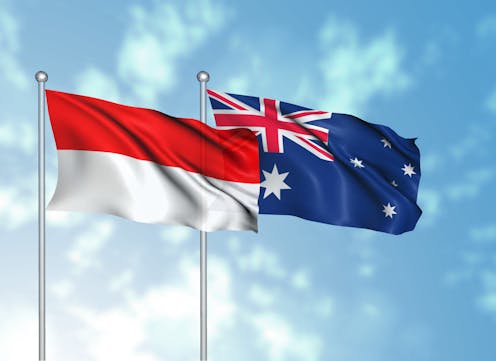
Australia and Indonesia have long had an uneasy relationship, over issues ranging from Timor-Leste’s independence to asylum seekers and bans on live cattle export to the aftermath of the Bali bombings.
While the politics have long been challenging, there’s reason to believe a change may be coming. One of the fastest-growing economies in the world, Indonesia has long been powered by coal. Now, it’s endeavouring to go green[1] through renewables, grid modernisation, electric vehicles and geothermal.
That’s where Australia comes in. In March this year, the two nations formalised a climate partnership[2], named KINETIK. Through the agreement, Indonesia will secure supplies of lithium for EV batteries, and Australia will gain more export markets for its critical minerals, as well as potential access to the batteries’ industry supply chain.

Why has the relationship been rocky?
Since winning independence from the Dutch, Indonesia has focused heavily on keeping its many islands and ethnic groups united.
But Australia’s role has sometimes been destabilising. During the Cold War, Australian agencies backed[4] the Indonesian army’s bloody purges of communists.
Australia also backed the cause[5] of East Timorese secession. In 1998, Australian Prime Minister John Howard wrote to Indonesia’s President, B.J Habibie, pushing for East Timorese independence. A year later, over 5,500 Australian soldiers[6] arrived as peacekeepers during a tense referendum over the region’s future.
 Then-Prime Minister John Howard’s letter on East Timor to Indonesian B.J Habibie proved instrumental.
Charles Dharapak/AP
Then-Prime Minister John Howard’s letter on East Timor to Indonesian B.J Habibie proved instrumental.
Charles Dharapak/AP
Many people in Indonesia saw Australia’s involvement as a threat to national unity and cohesion. Before Howard and Indonesia’s next president, Megawati Soekarnoputri, had time to restore the relationship, tensions ramped up again after the 2002 terrorist bombings in Bali which killed 88 Australians[7].
Four years later, the Australian decision to grant temporary protection visas to 43 asylum seekers from Papua, which has long sought independence from Indonesia, led Indonesia’s ambassador to Canberra to be recalled[8].
This diplomatic incident bore positive fruit, resulting in improved dialogue and, the same year, the signing of the Lombok Treaty[9], in which both countries promised not to interfere with the sovereignty of the other.
Since then, Australia has been diplomatically silent on other Indonesian territorial issues, such as the separatist movement in Papua.
Despite these efforts, many differences remain. Experts have[10] often warned[11] the relationship is tenuous.
In 2019, the two nations signed a new Comprehensive Economic Partnership after a tortuous negotiation period. With a focus on climate change and energy transition, this paved the way for this year’s announcement.
In a broader context, this partnership also illustrates Australia’s approach as a middle power nation to counterbalance China’s increasing economic dominance in the Indo-Pacific region.
Could the green transition help the relationship?
In 2022, Australian Prime Minister Anthony Albanese visited Indonesia, where he promised A$200 million to kickstart climate and infrastructure projects.
Now we have a formalised partnership[12]. This is an important step, which should improve the political relationship.
The two nations already trade[13] $18 billion of goods and services yearly, centred on Australian coal and beef and Indonesian fertilisers and petrol.
But there is room for much more growth. Indonesia’s population is young and large, with almost 280 million people. By 2030, estimates suggest[14] it could be the world’s fifth-largest economy.
If the KINETIK partnership works, it will be because it offers both nations what they need – Australia gets a new export market for green minerals, technology and know-how, and Indonesia starts to shift away from coal.
The agreement builds on a memorandum of understanding on electric vehicles[15] and another between Export Finance Australia and Indonesia’s State-owned Electricity Company[16] last year.
What are we likely to see as tangible outcomes?
Indonesia perches on the Pacific Ring of Fire, with a number of active volcanoes and frequent earthquakes. This also means the archipelago nation has huge geothermal resources, estimated at 40% of the world’s total[17]. Many geothermal plants are already running[18].
But making the most of the resource faces many technological challenges. The best underground heat resources tend to be located in mountains or in isolated areas. The KINETIK partnership could help through connecting Australian mining expertise to Indonesia’s deep heat resources.
Australia’s expertise[19] in using renewables to power isolated communities[20] will be vital to make exploration easier. And Australian investors will be allowed[21] to own a majority share of Indonesian geothermal plants.
 Indonesia has 16 geothermal plants running at present – but the resource is much larger.
Geothermal Rising/Flickr, CC BY-NC-ND[22][23]
Indonesia has 16 geothermal plants running at present – but the resource is much larger.
Geothermal Rising/Flickr, CC BY-NC-ND[22][23]
The partnerships are expected to align with Indonesia’s National Energy Policy[24], which aims in part to shift from exporting raw energy resources and critical minerals to exporting value-added energy products through downstream projects such as EV and battery industries.
Australia is home to the world’s largest hard-rock lithium mine, Greenbushes. The new partnership will open up options for Indonesian battery manufacturers to access this key metal.
Indonesia, in turn, is rich in nickel, which will be needed in great quantities for green technologies. In fact, cheaper Indonesian nickel[25] has pushed some Australian producers out of the market. Indonesia has already secured commercial deals with EV and battery manufacturers such as Hyundai and LG from South Korea, as well as Foxconn from Taiwan.
Will this be enough?
Politically, the relationship between Indonesia and Australia has long been thorny. A new focus on mutual advantageous investment could help, especially given the deal has strong political backing on both sides. Developing electric vehicles in Indonesia was also a key campaign issue for the newly elected Indonesian president, Prabowo Subianto.
From the Australian side, the agreement bolsters the Albanese government’s push to make the nation a green energy superpower[26].
Of course, many agreements stay on paper and don’t shape the real world. But this one has a better chance, given the alignment between Indonesia’s efforts to make itself part of the electric vehicle supply chain, and Australia’s dream of becoming a green superpower.
Bilateral agreements like these also show how the world is changing. More and more, middle power cooperation is emerging as a counterbalance against the intensifying Chinese-American rivalry.
It’s also a positive sign Australia has realised the need to more actively build alliances across the Indo-Pacific region.
References
- ^ go green (www.power-technology.com)
- ^ climate partnership (indonesia.embassy.gov.au)
- ^ David Swift/AAP (photos.aap.com.au)
- ^ backed (www.internationalaffairs.org.au)
- ^ backed the cause (dkiapcss.edu)
- ^ 5,500 Australian soldiers (anzacportal.dva.gov.au)
- ^ killed 88 Australians (www.foreignminister.gov.au)
- ^ to be recalled (www.aph.gov.au)
- ^ Lombok Treaty (www.dfat.gov.au)
- ^ have (theconversation.com)
- ^ warned (www.aspistrategist.org.au)
- ^ formalised partnership (indonesia.embassy.gov.au)
- ^ already trade (www.dfat.gov.au)
- ^ estimates suggest (asiasociety.org)
- ^ electric vehicles (iipc-sydney.com)
- ^ Export Finance Australia and Indonesia’s State-owned Electricity Company (www.trademinister.gov.au)
- ^ world’s total (www.aseanbriefing.com)
- ^ already running (en.wikipedia.org)
- ^ Australia’s expertise (indonesiaatmelbourne.unimelb.edu.au)
- ^ renewables to power isolated communities (arena.gov.au)
- ^ will be allowed (www.dfat.gov.au)
- ^ Geothermal Rising/Flickr (www.flickr.com)
- ^ CC BY-NC-ND (creativecommons.org)
- ^ National Energy Policy (policy.asiapacificenergy.org)
- ^ cheaper Indonesian nickel (www.lowyinstitute.org)
- ^ green energy superpower (theconversation.com)