


Why do we love to see unlikely animal friendships? A psychology expert explains
- Written by: Shane Rogers, Lecturer in Psychology, Edith Cowan University
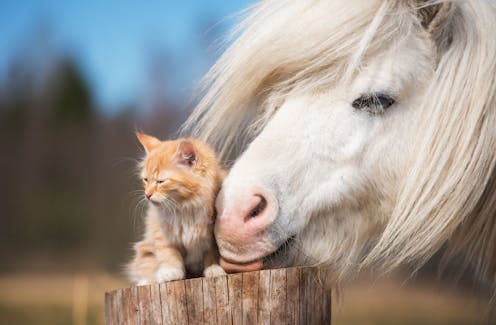
The internet is awash with stories and videos of unlikely animal friendships, often with many millions of views. This content typically shows animals from different species showing affection to one another, signifying a bond or even a “friendship”.
These relationships have been captured in people’s homes, such as with Molly the magpie and Peggy the dog[1], in zoos, such as with[2] Baloo the bear, Leo the lion and Shere Khan the tiger, and even in the wild[3], such as one case of a fox and cat living together[4] in Turkey.
A plethora of research on primates[5], birds[6], kangaroos[7], dolphins[8], horses[9], cats[10] and dogs[11] has shown many non-human animals can develop deep social bonds with their own kind.
And while inter-species bonding hasn’t been studied to the same extent, videos like those mentioned above show animals from different species displaying the same affection to each other as they would to their own, such as through cuddling, playing and grooming.
Why do we, as people, find these stories so enjoyable? Answering this question requires us to consider some of the nicer aspects of our own nature.
When animals reflect us
Witnessing animals get along well together isn’t just cute, it can also make us feel like we have things in common with other species, and feel more connected with the other life on the planet. Decades of research[12] reveals how feeling connected to nature fosters happiness in humans.
While the mechanisms behind inter-species bonding are not fully understood, one 2022 research review[13] suggests the mechanisms that operate in other animals’ brains during social interactions with their own are similar to those that operate in human brains.
The researchers suggest that, due to the evolution of common brain mechanisms, animals engaged in social interaction may experience similar emotions to humans who engage with their own friends or loved ones.
So while it’s very hard to know what this subjective social experience is like for other animals – after all, they can’t report it on a questionnaire – there’s no reason to think it isn’t similar to our own.
Humans like co-operation and pleasant surprises
Humans have evolved to enjoy co-operation[14], which might also help explain why we enjoy seeing co-operation between different animal species. Some scholars[15] suggest the human instinct for co-operation is even stronger than our instinct for competition.
Another reason we may be drawn to unlikely animal friendships is that they are, in fact, so unlikely. These interactions are surprising, and research shows humans enjoy being surprised[16].

Our brain has evolved to be incredibly efficient[17] at categorising, solving problems and learning. Part of the reason we’re so efficient is because we are motivated to seek new knowledge and question what we think we know. In other words, we’re motivated to be curious[18].
Inter-species friendships are indeed a very curious thing. They contradict the more common assumption and observation that different species stick with their own kind. We might think “cats eat birds, so they must not like each other”. So when we see a cat and a bird[19] getting along like old pals, this challenges our concept of how the natural world works.
Neuroscientists have documented that, when surprised, humans experience a release of brain chemicals responsible for making us more alert[20] and sensitive to reward[21]. It is this neurochemical reaction that produces the “pleasantness” in the feeling of being pleasantly surprised.
A desire for peace and harmony
Perhaps another explanation for why humans are so intrigued by inter-species friendships is because they feed a human desire for peace and harmony.
These connections may be symbolic of what many people yearn for: a world where differences can be put aside in favour of a peaceful co-existence. These friendships might even prompt us to imagine, consciously or subconsciously, a future in which we become more enlightened as a species.
 Perhaps seeing such peace and cohesion in the natural world inspires humans on some level.
Shutterstock
Perhaps seeing such peace and cohesion in the natural world inspires humans on some level.
Shutterstock
One could argue a key reason behind the success of the TV series Star Trek[22] is its optimistic take on the future of humanity[23]. Inter-species co-operation is a central theme of the show.
Inter-species friendships may serve as a concrete example of breaking free of the “natural” way of being for a more peaceful way of being. And while it might only be a dream, it’s nice to watch cute animal videos that help us feel like this dream might be possible.
References
- ^ Molly the magpie and Peggy the dog (www.abc.net.au)
- ^ such as with (www.abc.net.au)
- ^ in the wild (www.youtube.com)
- ^ a fox and cat living together (www.huffpost.com)
- ^ primates (www.nature.com)
- ^ birds (blog.mybirdbuddy.com)
- ^ kangaroos (theconversation.com)
- ^ dolphins (theconversation.com)
- ^ horses (www.mdpi.com)
- ^ cats (www.mdpi.com)
- ^ dogs (www.nature.com)
- ^ Decades of research (www.frontiersin.org)
- ^ one 2022 research review (www.frontiersin.org)
- ^ evolved to enjoy co-operation (royalsocietypublishing.org)
- ^ Some scholars (www.abc.net.au)
- ^ enjoy being surprised (www.scientificamerican.com)
- ^ evolved to be incredibly efficient (www.imperial.ac.uk)
- ^ curious (www.ncbi.nlm.nih.gov)
- ^ a cat and a bird (www.youtube.com)
- ^ more alert (www.scientificamerican.com)
- ^ sensitive to reward (www.sciencedirect.com)
- ^ Star Trek (www.youtube.com)
- ^ optimistic take on the future of humanity (jacobin.com)










