For a century, it’s been illegal to swim in the Seine. Will Paris’s clean-up make the river safe for Olympic swimmers?
- Written by: Ian A. Wright, Associate Professor in Environmental Science, Western Sydney University
Five eagerly anticipated events in the Paris Olympics will be the mens and womens 10 kilometre marathon swimming races, as well as the 1,500 metre swimming section of three triathlon events. Why? Because all will be held in the Seine River in the centre of Paris. The swimmers – including four Australians[1] – will pass famous landmarks such as the Musee d'Orsay as they swim through the historic heart of the city. This will have enormous scenic appeal for spectators.
But will it be safe for swimmers? Rivers running through large cities are often polluted[2], whether from stormwater, chemical pollution or wastewater spills. As the marathon swimmers pass the Paris Sewer Museum[3], they may well wonder if they’re in clean water.
For more than 100 years, swimming in the Seine has actually been illegal, due to concerns over what the water could do to human health. Authorities have been working[4] to clean up the water, spending A$2.2 billion (€1.3 billion) on improving water quality. The goal: cut bacterial contamination by 75% before the first swimmer touches the water. These measures are having an impact – but recent heavy rains have seen bacteria levels spike.
While officials have put on brave faces, there’s now a contingency plan[5] in case the Seine isn’t safe.
Why swim in the Seine at all?
Urban rivers have a questionable reputation. But this isn’t the first time the Seine River has been used for Olympic swimming.
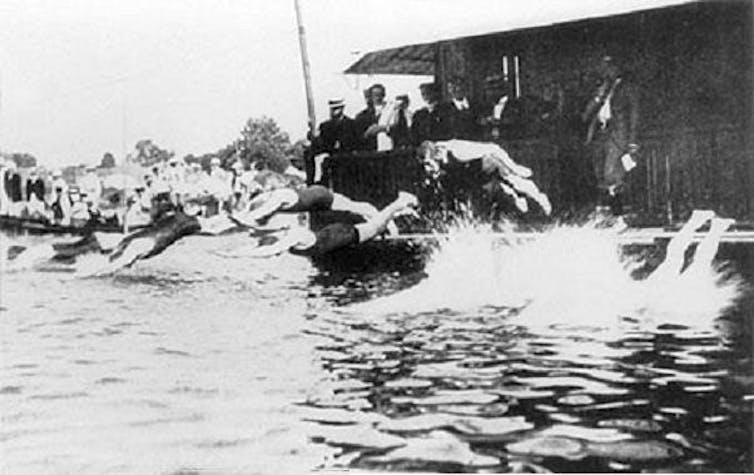
In the 1900 Paris Olympics, seven swimming events[6] were all held in the river. These games were the first modern Olympics where women could compete[7] in some sports, but swimming was not one of those permitted.
The Australian swimmer who competed, Frederick Lane, had to swim under the United Kingdom’s flag as Australia did not have a flag until Federation the following year. He won two gold medals. One was for the 200 metre freestyle race, and the other for a bizarre race never held again: the 200m swimming obstacle race[8], where swimmers had to climb over poles and boats. These Olympics also saw the first and last underwater swimming race, which was also in the Seine.

Back then, the waters of the Seine were cleaner. That’s because there was a great demand for human waste on farms – and cities were the main source. Back then, “night soil” (human waste) had a real market value[11]. No one would think of dumping it in rivers.
But as time went on, sewerage systems developed and other fertilisers such as guano and mineral fertilisers arrived. By the early 20th century, most of the city’s wastewater went into the Seine. In 1923, the swimming ban came into effect. A year later, Paris hosted the Olympics for its second time – and swimmers competed in 50 metre pools.
In recent years, many cities around the world have worked to clean up their urban waterways. River swimming is now common[12] in cities such as Copenhagen, Berlin and Vienna, where river health has improved dramatically.
How can you clean a river like the Seine?
Cleaning the Seine is a challenge. Paris is home to 11 million people, with plenty of industry. Urban rivers are almost inevitably polluted by waste from the surrounding city[13].
Leaking and overflowing sewage systems are a major source of pollution. In places like the UK, sewage spills[14] into waterways have become a major political issue.
When wastewater spills into rivers, it carries pollutants and dangerous loads of disease-causing microorganisms[15], such as Escherichia coli (commonly known as E. coli). Untreated water can have viruses, bacteria and disease-causing protozoa.
In the lead-up to the Paris games, authorities have been working to improve water quality enough to bring some Olympic swimming back to the Seine. Stormwater – often contaminated by dog poo or sewage overflows – is being cleaned[16] before it is released into the river.
Despite the money and effort, there are still real questions over whether it will be enough to guarantee swimmer safety. Bacterial levels hit risky levels most days in June[17] due to unseasonally heavy rains, but the water has improved in July[18].
This week, French sports minister Amélie Oudéa-Castéra swam a few metres[19] in the Seine in an effort to douse concerns.
 French sports minister Amelie Oudea-Castera and Tokyo 2020 Paralympics Triathlon gold medalist Alexis Hanquinquant took a dip in the Seine on Saturday, less than two weeks before the Olympics kick off.
AP
French sports minister Amelie Oudea-Castera and Tokyo 2020 Paralympics Triathlon gold medalist Alexis Hanquinquant took a dip in the Seine on Saturday, less than two weeks before the Olympics kick off.
AP
By contrast, the other Olympic swimming events will take place in a recently constructed 50 metre pool, which will have very good water quality. The pool water is filtered and treated with a disinfectant such as chlorine or bromine. It will be regularly tested to ensure optimal water quality.
At the Tokyo 2020 Olympics, triathletes had to swim in polluted Tokyo Bay. But similar concerns over sickness proved unfounded. The real challenge was the oppressive heat[20].
What’s at risk?
The most likely outcome if races are held when bacterial levels are unsafe would be getting a gastrointestinal bug.
Officials have some control over this. Contamination is worst after heavy rain. Races could be delayed if need be.
Many swimmers – especially those who compete in open-water competitions – are familiar with swimming in water with some level of pollution. Some see it as worth the risk. Italian double world champion swimmer Gregorio Paltrinieri said in January[21]:
Even if the water is dirty, I would rather swim in an electric atmosphere in the centre of Paris than in an anonymous stretch of water.
Paris 2024 organisers previously warned there was no plan B for the 10 km marathon races in the Seine if water quality testing is unsuitable. But this has now changed. If the river isn’t clean enough, open water swimming will be moved[22] to the rowing venue.
The Olympic triathlon is planned around a swimming leg in the Seine. But triathletes have been told[23] the swim leg could be skipped if the water is unsafe, which would turn the race into a running and cycling duathlon.
As the world’s attention turns to Paris, there will be many anxious officials behind the scenes hoping their hard work on making the Seine swimmable pays off.
References
- ^ four Australians (www.swimmingworldmagazine.com)
- ^ often polluted (www.nature.com)
- ^ Paris Sewer Museum (musee-egouts.paris.fr)
- ^ have been working (www.theguardian.com)
- ^ contingency plan (www.reuters.com)
- ^ seven swimming events (olympics.com)
- ^ women could compete (olympics.com)
- ^ swimming obstacle race (www.olympedia.org)
- ^ Wikimedia Commons (commons.wikimedia.org)
- ^ CC BY (creativecommons.org)
- ^ real market value (hess.copernicus.org)
- ^ now common (www.timeout.com)
- ^ surrounding city (www.nature.com)
- ^ sewage spills (www.bbc.com)
- ^ disease-causing microorganisms (www.cdc.gov)
- ^ being cleaned (www.theguardian.com)
- ^ most days in June (edition.cnn.com)
- ^ improved in July (www.france24.com)
- ^ swam a few metres (www.nbclosangeles.com)
- ^ oppressive heat (www.theguardian.com)
- ^ said in January (www.france24.com)
- ^ will be moved (www.reuters.com)
- ^ have been told (www.espn.com.au)