AI-powered weather and climate models are set to change the future of forecasting
- Written by: Sanaa Hobeichi, Research Associate, Climate Change Research Centre, UNSW Sydney

A new system for forecasting weather and predicting future climate uses artificial intelligence (AI) to achieve results comparable with the best existing models while using much less computer power, according to its creators.
In a paper published in Nature[1] today, a team of researchers from Google, MIT, Harvard and the European Centre for Medium-Range Weather Forecasts say their model offers enormous “computational savings” and can “enhance the large-scale physical simulations that are essential for understanding and predicting the Earth system”.
The NeuralGCM model is the latest in a steady stream of research models that use advances in machine learning to make weather and climate predictions faster and cheaper.
What is NeuralGCM?
The NeuralGCM model aims to combine the best features of traditional models with a machine-learning approach.
At its core, NeuralGCM is what is called a “general circulation model”. It contains a mathematical description of the physical state of Earth’s atmosphere, and it solves complicated equations to predict what will happen in the future.
However, NeuralGCM also uses machine learning – a process of searching out patterns and regularities in vast troves of data – for some less well-understood physical processes, such as cloud formation. The hybrid approach makes sure that the output of the machine learning modules will be consistent with the laws of physics.
Google researchers explain the NeuralGCM model.The resulting model can then be used for making forecasts of weather days and weeks in advance, as well as looking months and years ahead for climate predictions.
The researchers compared NeuralGCM against other models using a standardised set of forecasting tests called WeatherBench 2[2]. For three- and five-day forecasts, NeuralGCM did about as well as other machine-learning weather models such as Pangu[3] and GraphCast[4]. For longer-range forecasts, over ten and 15 days, NeuralGCM was about as accurate as the best existing traditional models.
NeuralGCM was also quite successful in forecasting less-common weather phenomena, such as tropical cyclones and atmospheric rivers.
Why machine learning?
Machine learning models are based on algorithms that learn patterns in the data they are fed with, then use this learning to make predictions. Because climate and weather systems are highly complex, machine learning models require vast amounts of historical observations and satellite data for training.
The training process is very expensive and requires a lot of computer power. However, after a model is trained, using it to make predictions is fast and cheap. This is a large part of their appeal for weather forecasting.
The high cost of training and low cost of use is similar to other kinds of machine learning models. GPT-4, for example, reportedly[5] took several months to train at a cost of more than US$100 million, but can respond to a query in moments.
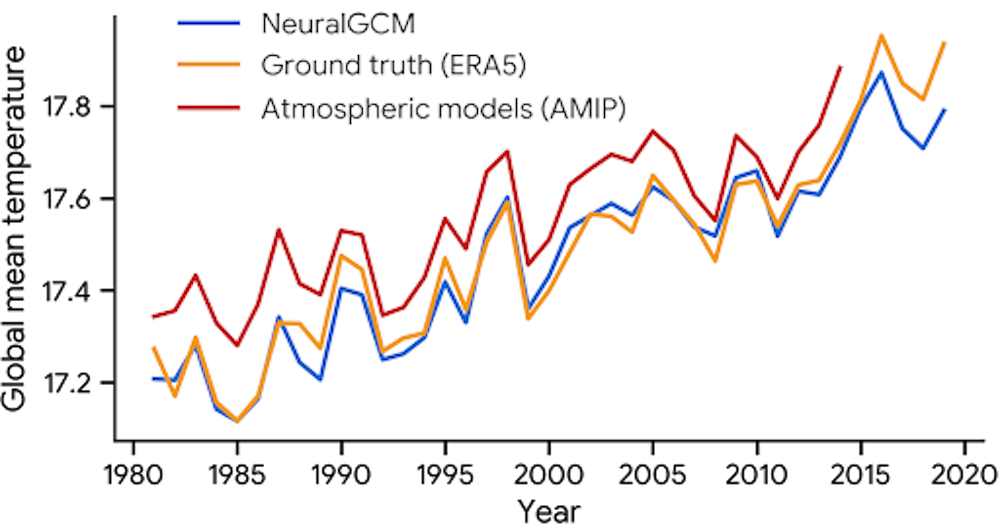
A weakness of machine learning models is that they often struggle in unfamiliar situations – or in this case, extreme or unprecedented weather conditions. To do this, a model needs to be able to generalise, or extrapolate beyond the data it was trained on.
NeuralGCM appears to be better at this than other machine learning models, because its physics-based core provides some grounding in reality. As Earth’s climate changes, unprecedented weather conditions will become more common, and we don’t know how well machine learning models will keep up.
Nobody is actually using machine learning-based weather models for day-to-day forecasting yet. However, it is a very active area of research – and one way or another, we can be confident that the forecasts of the future will involve machine learning.
References
- ^ published in Nature (www.nature.com)
- ^ WeatherBench 2 (arxiv.org)
- ^ Pangu (www.nature.com)
- ^ GraphCast (www.science.org)
- ^ reportedly (www.wired.com)