Non-diabetics are buying continuous glucose monitors – but are there actually any health benefits?
- Written by: Amy-Lee Bowler, Lecturer, School of Health, Nutrition & Dietetics, University of the Sunshine Coast
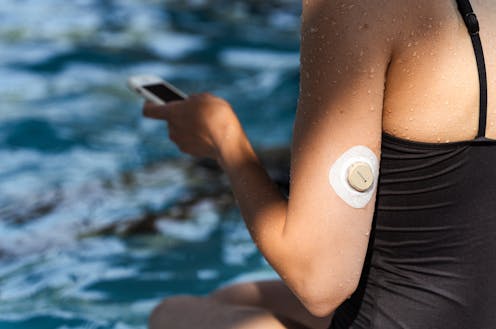
Many people living with diabetes use continuous glucose monitors (CGMs) to track their blood sugar levels. These small devices, often attached to the back of your upper arm or abdomen, send data to an app on your phone. This allows you to see, in near real-time, how your blood sugar levels spike or drop depending on what you eat or how active you have been.
The benefits for people living with diabetes are obvious, as failing to keep abreast of blood sugar levels can be dangerous. But these devices are increasingly being advertised as health aids to the broader community, including health-conscious non-diabetics and elite athletes.
But our own research[1] has found using these pricey devices provides little benefit for healthy athletes without diabetes. And there’s very little research[2] to support their use in healthy active people with normal glucose control.
That said, there are several areas which warrant further research.
Do these devices benefit athletes without diabetes?
If your blood sugar levels drop below normal range (known as hypoglycaemia) during endurance exercise, your athletic performance suffers.
So it’s easy to see why it might seem logical to track blood glucose in real time during endurance exercise. Many assume this data could signal when it’s time to consume more carbohydrates during or after exercise. Carbs help maintain your blood sugar levels, fuelling your body to ensure it has enough energy to complete the session.
However, glucose regulation during exercise is incredibly complex. It is influenced by a range of factors such as how much and what you eat or drink, recovery and stress. Even exercise can sometimes make your blood sugar readings go up. Results from current studies[3] have reported[4] mixed[5] findings[6] when exploring fuelling practices (meaning what or how they eat and drink).
Despite enthusiastic marketing and athlete testimonials about the use of continuous glucose monitors, our research[7] concluded there’s not enough clear evidence to support the use of continuous glucose monitors as a tool to improve an athlete’s fuelling practices
We need more research before we can promote these devices as a useful addition to the athlete toolbox.
What are the possible downsides of using continuous glucose monitors?
Using continuous glucose monitors presents several practical limitations.
First, they’re expensive. These monitors may cost around A$90-$100 per fortnight (as monitors last a maximum of 14 days) and may require costly subscriptions to certain mobile apps.
They can also be knocked out of place if you’re training, in competition, sweating, or even doing everyday tasks such as showering.
It’s also easy to misinterpret the data, which can cause unnecessary anxiety. Our initial studies[8] stress the importance of working with a sports nutrition professional when wearing a continuous glucose monitor to ensure you’re not misinterpreting the data.
Elite athletes may also find their sport’s governing body has restrictions around these devices. For instance, the world governing body for sports cycling, Union Cycliste International[9], has banned the use of continuous glucose monitors during sanctioned races.
Healthy people obsessing over blood sugar readings
As these devices make glucose readings available 24 hours a day, it’s also easy to end up obsessing over the data.
This can cause people to make unnecessary and overly strict changes to eating behaviours, leading to what some doctors have termed “glucorexia”.
It’s quite natural for your blood glucose to go up in response to eating carbohydrate-rich foods and fluids.
Alarmingly, there are influencers suggesting glucose should never “spike” and should always remain within a very tight range, even during the window immediately after meals.
In fact, it is prolonged increases in glucose levels outside of normal range that are the concern to health and wellbeing.
This underscores the danger of people without robust nutrition and physiology knowledge misinterpreting data from continuous glucose monitors.
If you’re active and plan to trial a continuous glucose monitoring device, you should consider consulting an accredited sports dietition[10] so you’re properly informed about what’s a normal response.
More research is needed
Given the utility of continuous glucose monitors and the fact they can be worn by athletes while training and resting, we have started to explore whether data from these monitors can help elite athletes adjust their diet in response to exercise.
In our studies, we have been particularly interested in tracking how data from continuous glucose monitors changes in response to a day of training and eating. They may also be useful for exercise scientists trying to understand whether an athlete has been overtraining.
But the fact is, most people are not elite athletes.
Ordinary people who have the cash to splash on these devices should understand there’s not much research showing a benefit to healthy individuals using continuous glucose monitors.
If you are particularly concerned about your own blood sugar levels, we recommend seeing a GP and/or a dietitian. That’s better than stressing about and scrutinising yet another data set that isn’t yet particularly useful.
References
- ^ research (journals.humankinetics.com)
- ^ very little research (onlinelibrary.wiley.com)
- ^ studies (www.mdpi.com)
- ^ reported (www.mdpi.com)
- ^ mixed (www.sciencedirect.com)
- ^ findings (journals.humankinetics.com)
- ^ research (pubmed.ncbi.nlm.nih.gov)
- ^ initial studies (pubmed.ncbi.nlm.nih.gov)
- ^ Union Cycliste International (www.cyclingnews.com)
- ^ accredited sports dietition (www.sportsdietitiansaustralia.com.au)