3 ways schools can improve STEM learning for Black students
- Written by: James Holly Jr., Assistant Professor of Urban STEM Education, Wayne State University
Black people make up just 9%[1] of the STEM workforce in the U.S. As a scholar[2] who studies how STEM educators can more effectively reach Black students, I want to help all people develop an understanding of how anti-Black racism[3] is a significant barrier for Black students learning STEM.
Many scholars[4] have argued that our current ways of teaching STEM are bad for everyone because only the experiences and contributions of white people are discussed, but the negative effects are greater[5] for Black people. Teachers frequently question the intellectual ability of Black students and prevent them from using their cultural worldviews[6], spirituality[7] and language in the STEM learning setting.
Still, Black people continue to boost STEM knowledge across the world. It is time to generate new teaching practices in STEM that affirm Black students in a way that connects with their lives.
1. Talk about Black excellence
The projection of ideas about who can who can pick up STEM concepts is important. Research has shown that many people think of engineers as white men[8]; therefore, seeing Black STEM professionals in person or via media representation can build inspiration among Black youths.
Although Black representation is essential, it alone won’t address the barriers Black students face[9]. These barriers include racial stereotyping[10], stressful academic culture[11] and other social and cultural factors. Some of these issues are not unique to Black people, but together they can create a particularly harmful experience for Black students. When teachers celebrate the successes of Black people in STEM, they can also discuss the resources and opportunities these individuals had or did not have while navigating racism.
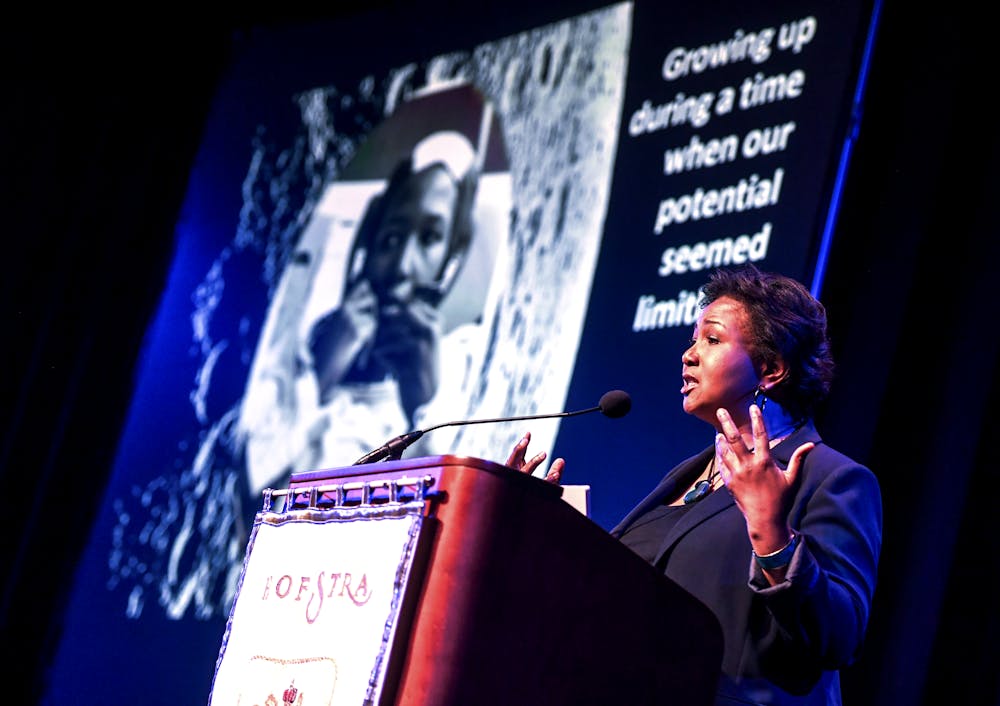 In 1992, Mae C. Jemison became the first Black woman to go into space.
Thomas A. Ferrara/Newsday RM via Getty Images[12]
In 1992, Mae C. Jemison became the first Black woman to go into space.
Thomas A. Ferrara/Newsday RM via Getty Images[12]
Many Black people throughout history have achieved advanced STEM knowledge. Dr. Patricia Bath[13], an ophthalmologist who developed laser technology used in treating cataracts, and Steven Townsend[14], who has advanced awareness of the benefits of breastfeeding, are just two examples. But Black contributions to STEM[15] predate American enslavement. Recalling this history[16] normalizes Black success across STEM disciplines.
Educators must be mindful of how they tell Black success stories in STEM. When educators reduce examples of Black excellence to just a few people, it perpetuates the myth of Black exceptionalism[17], the idea that Black people who are capable of success are rare. Individual success stories can also portray these people as being successful without assistance or serve as limited representations. Instead, teachers can share varied examples of successful Black scientists, technologists, engineers and mathematicians, including local residents and family members of their students.
2. Emphasize social skills
Although STEM professions require both social and technical knowledge, technical skills are typically valued more[18] than social skills.
Math[19] and science[20] instruction often encourage competition and rigor, which constrains students’ ability to value differences in experience, style and problem-solving approaches. This also limits students’ ability to see how math and science knowledge can solve social problems[21]. Furthermore, traditional math[22] and science[23] teaching has punished Black students for how they speak[24] and live[25]. This happens when teachers focus more on using scientific language than on displaying scientific understanding[26]. Therefore, many Black students become disengaged and lose interest.
STEM education in its current form pushes Black students away[27] instead of addressing the racial and socioeconomic problems[28] within STEM classrooms and broader society.
Black youths tend to have a strong sense of social realities and a “soulfulness[29]” that causes them to focus more on people than objects. STEM educators can train Black youths to utilize their emotional strengths in designing problem-solving technologies that are both effective and humane. For example, Black-centered design[30], a race-conscious application of human-centered design[31], allows Black people to use their cultural knowledge to provide scientific solutions to problems in their community. However teachers choose to do it, Black identity and culture should be seen as an asset to STEM education and careers[32].
3. Teach with sociopolitical awareness
 Demonstrators hold Black Lives Matter signs during the ‘Justice for George Floyd’ march in 2021.
Kerem Yucel/AFP via Getty Images[33]
Demonstrators hold Black Lives Matter signs during the ‘Justice for George Floyd’ march in 2021.
Kerem Yucel/AFP via Getty Images[33]
An abundance of resources[34] can help teachers develop curriculum that highlights the ways culture influences[35] how we learn and practice STEM. One example is The Woke STEM Teacher[36], a website where educators can get tools to include social justice topics in their STEM curriculum.
Teachers can design or use enjoyable exercises that prompt students to use STEM knowledge to solve problems relevant to their lives outside of the classroom. This allows opportunities for students’ communities[37] to be used as spaces for STEM learning.
Also, the creativity of Black students may look different from that of other students, so it is important to develop a supportive[38] approach. Educators have used hip-hop[39], cosmetology[40], and double-Dutch[41] to demonstrate Black intelligence in STEM.
I believe these simple steps are powerful ways to shift STEM education toward better appreciating and elevating the knowledge and contributions of Black people in STEM.
[Over 106,000 readers rely on The Conversation’s newsletter to understand the world. Sign up today[42].]
References
- ^ 9% (www.pewresearch.org)
- ^ scholar (scholar.google.com)
- ^ anti-Black racism (doi.org)
- ^ Many scholars (www.rutgersuniversitypress.org)
- ^ negative effects are greater (doi.org)
- ^ prevent them from using their cultural worldviews (doi.org)
- ^ spirituality (doi.org)
- ^ engineers as white men (eandt.theiet.org)
- ^ barriers Black students face (www.youtube.com)
- ^ racial stereotyping (emerging-researchers.org)
- ^ stressful academic culture (www.ncbi.nlm.nih.gov)
- ^ Thomas A. Ferrara/Newsday RM via Getty Images (www.gettyimages.com)
- ^ Dr. Patricia Bath (www.sciencebuddies.org)
- ^ Steven Townsend (www.prolacta.com)
- ^ Black contributions to STEM (youtu.be)
- ^ Recalling this history (jaamejournal.scholasticahq.com)
- ^ myth of Black exceptionalism (systemicjusticeblog.wordpress.com)
- ^ typically valued more (doi.org)
- ^ Math (www.chronicle.com)
- ^ science (onlinelibrary.wiley.com)
- ^ problems (scholarworks.iupui.edu)
- ^ math (www.google.com)
- ^ science (onlinelibrary.wiley.com)
- ^ speak (www.tandfonline.com)
- ^ live (www.worldcat.org)
- ^ scientific understanding (doi.org)
- ^ students away (doi.org)
- ^ racial and socioeconomic problems (doi.org)
- ^ soulfulness (www.jstor.org)
- ^ Black-centered design (tcaalf.com)
- ^ human-centered design (www.designkit.org)
- ^ asset to STEM education and careers (www.jstor.org)
- ^ Kerem Yucel/AFP via Getty Images (www.gettyimages.com)
- ^ resources (www.wpi.edu)
- ^ culture influences (stemteachingtools.org)
- ^ The Woke STEM Teacher (www.thewokestemteacher.com)
- ^ communities (www.naeyc.org)
- ^ supportive (jaamejournal.scholasticahq.com)
- ^ hip-hop (doi.org)
- ^ cosmetology (www.worldcat.org)
- ^ double-Dutch (invention.si.edu)
- ^ Sign up today (theconversation.com)
Read more https://theconversation.com/3-ways-schools-can-improve-stem-learning-for-black-students-156094