


tiny crystal films could make night vision an everyday reality
- Written by: Rocio Camacho Morales, Postdoctoral fellow, ARC Center of Excellence for Transformative Meta-Optical Systems (TMOS), Australian National University
It’s a familiar vision to anyone who has watched a lot of action movies or played Call of Duty: a ghostly green image that makes invisible objects visible. Since the development of the first night-vision devices in the mid-1960s, the technology has captured the popular imagination.
Night vision goggles, infrared cameras and other similar devices detect infrared light reflected from objects or rather detect infrared light emitted from objects in the form of heat. Today these devices are widely used not only by the military, but also by law enforcement and emergency services, the security and surveillance industries, wildlife hunters, and camping enthusiasts.
But current technology is not without its problems. Commercial infrared cameras block visible light, disrupting normal vision. The gear is bulky and heavy, and requires low temperatures — and, in some cases, even cryogenic cooling — to work.
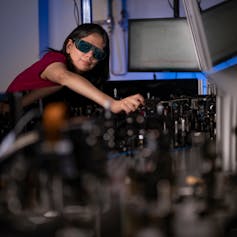 Rocio Camacho Morales in the optics lab.
Jamie Kidston / ANU, Author provided
Rocio Camacho Morales in the optics lab.
Jamie Kidston / ANU, Author provided
We have proposed a new technology that uses ultra-thin layers of nanocrystals to make infrared light visible, addressing many of the longstanding problems with current devices. Our research is published in Advanced Photonics[1].
Our eventual goal is to produce a light, film-like layer that can sit on glasses or other lenses, powered by a tiny built-in laser, allowing people to see in the dark.
Conventional infrared detection
Commercial infrared cameras convert infrared light to an electric signal, which is then shown on a display screen. They require low temperatures, because of the low energy and frequency of infrared light. This makes conventional infrared detectors bulky and heavy – some security personnel have reported chronic neck injury due to regular use of night vision goggles[2] .
Another drawback of the current technology is that it blocks the transmission of visible light, thereby disrupting normal vision. In some cases, infrared images could be sent to a display monitor, leaving normal vision intact. However, this solution is not feasible when users are on the move.
Read more: Looking at the universe through very different 'eyes'[3]
All-optical alternatives
There are also some all-optical alternatives[4], which do not involve electrical signals. Instead, they directly convert infrared light into visible light. The visible light can then be captured by the eye or a camera.
These technologies work by combining incoming infrared light with a strong light source – a laser beam – inside a material known as “nonlinear crystal”. The crystal then emits light in the visible spectrum.
However, nonlinear crystals are bulky and expensive, and can only detect light in a narrow band of infrared frequencies.
Metasurfaces provide the solution
Our work advances this all-optical approach. Instead of a non-linear crystal, we set out to use carefully designed layers of nanocrystal called “metasurfaces”. Metasurfaces are ultra-thin and ultra-light, and can be tweaked to manipulate the color or frequency of the light that passes through them.
This makes metasurfaces an attractive platform to convert infrared photons to the visible. Importantly, transparent metasurfaces could enable infrared imaging and allow for normal vision at the same time.
Our group set out to demonstrate infrared imaging with metasurfaces. We designed a metasurface composed of hundreds of incredibly tiny crystal antennas made of the semiconductor gallium arsenide.
This metasurface was designed to amplify light by resonance at certain infrared frequencies, as well as the frequency of the laser and the visible light output. We then fabricated the metasurface and transferred it to a transparent glass, forming a layer of nanocrystals on a glass surface.
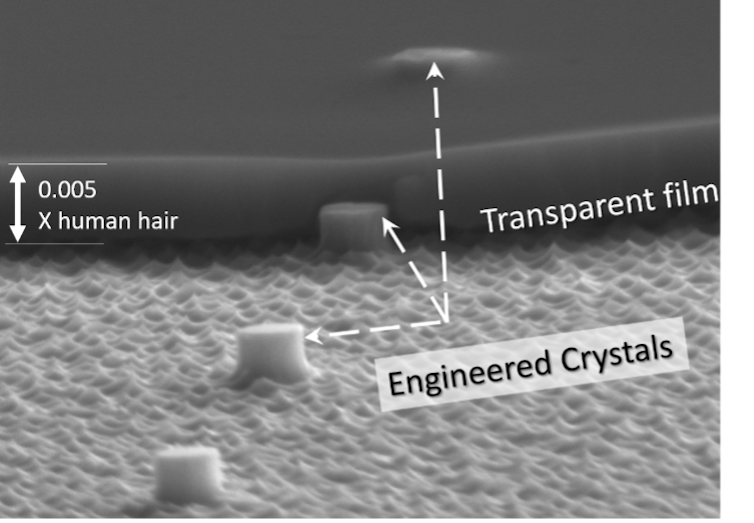 A scanning electron microscope image shows the nanocrystal structures of the metasurface used to make infrared light visible.
Mohsen Rahmani/ NTU, Author provided
A scanning electron microscope image shows the nanocrystal structures of the metasurface used to make infrared light visible.
Mohsen Rahmani/ NTU, Author provided
To test our metasurface, we illuminated it with infrared images of a target and saw that the infrared images were converted to visible green images. We tested this with various positions of the target, and also with no target at all — so we could see the green emission of the metasurface itself. In the images obtained, the dark stripes correspond to the infrared target, surrounded by the green visible emission.
Despite different parts of the infrared images being up-converted by independent nanocrystals composing the metasurface, the images were well reproduced in visible light.
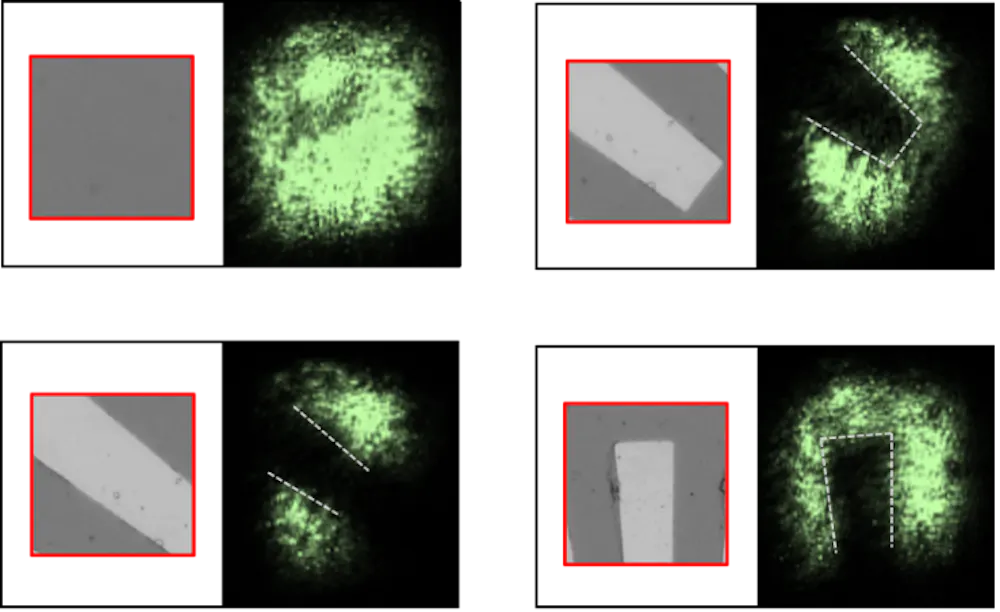 These pairs of images show the shape of the infrared target at left and the visible-light view through the metasurface at right.
Rocio Camacho Morales, Author provided
These pairs of images show the shape of the infrared target at left and the visible-light view through the metasurface at right.
Rocio Camacho Morales, Author provided
While our experiment is only a proof of concept, this technology can in principle do many things that are not possible with conventional systems, such as a broader angle of view and multi-colour infrared imaging.
The future of metasurfaces in novel technologies
The demand for detecting infrared light, invisible to human eyes, is constantly growing, due to a wide variety of applications beyond night vision. The technology could be used in the agricultural industry to help monitor and maintain food quality control, and in remote sensing techniques such as LIDAR – a technology that is helping to map natural and manmade environments.
In a wider context, the use of metasurfaces to detect, generate and manipulate light is booming. Harnessing the power of metasurfaces will bring us closer to technologies such as real-time holographic displays, artificial vision for autonomous systems, and ultra-fast light-based wifi.
Read more: Small and bright: what nanophotonics means for you[5]
References
- ^ Advanced Photonics (doi.org)
- ^ regular use of night vision goggles (doi.org)
- ^ Looking at the universe through very different 'eyes' (theconversation.com)
- ^ alternatives (doi.org)
- ^ Small and bright: what nanophotonics means for you (theconversation.com)










