Is it more infectious, and can it escape vaccines? A virologist explains
- Written by: Adam Taylor, Early Career Research Leader, Emerging Viruses, Inflammation and Therapeutics Group, Menzies Health Institute Queensland, Griffith University
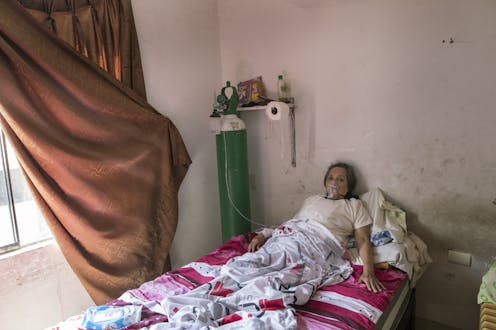
The Lambda coronavirus variant was first reported in Peru in December 2020[1], according to the World Health Organization (WHO).
It then spread to multiple countries in South America[2], where it currently accounts for over 20% of detected variants[3].
One case of Lambda was recorded[4] in hotel quarantine in New South Wales in April.
Lambda has now been detected in more than 20 countries around the globe[5].
The European Centre for Disease Prevention and Control has designated[6] Lambda a “variant under monitoring”, and Public Health England regards[7] it as a “variant under investigation”.
In June this year, the WHO designated[8] it a “variant of interest”. This is due to mutations thought to affect the virus’ characteristics, such as how easily it’s transmitted. Though it’s not yet concerning enough for the WHO to deem it a “variant of concern”, such as Alpha or Delta[9].
Epidemiological evidence is still mounting as to the exact threat Lamda poses. So, at this stage more research is required to say for certain how its mutations impact transmission, its ability to evade protection from vaccines, and the severity of disease.
Preliminary evidence suggests Lambda has an easier time infecting our cells and is a bit better at dodging our immune systems. But vaccines should still do a good job against it.
Is Lambda more infectious? And can it escape vaccines?
Mutations affecting the spike protein[10] of the SARS-CoV-2 virus can increase infectivity[11], which is the ability of the virus to infect cells.
What’s more, as many of the coronavirus vaccines currently available or in development are based on the spike protein, changes to the spike protein in new variants can impact vaccine effectiveness[12]
Lambda contains multiple mutations[13] to the spike protein.
One mutation (F490S) has already been associated[14] with reduced susceptibility to antibodies generated in patients who had recovered from COVID. This means antibodies generated from being infected with the original Wuhan strain of COVID aren’t quite as effective at neutralising Lambda.
Another Lambda mutation (L452Q) is at the same position in the spike protein as a previously studied mutation found in the Delta variant (L452R). This mutation in Delta not only increases[15] the ability of the virus to infect cells, but also promotes immune escape meaning the antibodies vaccines generate are less likely to recognise it.
Both mutations F490S and L452Q are in the “receptor binding domain”, which is the part of the spike protein that attaches to our cells.
Read more: Why is Delta such a worry? It's more infectious, probably causes more severe disease, and challenges our vaccines[16]
Preliminary data[17] on the Lambda spike protein suggests it has increased infectivity, meaning it’s more easily able to infect cells than the original Wuhan virus and the Alpha and Gamma variants. These early studies also suggest antibodies generated in people receiving the CoronaVac vaccine (developed by Chinese biotech Sinovac) were less potent[18] at neutralising the spike protein of Lambda than they were the Wuhan, Alpha or Gamma variants.
It’s worth noting infectivity is not the same as being more infectious between people. There’s not enough evidence yet that Lambda is definitely more infectious, but the mutations it has suggest it’s possible.
A separate small study[19], also yet to be reviewed by the scientific community, suggests the L452Q mutation in the Lambda spike protein is responsible for its increased ability to infect cells. Like the L452R mutation in the Delta variant, this study suggests the L452Q mutation means Lambda may bind more easily to the “ACE2 receptor[20]”, which is the gateway for SARS-CoV-2 to enter our cells.
This preliminary study[21] suggests Lambda’s spike protein mutations reduce the ability of antibodies generated by both Pfizer and Moderna’s vaccines to neutralise the virus. Also, one mutation was shown[22] to resist neutralisation by antibodies from antibody therapy to some extent.
Read more: What monoclonal antibodies are – and why we need them as well as a vaccine[23]
However, these reductions were moderate. Also, neutralising antibodies are only one part of a protective immune response elicited by vaccination. Therefore, these studies conclude[24] currently approved vaccines and antibody therapies can still protect against disease caused by Lambda.
Is it more severe?
A risk assessment[25] released by Public Health England in July concedes there’s not yet enough information on Lambda to know whether infection increases the risk of severe disease.
The risk assessment also recommends ongoing surveillance in countries where both Lambda and Delta are present be implemented as a priority. The aim would be to find out whether Lambda is capable of out-competing Delta.
With ongoing high levels of transmission of the coronavirus, there’s a continued risk of new variants emerging[26]. The Lambda variant again highlights the risk of these mutations increasing the ability of SARS-CoV-2 to infect cells or disrupt existing vaccines and antibody drugs.
The WHO will continue to study Lambda to determine whether it has the potential to become an emerging risk to global public health and a variant of concern.
References
- ^ in December 2020 (www.who.int)
- ^ multiple countries in South America (www.medrxiv.org)
- ^ over 20% of detected variants (covid19dashboard.regeneron.com)
- ^ recorded (www.abc.net.au)
- ^ more than 20 countries around the globe (www.gisaid.org)
- ^ designated (www.ecdc.europa.eu)
- ^ regards (www.gov.uk)
- ^ designated (www.who.int)
- ^ Delta (theconversation.com)
- ^ spike protein (theconversation.com)
- ^ can increase infectivity (www.nature.com)
- ^ can impact vaccine effectiveness (www.sciencedirect.com)
- ^ multiple mutations (covariants.org)
- ^ been associated (www.sciencedirect.com)
- ^ increases (www.sciencedirect.com)
- ^ Why is Delta such a worry? It's more infectious, probably causes more severe disease, and challenges our vaccines (theconversation.com)
- ^ Preliminary data (www.medrxiv.org)
- ^ less potent (www.medrxiv.org)
- ^ small study (www.biorxiv.org)
- ^ ACE2 receptor (theconversation.com)
- ^ This preliminary study (www.biorxiv.org)
- ^ was shown (www.biorxiv.org)
- ^ What monoclonal antibodies are – and why we need them as well as a vaccine (theconversation.com)
- ^ conclude (www.biorxiv.org)
- ^ risk assessment (assets.publishing.service.gov.uk)
- ^ risk of new variants emerging (www.ncbi.nlm.nih.gov)