Why students learn better when they move their bodies – instead of sitting still at their desks
- Written by: Katie Headrick Taylor, Associate Professor of Learning Sciences and Human Development, University of Washington
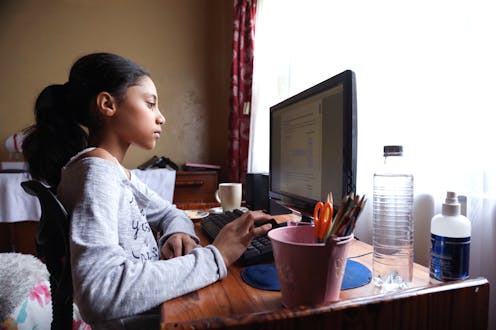
My son’s kindergarten teachers, holding class on Zoom last year, instructed: “Eyes watching, ears listening, voices quiet, bodies still.” However, I noticed my 6-year-old’s hands would stay busy with items found around our house, building with Legos, shaping clay or doodling with a crayon.
While some might describe this child as being “off task,” research suggests[1] his manipulation of materials actually aroused his mind, allowing it to focus on the required task.
As a parent[2] of two school-aged children and a professor and researcher of learning with technology[3], I believe current models of remote education are inefficient for learning, teaching and productivity.
That’s because sitting in front of a computer screen subdues, or completely detaches people from, many of the sense-making abilities of their bodies[4]. To learn most efficiently, our minds depend on the movement of our bodies[5], working with a variety of tools[6], being in dynamic places[7] and having our collaborators nearby[8].
The body’s role in thinking
Most notably, remote learning assumes that as long as the mind is engaged, it’s fine if the body stays still. But this argument is backward[9].
Research from embodied cognition – the study of the body’s role in thinking – shows that the body must first be interacting with the world to activate and open up the mind for learning[10].
That’s why, for example, students working with a variety of tools and materials during a learning activity are better able to grasp abstract concepts[11], such as gravitational acceleration or fractions.
To ask students to sit still while performing their work actually increases their cognitive load[12], or the burden on the mind. It requires them to concentrate on quieting their bodies, which are seeking out avenues for sense-making, as well as on the primary task that fixes them to their desk or digital screen.
As psychologists Christine Langhanns and Hermann Müller[13] concluded from studies of people solving math problems, “Sitting quietly is not necessarily the best condition for learning in school.”
Learning from our environment
Humans’ internal thoughts are extensions of the world around them. The technologies and tools they use[14], the people they collaborate with[15], the walk they take[16] to school or work, all evoke feelings in the body. Their minds then assemble these feelings[17], making meaning or thoughts that are informed by past experiences.
In this way, thoughts are iterative[18]. People sense their way through current moments while bringing to bear what they have learned over the body’s accumulated history[19]. Learning to safely cross the road, for instance, takes practice. Over time, the brain organizes input from the senses to recognize a good time for crossing.
Importance of gesture
Gesture is yet another essential use of the body for thinking and learning[20].
Not only do people’s hand movements, head turns and shrugs add nuance and emphasis to words spoken to listeners, gestures help speakers form thoughts into words before speaking them[21].
In problem-solving scenarios, research shows[22] that for many math learners, their gestures show they understand strategies before they can articulate those solutions through speech. In this way, educators trained to look for and understand gesture can see a learner’s process and progress in understanding concepts before a student is able to translate that understanding to speech or a written test.
Additionally, educators and other experts can use gesture to more efficiently explain concepts[23] to students and novices. Gestures make abstractions visible, giving them temporary form.
A view of the whole person, therefore, facilitates learning from one another. But that’s a stark contrast to a year spent seeing only the faces of fellow students and teachers, or just a blank box.
[Get the best of The Conversation, every weekend. Sign up for our weekly newsletter[24].]
Get ready to move
Some students will remain online this school year – due to health or other concerns – while others will return to in-person classrooms. I believe both models of school can better incorporate the body to support learning. The following tips are for educators designing remote or in-person classes, though parents and students can also encourage and help sustain an active classroom culture.
Normalize movement during classes, not just during movement breaks. For instance, make a neighborhood walk the mode of inquiry for the day’s science lesson. Ask students to bring back their observations to the whole group.
Begin every class with time to assemble different materials to think and work with, such as notebooks and different kinds of paper, various writing and drawing instruments, putty and blocks. Incorporate interaction with these tools throughout the lesson.
Encourage and use gestures. If online, invite camera use, and back away to give students a wider view.
Build in time for students to tune in to how their body is feeling as a window into their emotional state.
Provide opportunities for iteration, practicing a task in different contexts and with different tools and people that engage the body in different ways. The content or big idea stays the same, but how and with whom students engage shifts.
If online, try out videoconferencing platforms like Ohyay[25] that try to replicate physical closeness and movement in a virtual space.
Consider the classroom as extending out into the school campus and neighborhood[26]. Allowing students to experience a familiar location in a different way, with their classmates and teacher, can evoke new perspectives and thoughts.
Teachers, parents and students can all change their expectations of what being “on task” looks like. Walking, running or dancing may not seem related to a particular task at hand, but these activities often help people do their best thinking[27]. Activating the body activates the mind, so “seat time[28]” might better be titled “activity time.”
References
- ^ research suggests (www.additudemag.com)
- ^ As a parent (www.pangyrus.com)
- ^ a professor and researcher of learning with technology (education.uw.edu)
- ^ sense-making abilities of their bodies (doi.org)
- ^ movement of our bodies (doi.org)
- ^ variety of tools (www.naeyc.org)
- ^ dynamic places (thinkingcity.org)
- ^ collaborators nearby (doi.org)
- ^ is backward (www.nytimes.com)
- ^ activate and open up the mind for learning (wvupressonline.com)
- ^ better able to grasp abstract concepts (doi.org)
- ^ increases their cognitive load (www.washingtonpost.com)
- ^ Christine Langhanns and Hermann Müller (doi.org)
- ^ technologies and tools they use (doi.org)
- ^ people they collaborate with (teaching.cornell.edu)
- ^ walk they take (doi.org)
- ^ assemble these feelings (www.nyu.edu)
- ^ thoughts are iterative (doi.org)
- ^ what they have learned over the body’s accumulated history (doi.org)
- ^ essential use of the body for thinking and learning (doi.org)
- ^ gestures help speakers form thoughts into words before speaking them (doi.org)
- ^ research shows (www.hup.harvard.edu)
- ^ use gesture to more efficiently explain concepts (edu.rsc.org)
- ^ Sign up for our weekly newsletter (theconversation.com)
- ^ Ohyay (ohyay.co)
- ^ school campus and neighborhood (www.youtube.com)
- ^ people do their best thinking (www.inc.com)
- ^ seat time (coloradosucceeds.org)