Headless fish and babies take centre stage during election season – but don’t let the theatre of politics distract you
- Written by: Daniel Johnston, Director of Learning and Teaching at Excelsia University College and Research Affiliate, University of Sydney
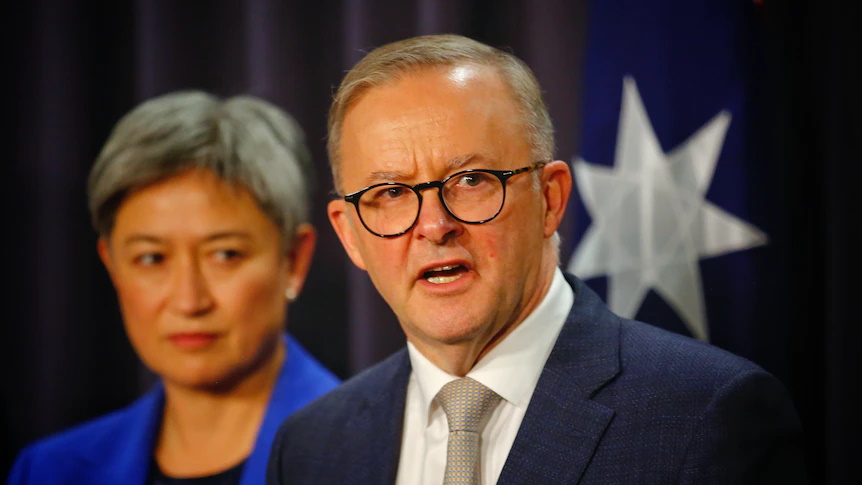
As Greens Senator Sarah Hanson-Young waved a decapitated salmon[1] dripping with blood in parliament last week, you could feel the election coming.
Hanson-Young was protesting the watering down[2] of Australia’s environmental laws aimed at preserving salmon farming in Tasmania.
Using props and orchestrated performances to provoke a response has been common throughout the history Australian politics[3]. In 2017, then treasurer Scott Morrison held out a lump of coal[4] to ridicule the opposition’s renewable energy policies. He mockingly declared:
This is coal. Don’t be afraid, don’t be scared.
Later that same year, One Nation leader Pauline Hanson wore a burqa[5] into the Senate to argue for a ban on full-face coverings – dramatically embodying her anti-Islam rhetoric.
More recently, independent members of parliament Andrew Wilkie and Bob Katter donned inflatable pig costumes[6] to criticise the major supermarkets as pigs with their snouts in the trough, given their excessive profit margins.
It’s clear Australian politicians are drawn to drama. With the election campaign in full swing, it’s worth being wary of such beguiling performances.
Visceral is memorable
The history of theatre is peppered with shocking moments, often enhanced by props[7]. Props help to provoke a visceral emotional response[8] from the audience, while blurring the boundary between reality and fiction.
In Sophocles’ ancient Greek tragedy Oedipus Rex, Oedipus exits the stage with sharp gold brooches to gorge out his eyes after discovering of his wife Jocasta’s suicide. Upon his return, his bleeding eye sockets also allude to his metaphorical blindness, having killed his own father and married his mother.
Similarly, at the end of Shakespeare’s Macbeth, the tyrant king’s severed head is brought onstage – fulfilling a deceptive prophecy foretold by the fiendish witches at the beginning of the play.
In a more contemporary example, Australian playwright Patrick White’s surrealist play Ham Funeral[9] features a ham representing gluttony, death, lust and decay, served at the wake of Mrs Lusty’s husband. We’re also shocked by a fetus from a back-alley trash can.
These are all attention-grabbing examples of how props can be much more than just the thing they represent[10].
In politics, as on stage, theatrical objects are an easy way to heighten emotions, and convey meaning and context. They can make abstract concepts feel more concrete. And even when they’re highly theatrical, they can communicate authenticity and passion – ready to go viral online.
Flags, high-vis vests[11], pints of beer[12] and babies are all common props[13] on the election campaign trail. Over time, they can lead voters to associate certain politicians with certain values and worldviews.

All the world’s a stage
As politician and activist Harvey Milk[14] (played by James Franco) declares in the 2008 biopic Milk:
Politics is theatre. It doesn’t matter if you win. You make a statement. You say, “I’m here, pay attention to me”.
Evidence suggests[15] political personas can be successfully constructed through careful attention to meaning-making processes, such as facial expressions, hand gestures and emotional rhetoric.
Take Adolf Hitler. In 1932, Hitler carefully crafted his speeches[16] and vocal delivery with Paul Devrient, an operatic tenor and director. He also worked with Heinrich Hoffmann, his official photographer, in theatre-like rehearsals to strike dramatic poses and fine-tune his body language and persuasive gestures.
His performances culminated in the Nuremberg rallies[17]. These events, choreographed[18] like a Wagnerian opera, featured monumental architecture and lighting, banners, torches and music that positioned the Führer as a mythical hero.
Bertolt Brecht famously satirised the fabricated display in his play The Resistable Rise of Artuo Ui[19], in which a washed-up Shakespearean actor teaches a Chicago gangster how to present himself as a legitimate, commanding leader.
Peek behind the curtain
Performance takes place along a continuum, from mundane everyday life, to highly-staged aesthetic enactments[20]. We’re all taking part in performances all the time, whether it’s ordering a morning coffee, or delivering Hamlet’s soliloquy at the Opera House, holding Yorick’s skull aloft.
In politics, compelling representatives hope to craft an authentic image for themselves through emotional performance – sometimes using props as framing devices[21] to signal certain moments as marked or special[22].
When Julia Gillard delivered her unexpectedly viral, off-the-cuff misogyny speech[23], or when John Howard declared[24], “We will decide who comes to this country and the circumstances in which they come”, they shifted our attention from the ordinary to the performative. They incited us to feel outrage and fear, to drive a political narrative.
The warning of theatre is that we should look through appearances, to discern the substance[25] of what’s going on.
References
- ^ waved a decapitated salmon (www.smh.com.au)
- ^ watering down (www.abc.net.au)
- ^ Australian politics (www.tiktok.com)
- ^ out a lump of coal (theconversation.com)
- ^ wore a burqa (www.theguardian.com)
- ^ donned inflatable pig costumes (www.skynews.com.au)
- ^ enhanced by props (www.google.com.au)
- ^ visceral emotional response (www.google.com.au)
- ^ Ham Funeral (meanjin.com.au)
- ^ thing they represent (www.google.com.au)
- ^ high-vis vests (theconversation.com)
- ^ pints of beer (www.theguardian.com)
- ^ babies are all common props (www.theguardian.com)
- ^ Harvey Milk (en.wikipedia.org)
- ^ Evidence suggests (www.tandfonline.com)
- ^ Hitler carefully crafted his speeches (www.google.com.au)
- ^ Nuremberg rallies (en.wikipedia.org)
- ^ choreographed (www.google.com.au)
- ^ The Resistable Rise of Artuo Ui (www.google.com.au)
- ^ highly-staged aesthetic enactments (www.google.com.au)
- ^ framing devices (www.google.com.au)
- ^ marked or special (www.google.com.au)
- ^ misogyny speech (pursuit.unimelb.edu.au)
- ^ declared (www.youtube.com)
- ^ discern the substance (stories.theconversation.com)