In dumping net zero, the Liberals have thumbed their noses at voters they need to win
- Written by: Michelle Grattan, Professorial Fellow, University of Canberra
With much talk this week about the end of the Whitlam government, Liberal conservatives might do well to read Gough Whitlam’s 1967 speech to the Victorian Labor Party, at the start of his climb to power.
Like the Liberals now, federal Labor had been trounced at the 1966 election. Whitlam was the new leader, and he took on Victorian hardliners who put ideology ahead of electability.
“Certainly, the impotent are pure,” Whitlam told the delegates at the conference, in a line that echoed down the years.
The Liberal conservatives’ success in forcing their party to dump its commitment to the net zero emissions reduction target has been a triumph of ideology over pragmatism, worthy of those 1960s Labor zealots.
Walking away from the commitment is ill-judged and politically dangerous. It’s also unnecessary.
Many political players, including in Labor, don’t think net zero by 2050 is attainable. But the timeframe is a generation away. Given that, why is it so urgent to reject the target?
Especially when, as Liberal federal director Andrew Hirst told the party room on Wednesday, among voters net zero has become a “proxy” for action on climate. Hirst did talk about possible arguments that could be mobilised if net zero was dumped. For those listening, however, his message, based on research, was clear: ditching net zero was high-risk politics. The conservatives didn’t care.
But the party, with its moderates, had to be held together. On Thursday, when the Liberal shadow ministers met, the leadership stuck a tiny plaster on the gaping wound. Bottom line: commitment to the target is out, but if net zero happened to be achieved, that would be “a welcome outcome”.
The Liberals are in a dreadful state and a climate and energy policy that’s all over the shop can only worsen things. No one thinks they can return to power in under two elections. Even for that they’d have to pick up a significant number of seats in 2028.
At present, the Coalition is on 24% primary vote (in Newspoll[1]). The Liberals will never do well with young voters, but to be competitive overall they have to at least make inroads with them. That’s to say nothing of the women’s vote, on which Labor has a stranglehold.
The Liberals have hardly any urban seats and, apart from Goldstein, the formerly Liberal teal seats stayed solidly independent at the last election.
Net zero resonates with young voters, women, urban dwellers and those in teal electorates, whether or not it is pie in the sky. By dropping it, the Liberals have delivered a slap in the face to these voters. They are saying, in effect, “you might have rejected us at two elections, but we still know better than you do”.
A commonsense voice came ahead of Wednesday’s meeting from Gisele Kapterian, who failed by a handful of votes in the traditional Liberal Sydney seat of Bradfield. It went to a teal. In an email to Liberals on Tuesday, Kapterian described herself as “a concerned Liberal, a technology executive, a former international trade lawyer, a millennial, and […] the former Liberal candidate in the most marginal seat in the country”.
She wrote, “In my experience, echoed throughout the most marginal, winnable, metropolitan seats, our party must remain firmly committed to the language of a ‘net zero’ emissions target as part of an energy policy that is differentiated from the ALP. Retreat is an electoral liability.
"My experience on the ground is that a credible, technology-focused climate policy is essential to securing the many discerning voters in key urban and suburban seats.”
What will all these constituencies take out of the new policy? That the Liberals don’t believe in net zero, that’s what. Not that they have found some great ways to bring down power bills.
And who is going to sell persuasively the messy new policy? Not Sussan Ley, who struggled with its contradictions at her news conference on Thursday. Far from being a conviction politician, Ley didn’t even give a personal view to Wednesday’s party meeting. Nor is the affable energy spokesman, Dan Tehan, likely to convince many people. He looks out of his depth.
The divisions in the party will remain obvious. Even if the moderates stay in line, their views are on the record because they have previously been talking their heads off – as have the conservatives.
The loud voices in the Nationals, who’ve had a massive win, leading the Coalition by the nose, will come across as clear and unconflicted. Can anyone miss the irony that Barnaby Joyce, thought to be on his way to One Nation, has had a triumphant hurrah?
To return to Whitlam: he led from the front and imposed himself on his party, even willing to risk expulsion. Ley is at the opposite end of the leadership spectrum.
Despite once having extolled net zero, Ley decided a while ago to go with the flow in the interests of preserving her job. Was there an alternative? A brave (maybe crazy brave) leader might have stepped out and argued for a position.
Yes, given the dominance of the conservatives (including in the party branches), she might have been rolled on the issue and, sooner rather than later, as leader. But at least she would have stood for something, and gone down fighting.
As for losing the leadership, most Liberals see that as inevitable – it’s only a matter of timing.
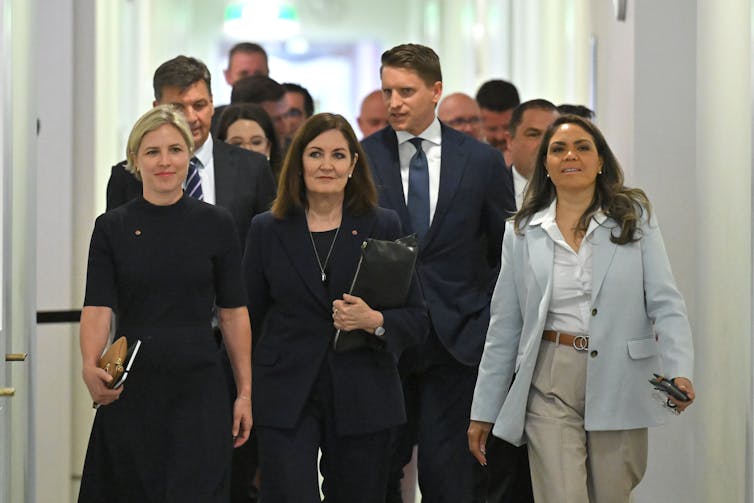
Some point out it would look bad to bring down the party’s first woman leader. Let it be recorded, however, that a couple of high-profile Liberal women are among those with political knives out for Ley. The front row of the conservative phalanx who marched into the party meeting comprised three women: Jacinta Nampijinpa Price, Sarah Henderson and Jessica Collins.
The conservatives are in charge of the Liberal Party and, when it suits them, they will install a conservative leader. The problem for him (and it will be a him) is he will be operating in an Australian electorate that is progressive, both now and for the foreseeable future.
References
- ^ in Newspoll (www.theaustralian.com.au)