COVID has brought Auslan into the spotlight, but it would be wrong to treat the language as a hobby or fad
- Written by: Jessica Kirkness, Postdoctoral research fellow, Macquarie University
As government COVID updates have become a daily part of our lives over the past 12 months, so too has the sight of sign language interpreters on our screens.
This has understandably had a huge impact on the lives of Deaf Australians — it means they have access to critical health and safety information in their first language, Australian Sign Language, or Auslan[1].
Read more: Explainer: what is sign language?[2]
But this upswing in accessibility has had other unexpected impacts.
The Deaf Society and Deaf Services reports enrolments in Auslan courses have risen by more than 400% since the pandemic began. They attribute this directly to COVID and the increased visibility of signing on the national stage.
But we need to make sure the increased focus on Auslan is more than a mere curiosity or trend. We should use the opportunity to see Auslan recognised as an official language.
The personal and the political
My grandparents are deaf. I grew up signing[3] as a child but stopped during my early school years. Though proud of their Deaf culture, my grandparents felt signing in public drew attention to their difference. It made them targets for ridicule.
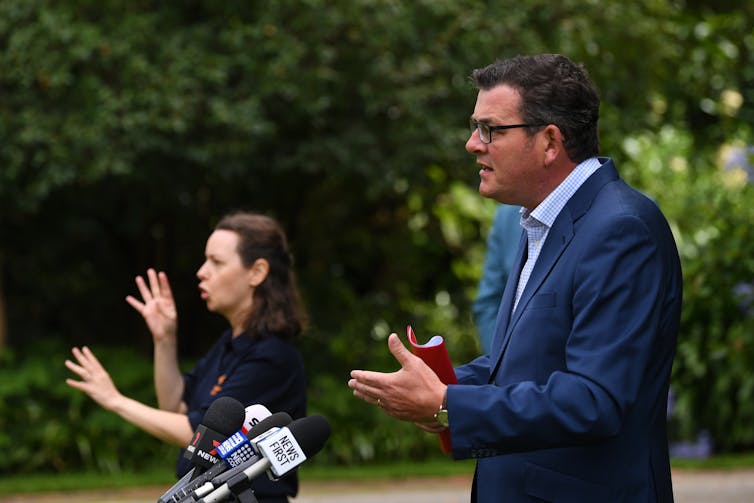 Auslan interpreters have become a regular feature at COVID and emergency press conferences.
James Ross/ AAP
Auslan interpreters have become a regular feature at COVID and emergency press conferences.
James Ross/ AAP
During my childhood, I heard people use the word “spastic” to describe their movements. Now, when I sign in public or talk about my grandparents, people sit upright. They mention the interpreters they’ve seen on the news or in viral videos[4]. Some exclaim about the beauty of the language and liken it to a dance.
They’re not wrong. But there is an alarming tokenism to some people’s interest. Some interpreters have gained a cult-like following as a result of their regular appearances at press conferences. One Melbourne interpreter was recently dubbed a “quiet Adonis[5]” after he attracted the attention of admirers online.
But Auslan is more than a faddish hobby, like crocheting or baking sourdough. It is a vital means of communication and a point of cultural pride.
Deaf people have long felt the double-edged sword of other people’s intrigue. When interpreters appear in concerts and live performances, their videos go viral[6]. The unintended but uncomfortable truth here is that while sign is thrust to the fore, Deaf people often remain in the background.
Still not a national language
About 30,000 deaf people[7] use Auslan to communicate. But widespread Auslan coverage is a relatively new phenomenon. Though in many states, interpreters have appeared in emergency broadcasts since 2011, others have only recently adopted the practice. There is no legislation[8] that mandates Auslan interpreting in news programs.
While this is exclusionary, it is not unsurprising, given Auslan is still not a national language. The Australian government recognised it as a “community language[9]” in 1987, and it will be counted in the 2021 Census[10] as a language option, but the deaf community continues to lobby for greater recognition.
Full status for Auslan as an official language — like in New Zealand — would provide both legal safeguards and important recognition for Deaf Australians.
Auslan’s fraught history
The fact Australia lags behind in this regard speaks to the the fraught and overlooked history[11] of Deaf people in our nation. For most of the 19th and 20th centuries, signing was banned in schools for deaf children.
For more than 200 years, deaf people were seen as “unfortunates” in need of cure and were forced to rely on speech, lip-reading, and auditory training — where children were taught to listen using the little hearing they had. This is because sign language was deemed primitive and deaf people were told to put their hands away.
Auslan is the first language of many Deaf Australians and while captions and lip-reading are handy tools, they’re no substitute for sign, especially since captions are often riddled with errors.
What does it mean to be an ally?
For members of the Australian Deaf community, this is a critical time. Advocates continue to lobby[12] MPs and broadcasters for interpreting to be included in all press conferences, emergency broadcasts and breaking news, so Deaf Australians can access vital information. They also want to see wider recognition and use of sign language.
Prime Minister Scott Morrison[13], Labor leader Anthony Albanese[14] and Greens senator Larissa Waters[15] are among MPs who have made videos in Auslan in support of International Day of Sign Languages.
The Wiggles: Say the Dance, Do the Dance in Auslan.Emma Wiggle is also a high profile supporter of the Deaf community, regularly including Auslan[16] in her programs and performances.
Participation of this kind provides great opportunity, but equally, raises the difficult question of what it means to be an ally. More than learning a few phrases, it’s crucial that we support the campaign for meaningful recognition of Auslan.
Recognise deaf people, not just their language
In addressing the new-found interest in Auslan, The Deaf Society stresses the importance of showing respect to Deaf people and their language. This means if you are learning Auslan, signing up with a registered training organisation where Deaf history is part of the course.
But even more important is that Deaf people’s lives and their stories are recognised in the public eye — not just their language.
The Deaf community is mourning the shock loss of Deaf Society and Deaf Services executive manager Leonie Jackson, who died earlier this month[17]. Leonie was a tireless advocate[18] for the community. Recently, she explained to me the importance of properly recognising Deaf Australians:
For a long time, Deaf people’s voices have not been heard. It is important that we raise the profile of everyday Deaf people, so that everyone knows that Deaf people can achieve and lead extraordinary lives.
References
- ^ Auslan (www.ndp.org.au)
- ^ Explainer: what is sign language? (theconversation.com)
- ^ grew up signing (meanjin.com.au)
- ^ viral videos (www.dailymail.co.uk)
- ^ quiet Adonis (www.pedestrian.tv)
- ^ videos go viral (www.nbcnews.com)
- ^ 30,000 deaf people (deafsociety.org.au)
- ^ no legislation (ilareporter.org.au)
- ^ community language (deafsociety.org.au)
- ^ 2021 Census (www.abc.net.au)
- ^ fraught and overlooked history (www.researchgate.net)
- ^ continue to lobby (www.facebook.com)
- ^ Scott Morrison (www.sbs.com.au)
- ^ Anthony Albanese (twitter.com)
- ^ Larissa Waters (www.facebook.com)
- ^ regularly including Auslan (honey.nine.com.au)
- ^ died earlier this month (www.smh.com.au)
- ^ tireless advocate (deafsociety.org.au)