

The PR disaster around Prince Andrew has taken a legal twist — what does this mean for the Duke of York?
- Written by: Rick Sarre, Emeritus Professor of Law and Criminal Justice, University of South Australia
Prince Andrew is making headlines again[1] for all the wrong reasons.
In November 2019 he stood down[2] from royal duties “for the foreseeable future” over the Jeffrey Epstein scandal (and a disastrous[3] TV interview to try and tell his side of the story).
His public image and royal career is already all but ruined. But with fresh legal action in the United States, is he now in trouble legally?
The story so far
The prince had a friendship with the late paedophile Epstein that dated back more than 20 years. He was first named in the Epstein scandal in 2015, when Virginia Giuffre claimed[4] she had been forced to have sex with the prince, which he denies[5].
Allegations re-emerged in 2019 that Prince Andrew had been a willing participant in sexual liaisons organised by Epstein’s then-girlfriend, Ghislaine Maxwell (whose affairs continue to be probed[6] by US prosecutors).
 Virginia Giuffre claims she was forced have sex with Prince Andrew, he denies having met her.
Alba Vigaray/EPA/AAP
Virginia Giuffre claims she was forced have sex with Prince Andrew, he denies having met her.
Alba Vigaray/EPA/AAP
Guiffre said[7] she had been a victim of Epstein’s sex trafficking and abuse from 2000 to 2002, starting when she was 16. The prince says[8] he has “no recollection” of ever meeting her. In November 2019 Scotland Yard reviewed the matter and announced[9] it was not going to open a formal criminal investigation, as it “would be largely focused on activities and relationships outside the UK”.
A new, civil claim
Matters took another turn last week when Giuffre (now living in Australia) filed a civil claim[10] in a New York court under its Child Victims Act, accusing Prince Andrew of the torts of battery and intentional infliction of emotional distress.
Read more: New laws give victims more time to report rape or sexual assault – even Jeffrey Epstein's[11]
The legal suit seeks unspecified compensatory and punitive damages. It has been made possible because the act gives claimants a generous time frame in which to commence new claims on the basis of historical allegations.
A consequence of the civil action will be that Prince Andrew will be called, formally, to answer questions under oath. As Giuffre’s lawyer, David Boies says[12]:
It’s one thing to ignore me. It’s another thing to ignore the judicial process of the state of New York and the United States […] If Prince Andrew does not take seriously the rule of law in this country, he is being very ill-advised.
Legal trouble?
Clearly, the headlines are very bad PR. But is there legal trouble for the prince? To examine this, we need to look at three associated questions.
how does Giuffre’s claim differ from Scotland Yard’s suspended review of the allegations of criminal behaviour?
can the royal family be sued?
is a legal judgement in the United States enforceable against a British citizen living in England?
What’s different this time?
The key issue here is that the standard of proof required for a civil claim is not as high as the requirement of proof “beyond reasonable doubt” that would guarantee a criminal conviction.
One can succeed in a claim alleging battery and emotional distress if a court determines that it was “more likely than not” the prince had a sexual liaison with Giuffre.
The most notorious example of the difference between criminal and civil proceedings is found in the case against former actor and football star OJ Simpson.
In 1997, a year after Simpson had been acquitted of the murders of his wife Nicole Brown Simpson and her friend Ronald Goldman, their families filed a civil suit alleging wrongful death. A civil jury awarded them US$33.5 million[13] in compensatory and punitive damages, by implication finding Simpson responsible for the crimes.
Suing the royal family
While the queen enjoys what is referred to as “sovereign immunity”[14], members of the royal family are not above the law when it comes to matters such as these.
Typically a formal letter of request would be issued by the New York court, asking the prince to give evidence under a mechanism called “mutual legal assistance”[15]. Because it’s a civil case, not a criminal one, the prince cannot be extradited to the US.
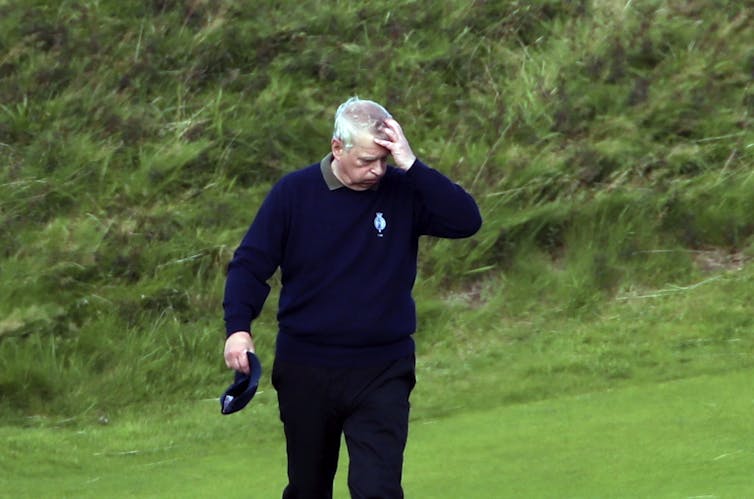 Prince Andrew can refuse to answer questions in Giuffre’s new civil case.
Liam McBurney/AP/AAP
Prince Andrew can refuse to answer questions in Giuffre’s new civil case.
Liam McBurney/AP/AAP
The High Court of Justice in England would then appoint a master of their court to oversee a private hearing. Prince Andrew could seek to have the mutual legal assistance request stopped as an abuse of process if he were able to establish that it was being undertaken vexaciously[16].
If the hearing proceeds, Prince Andrew would be entitled to legal representation as anyone else would. Questions would be put to him by lawyers representing Giuffre. He could refuse to answer these questions — and would not be in contempt if he remained silent.
The New York court would then make a determination according to the evidence presented. That could add months to the process.
US judgments in England
Do American rulings apply to citizens living in England? The answer is yes, but it’s complicated. This field of law is governed by the international rules[17] regarding the enforcement of foreign judgments.
Read more: Prince Andrew: the monarchy has a long history of dismissing women's suffering[18]
Interestingly, there is no treaty between the United States and the United Kingdom facilitating the enforcement of successful civil judgements across the Atlantic. So, if Giuffre’s suit is decided in her favour (which becomes more likely if the prince refuses to be involved) the judgement would form the basis of a completely new debt recovery legal action in England.
That could add another significant delay to the entire episode, as this new proceeding would be defended by the prince’s legal team. The legal costs to both sides would be eye-watering, although it is possible the Giuffre lawyers are being retained on a “contingency” basis[19] (no-win, no-fee).
According to media reports[20], the prince has been staying at Balmoral with the queen, while talking with his lawyers.
We can only assume these calls will become more frequent in the weeks to come.
References
- ^ headlines again (www.bbc.com)
- ^ stood down (www.bbc.com)
- ^ disastrous (edition.cnn.com)
- ^ claimed (honey.nine.com.au)
- ^ denies (www.bbc.com)
- ^ whose affairs continue to be probed (www.reuters.com)
- ^ said (www.aljazeera.com)
- ^ says (www.bbc.com)
- ^ announced (www.theguardian.com)
- ^ filed a civil claim (www.theguardian.com)
- ^ New laws give victims more time to report rape or sexual assault – even Jeffrey Epstein's (theconversation.com)
- ^ says (abcnews.go.com)
- ^ US$33.5 million (www.vanityfair.com)
- ^ “sovereign immunity” (www.royal.uk)
- ^ “mutual legal assistance” (fas.org)
- ^ vexaciously (www.parliament.vic.gov.au)
- ^ international rules (www.lw.com)
- ^ Prince Andrew: the monarchy has a long history of dismissing women's suffering (theconversation.com)
- ^ “contingency” basis (www.americanbar.org)
- ^ media reports (www.scotsman.com)