Germany "rested on its laurels" too long, report finds
LOS ANGELES, USA - Newsaktuell - 31 January 2025 - High levels of governance have masked a slow decline in Germany, with political, economic, and social fractures "festering over years", a new scientific report released only weeks ahead of the February 23 parliamentary elections concludes.
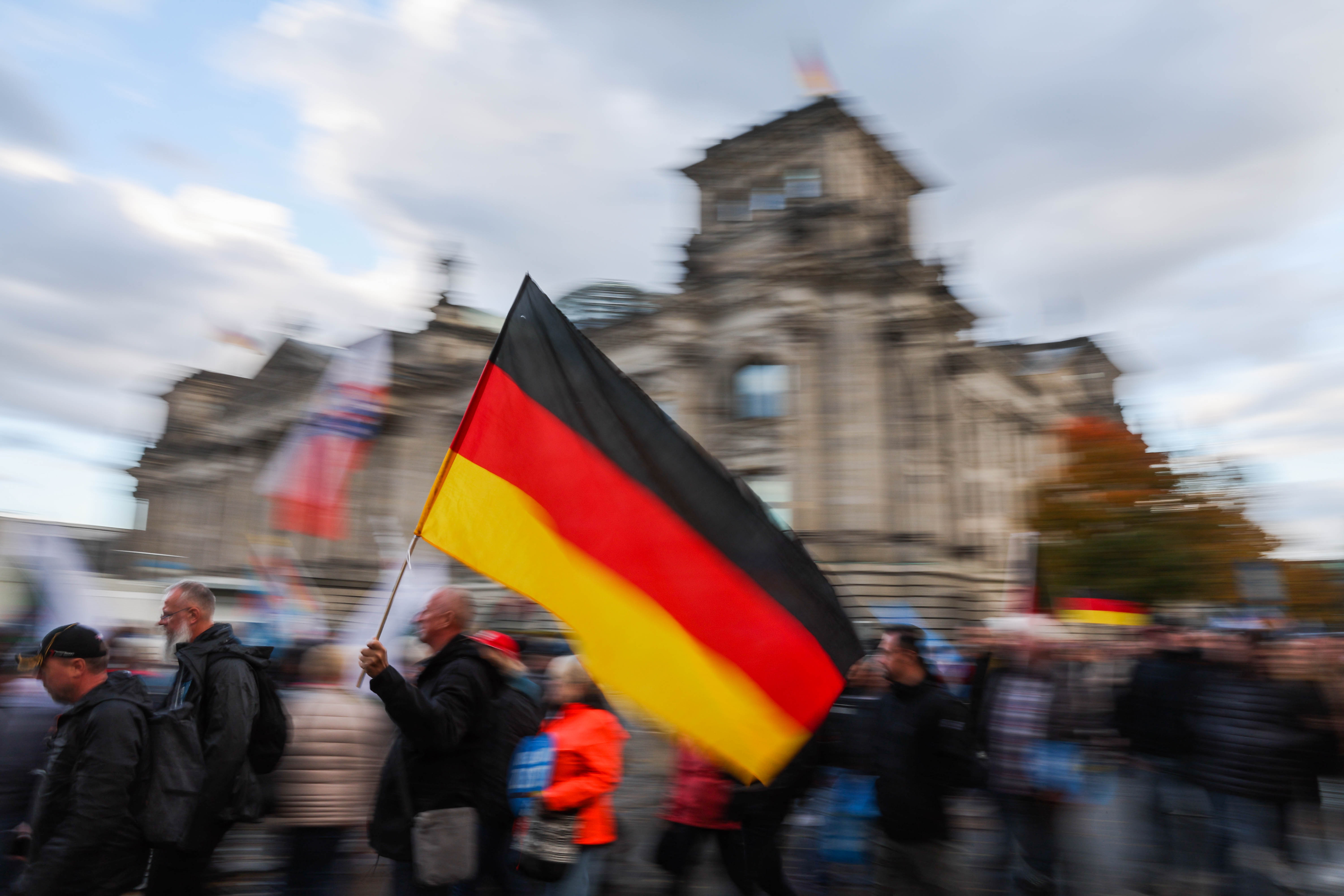
On February 23, Germany elects a new Bundestag. The issue of migration plays a particularly important role, not least for supporters of the far-right AfD party - seen here at a demonstration in front of the Reichstag building in Berlin, the seat of the Bundestag, in 2022. (Photo by Christoph Soeder/dpa)
"It has become clear that Germany rested on its laurels for far too long", the BGI Germany Report on the country's governance performance says. It is based on the Berggruen Governance Index (BGI) and was conducted by researchers from the Los Angeles-based Berggruen Institute think tank, the Luskin School of Public Affairs at the University of California Los Angeles (UCLA), and the Hertie School, a German university.
In their report "Germany 2025 - Slow decline in governance performance erupts into crisis of government as geopolitics worsen" the researchers conclude that the country's government and administrative systems have appeared increasingly sclerotic and hesitant to adopt necessary changes. Effective, often painful reforms are urgently needed, but political and economic constraints make them difficult to implement, the researchers write.
The 2024 BGI measures democratic accountability, delivery of public goods and state capacity on a scale from 0 to 100. It analyses the years from 2000 to 2021. According to the report, Germany has lost ground on all three measures, with structural problems festering since the "deceptively benign" years of the chancellorship of Angela Merkel (2005-2021). The Democracy Accountability Index score, for example, slid to 93 in 2021 from a near perfect 99 at the beginning of the century.
The data "suggests that some of Germany's state capacity and democratic accountability challenges were masked by economic growth, driven by the success of its export-oriented model during the 2010s", the report says. Chief among Germany's challenges are economic troubles that have worsened in recent years, largely stemming from a lack of public investment during that period in areas such as digitalization and transport infrastructure.
On February 23, Germans go to the polls early after the ruling three-party coalition consisting of the Social Democrats (SPD), the Greens and the liberal Free Democrats (FDP) collapsed in November. Intra-government fighting over how to get the country's ailing economy back on track was a main factor of the break-up.
At the same time, social trust is declining in Europe's largest economy. However, a possible new government under the conservative CDU/CSU alliance and its candidate for the chancellorship, Friedrich Merz, seems poised to exacerbate divisions rather than resolving them, the researchers say.
The economic difficulties heighten uncertainty and discontent, the report argues – with migration emerging as the other major flashpoint. Rhetoric on economic scarcity is used to highlight tensions over migration, which are exploited by both the extreme right and left. That debate has been exacerbated by a recent deadly stabbing in which a migrant facing deportation from Germany is the main suspect.
Yet immigration is essential to Germany's future growth, the BGI report says: "Any future government will have to attempt to reconcile anti-immigrant attitudes with the social reality of integration and the economic necessity of attracting foreign-born workers."
Merz is promising a hard line on migration in case of an election victory. Despite provoking outrage from other political parties, Merz on Wednesday (January 29) pushed through a vote in parliament on proposals for tightening immigration controls. "Current asylum and immigration policy jeopardizes the security of the people and the confidence of all of society in the state," the text of the motion by the CDU/CSU says.
The passed proposal includes a request to the German government to turn back asylum seekers at Germany's borders. But even more incendiary in German politics has been Merz's willingness to break long-standing taboos and use votes from the far-right Alternative for Germany (AfD) in order to pass the motion. All long-established parties in the lower house of the German parliament, the Bundestag, had previously said they would not work with the AfD, with many Germans alarmed at the rise of the party in recent years in a country still scarred by its Nazi past.
According to the latest opinion polls by the five major polling institutes, the conservative CDU/CSU is clearly in the lead, polling at between 28 and 34 per cent. Second comes the AfD with 19 to 21 per cent, followed by the SPD with 15 to 19 per cent. The current German Chancellor Olaf Scholz is a member of the SPD. The Greens are at 12 to 15 per cent in the opinion polls, while the FDP this time may not clear the 5-per-cent-threshold necessary to enter the Bundestag.
----------------------------------------------
This text and the accompanying material (photos and graphics) are an offer from the Democracy News Alliance, a close co-operation between Agence France-Presse (AFP, France), Agenzia Nazionale Stampa Associata (ANSA, Italy), The Canadian Press (CP, Canada), Deutsche Presse-Agentur (dpa, Germany) and PA Media (PA, UK). All recipients can use this material without the need for a separate subscription agreement with one or more of the participating agencies. This includes the recipient's right to publish the material in own products.
The DNA content is an independent journalistic service that operates separately from the other services of the participating agencies. It is produced by editorial units that are not involved in the production of the agencies' main news services. Nevertheless, the editorial standards of the agencies and their assurance of completely independent, impartial and unbiased reporting also apply here.
Further coverage by the Democracy News Alliance can be found in the DNA digital newsroom at https://www.presseportal.de/en/nr/174021
Hashtag: #DNA
The issuer is solely responsible for the content of this announcement.