


The wonders and terrors of modern technology evoke the ancient concept of the sublime, and present us with a choice
- Written by: Nanda Jarosz, Research officer, University of Sydney

In recent weeks the world has been awed by the first series of colour images to emerge from the James Webb Space Telescope[1]. A celestial concert, the images of swirling galaxies and conflagrations of gas presented an unprecedented view of the early cosmos. US President Joe Biden spoke of the images as a “reminder that America can do big things” and that there is “nothing beyond our capacity”.
But what is it about images of the cosmos that engage our fascination?
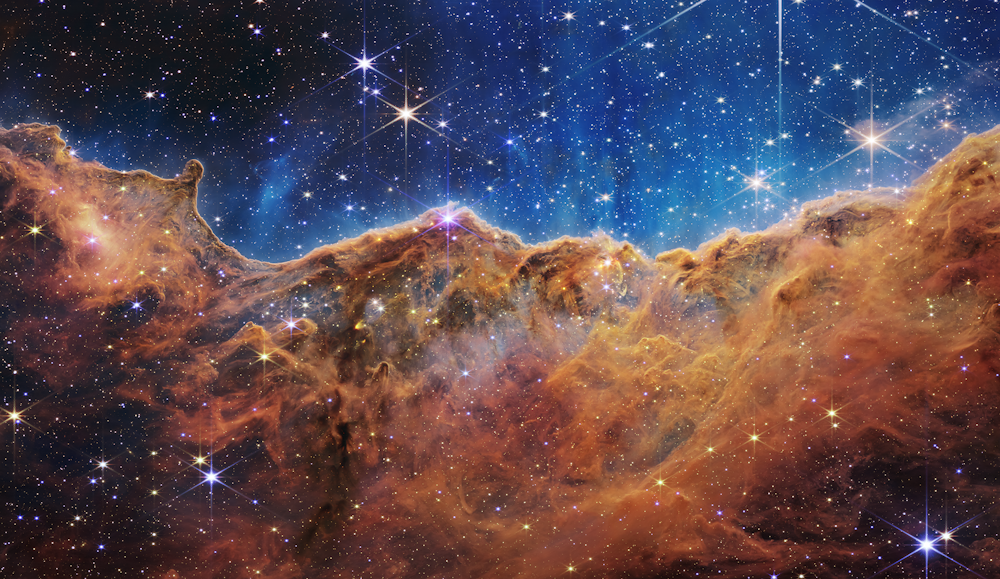
Read more: A cosmic time machine: how the James Webb Space Telescope lets us see the first galaxies in the universe[2]
Excitement and terror
An answer to this question can be found in the philosophical concept of the sublime. An ancient idea that can be traced back to a treatise written in the first century by the Greek philosopher Longinus[3], the sublime is associated with images of disruption, flux, chaos and contrast.
 Edmund Burke by Sir Joshua Reynolds (1771).
Public domain
Edmund Burke by Sir Joshua Reynolds (1771).
Public domain
The concept was revived in the 18th century, when Edmund Burke wrote in his Philosophical Inquiry into the Sublime and Beautiful[4] (1757) that “whatever is fitted in any sort to excite the ideas of pain, and danger, that is to say, whatever is in any sort terrible […] is a source of the sublime”.
In addition to terror, there is an aspect of gratification in the sublime. In 1790, Immanuel Kant observed[5] that the sublime inspires us to recognise “in our own mind a superiority over nature itself even in its immeasurability”.
One way of looking at this is that despite nature’s overwhelming complexity, the mind is able to conquer any terror that emerges in our experiences of the world. This yields a sense of pleasure in the exceptionalism of human reason.
The sublime thus touches upon a central tension in our experience of reality. We are awed and afraid of the scale and infinite complexity of the universe, but this feeling can be transformed into a positive view of ourselves because we are able to understand its wondrous quality. The paradoxical ability to experience these two sentiments simultaneously is a key feature of the sublime.
This is present in the way we talk about the Webb images. US Vice President Kamala Harris noted the transformative power of technology in her statement:
from the beginning of history, humans have looked up to the night sky with wonder and thanks to dedicated people who have been working for decades in engineering and scientific marvels we can look to the sky with new understanding.
The fascination with the Webb images captures this ambiguity: people want to share them as representations of a universe beyond human comprehension, but also to signal their erudition.
Read more: Explainer: the ideas of Kant[6]
The technological sublime
The tension inherent to the sublime has generated scepticism about what it stands for. Some see the sublime as a concept that privileges a self-aggrandising obsession with the powers of human reason and imagination. This critique is most apt when it comes to historical moments of human excess.
In the 1940s, when the Americans started experimenting with the atomic bomb, the language of the sublime was used to evoke the power of nuclear explosions. After the first nuclear test[7] in New Mexico on 16 July 1945, General Thomas Farrell stated[8]:
the effects could well be called unprecedented, magnificent, beautiful, stupendous and terrifying. No man-made phenomenon of such tremendous power had ever occurred before.
Farrell’s statement boasts of the terrifying heights of human ambition, but is tempered by a fear inspired by the act of placing human powers on par with those of God:
the strong, sustained, awesome roar which warned of doomsday and made us feel that we puny things were blasphemous to dare tamper with the forces heretofore reserved to the Almighty.
This is an example of the technological sublime[9]: the feeling of superiority experienced through advances in human technology. For some, the human propensity to self-aggrandisement and self-destruction, seen at its worst in the violence of nuclear weapons, goes hand in hand with the pleasure and pain of the sublime.
The overview effect
There is, however, another side to the sublime. Instead of privileging the power of human reason, the sublime can help us acknowledge the limits of human imagination and agency.
Some astronauts have spoken of a phenomenon that occurs during space travel. The overview effect[10] describes a shift in awareness that arises from seeing the earth from the distance of space. On his experience of the Apollo 9 mission, astronaut Rusty Schweickart said:
The Earth is so small and so fragile and such a precious little spot in that universe that you can block it out with your thumb […] And you realise from that perspective that you’ve changed, that there’s something new there, that the relationship is no longer what it was.
This sentiment is shared by those who have been right to the edges of human experience. Despite experiencing the heights of human technology first-hand, many astronauts do not return from space with a sense of human superiority. Instead, the moment changes their perspective.
For Schweickart and others who have experienced the overview effect, everything in the universe is related. The sublime helps to expose how the boundaries between humans and the rest of the world are merely conceptual.
 The Earth as seen from Apollo 17, 7 December 1972.
Public domain
The Earth as seen from Apollo 17, 7 December 1972.
Public domain
Read more: What the Voyager space probes can teach humanity about immortality and legacy as they sail through space for trillions of years[11]
Deep time
Most of us will never travel into space, but that doesn’t mean we can’t experience the sublime. In fact, the sublime is in the world around us.
In 1882, geologist Clarence Edward Dutton described [12]the view from a vantage point on the north rim of the Grand Canyon as providing “the most sublime and awe-inspiring spectacle in the world”. This moment was so memorable that he named the promontory where he stood Sublime Point.
Sublime Point draws thousands of visitors each year and has often been considered one of the most scenic vistas of the Canyon. And one of the main reasons the Grand Canyon continues to capture our interest is due to its physical incarnation of deep time[13].
Deep time is concept developed by the journalist John McPhee to explain representations of time based on the Earth’s geological record. Describing the hundreds of layers of strata apparent on the surface of the Grand Canyon, McPhee coined the phrase to express the awe associated with the age of the planet.
Deep time challenges our imagination because it forces us to think about processes and environments that are unfathomably old. Its appearance in places like the Grand Canyon can foster a new awareness of the place of humanity in relation to nature.
To put the age of the Grand Canyon in perspective, it is necessary to consider a time long before human existence. Thoughts of this nature are existentially challenging and evoke the sublime.
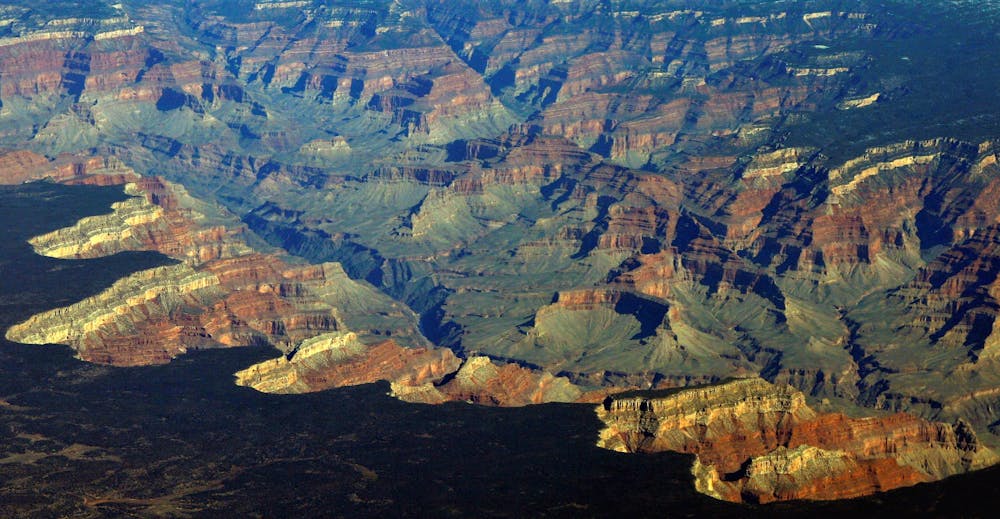 The layers of the Grand Canyon suggest a sense of deep time.
Doc Searls/Wikimedia commons, CC BY-SA[14]
The layers of the Grand Canyon suggest a sense of deep time.
Doc Searls/Wikimedia commons, CC BY-SA[14]
Read more: A map that fills a 500-million year gap in Earth's history[15]
Seeing with humility
The Webb images offer us both sides of the sublime. Some people share them because they elicit feelings of excitement and a sense of wonder in the face of things we don’t completely understand. For others, they tell the story of human ambition and striving for ever more knowledge and achievement.
Both sides are evident in President Biden’s announcement. In an acknowledgement of the dangers inherent to humanity’s propensity to excess, Biden emphasises that the US can lead “not by example of our power but the power of our example”. His message is that the power of these images lies in their demonstration of creative collaboration towards a shared aim, rather than a narrative of scientific domination.
The Webb observatory presents us with a chance to move away from the technological sublime. We can choose what we want the sublime to mean. Looking at the Webb images through the lens of the sublime can be a way of remaining humble in the face of scientific achievement – as long as we train our gaze upon the grandeur of the universe instead of our technological exceptionalism.
References
- ^ James Webb Space Telescope (www.nasa.gov)
- ^ A cosmic time machine: how the James Webb Space Telescope lets us see the first galaxies in the universe (theconversation.com)
- ^ a treatise written in the first century by the Greek philosopher Longinus (en.wikipedia.org)
- ^ Philosophical Inquiry into the Sublime and Beautiful (www.penguin.com.au)
- ^ Immanuel Kant observed (www.cambridge.org)
- ^ Explainer: the ideas of Kant (theconversation.com)
- ^ first nuclear test (www.afnwc.af.mil)
- ^ General Thomas Farrell stated (oxford-universitypressscholarship-com.ezproxy.library.sydney.edu.au)
- ^ technological sublime (mitpress.mit.edu)
- ^ overview effect (en.wikipedia.org)
- ^ What the Voyager space probes can teach humanity about immortality and legacy as they sail through space for trillions of years (theconversation.com)
- ^ Clarence Edward Dutton described (www.npca.org)
- ^ deep time (www.thoughtco.com)
- ^ CC BY-SA (creativecommons.org)
- ^ A map that fills a 500-million year gap in Earth's history (theconversation.com)










