Suicide rates reveal the silent suffering of Australia’s ageing men
- Written by: Rhys Mantell, PhD Candidate, School of Population Health, UNSW Sydney
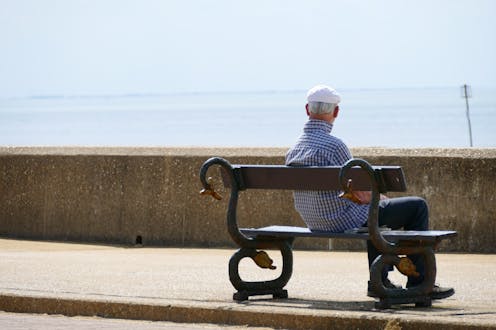
Men aged 85 and older have the highest suicide rates in Australia, but the tragedy has gone relatively unnoticed. This group is growing older, feeling alone and flying under the radar.
The tragedy of suicide is recognised as a major public health issue. Yet what may come as a surprise to many is data published[1] by the Australian Bureau of Statistics showing men over 85 have suicide rates more than three times the average rate.
Public perception is that men – in particular, young men – have the highest suicide risk. While this is true for the net number of suicides, if we don’t consider age-standardised rates (which account for differences in age distribution across the population) we miss a crucial finding.
Adjusting for age
Men aged over 85 accounted for a relatively small proportion of all male suicides (3.1%) in 2020 (the latest data available). But the age-specific suicide rate was 36.2 deaths per 100,000 (up from 32.3 per 100,000 in 2019). For women aged over 85, this rate was much lower (6.2 per 100,000). The next highest rate was for men in both the 40-44 and 50-54 age bands (27.1 per 100,000).
In 2020, the overall suicide rate was 12.1 per 100,000 people.
But this issue is rarely addressed in public discourse or policy directives. The National Study of Mental Health and Wellbeing[2] released last month did not include data on people older than 85.
This risk is not new[3], but little has changed to address it over the past decade. In light of COVID and what it has revealed about ageism[4] and the value of older people in our society, it is crucial to explore these issues again.

Read more: Drought increases rural suicide, and climate change will make drought worse[6]
Preventable deaths
It is startling that men who have shown resilience to survive to late life are at such risk of preventable death. Many factors contribute, including physical and material circumstances like frailty, chronic pain, bereavement[7] and financial troubles[8]. However, we cannot assume only external issues cause distress and lead to suicide.
In fact, for older people, successful ageing is rarely defined purely by physical circumstances. Ageing well often implies flourishing despite hardship.
The silent challenge among men aged over 85 who take their own lives is psychological and existential distress, which can reinforce feelings of loneliness and worthlessness[9]. Older men at risk of suicide may feel they are “no longer needed” or perceive themselves as “burdensome” to family and community.
These beliefs can overlap with major life transitions, such as retirement, stopping driving[10] or moving to residential care, where they are a minority[11]. Such stressful events can increase feelings of marginalisation, loss of independence and worthlessness, and also lead to social isolation.
Read more: How challenging masculine stereotypes is good for men[12]
Talking about it
A reluctance to express their feelings or be vulnerable has long been discussed as an important factor for men’s wellbeing, especially when they’re feeling low.
Research suggests gender stereotypes and social norms linked to masculinity reduce help-seeking behaviours[13] and can increase suicide risk[14]. Many ageing men hold restrictive and stoic beliefs about what it means to be a man. This may make them less inclined to share[15] when they aren’t coping.
Yet emerging research challenges the assumption[16] men don’t talk because they can’t. One reason men are not talking about their mental health struggles is because there’s nowhere for them[17] to open up in a way they see as culturally and socially acceptable.
Instead, older men are speaking through their actions.
Suicide prevention and early intervention responses that are not tailored to the needs of older men are unlikely to be effective. We need to meet men where they are and listen to their quiet and absent voices by designing programs in partnership with them.
This means better understanding men’s barriers[18] to suicide interventions. These include a lack of trust in traditional services and an aversion to “formal” supports that frame emotional distress and suicidal behaviours as mental illness.
It also means exploring, developing and funding new options that are acceptable, relevant and accessible, such as gendered support, peer-led programs, community-based informal support and programs combining exercise with mental health promotion.
The objective is not only to develop more suitable suicide prevention for this specific group, but also to examine broader interactions between ageing, isolation and loneliness; all key risk factors[19] for suicide that have become even more relevant due to COVID.
Read more: Friday essay: grey-haired and radiant – reimagining ageing for women[20]
More calls for help
Increased feelings of distress and loneliness produced by the pandemic can be measured by increased calls to services such as Lifeline[21]. And more persistent mental health problems are likely to present more slowly, over longer horizons[22], and peak after the most acute phases of the pandemic.
Older people have handled much of the burden of COVID, including unprecedented restrictions and ageist sentiments[23]. We must recognise these factors – growing old, being alone and feeling unheard - underpin increasing distress felt by men aged over 85, not only during the pandemic, but more generally.
This group must be seen as a priority population for suicide prevention. We must start listening and work together to find solutions so older men can access the help they need in a way that suits them.
UNSW Ageing Futures Institute would like to acknowledge the research contribution of Lifeline Research Foundation[24]’s Dr Anna Brooks (National Manager) and Dr Tara Hunt (Research and Engagement Manager).
If this article has raised issues for you, or if you’re concerned about someone you know, you can call these support services, 24 hours, 7 days:
Lifeline: 13 11 14
Suicide Call Back Service: 1300 659 467
Kids Helpline: 1800 551 800 (for people aged 5 to 25)
MensLine Australia: 1300 789 978
StandBy - Support After Suicide: 1300 727 24
References
- ^ published (www.abs.gov.au)
- ^ National Study of Mental Health and Wellbeing (www.abs.gov.au)
- ^ not new (theconversation.com)
- ^ revealed about ageism (www.frontiersin.org)
- ^ Shutterstock (www.shutterstock.com)
- ^ Drought increases rural suicide, and climate change will make drought worse (theconversation.com)
- ^ frailty, chronic pain, bereavement (pubmed.ncbi.nlm.nih.gov)
- ^ financial troubles (pubmed.ncbi.nlm.nih.gov)
- ^ reinforce feelings of loneliness and worthlessness (pubmed.ncbi.nlm.nih.gov)
- ^ stopping driving (pubmed.ncbi.nlm.nih.gov)
- ^ moving to residential care, where they are a minority (pubmed.ncbi.nlm.nih.gov)
- ^ How challenging masculine stereotypes is good for men (theconversation.com)
- ^ reduce help-seeking behaviours (pubmed.ncbi.nlm.nih.gov)
- ^ can increase suicide risk (journals.sagepub.com)
- ^ less inclined to share (pubmed.ncbi.nlm.nih.gov)
- ^ challenges the assumption (pubmed.ncbi.nlm.nih.gov)
- ^ nowhere for them (opus.lib.uts.edu.au)
- ^ barriers (pubmed.ncbi.nlm.nih.gov)
- ^ all key risk factors (www.cambridge.org)
- ^ Friday essay: grey-haired and radiant – reimagining ageing for women (theconversation.com)
- ^ increased calls to services such as Lifeline (www.abc.net.au)
- ^ over longer horizons (psycnet.apa.org)
- ^ restrictions and ageist sentiments (www.ncbi.nlm.nih.gov)
- ^ Lifeline Research Foundation (www.lifeline.org.au)