Governments are making nursing degrees cheaper or 'free' – these plans are not going to help attract more students
- Written by: Andrew Norton, Professor in the Practice of Higher Education Policy, Australian National University
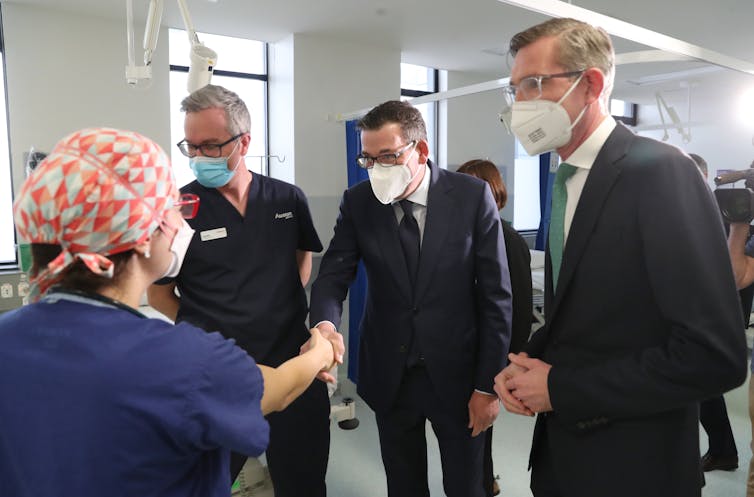
Australian politicians like the idea that cheap nursing courses can increase the number of nurses, one of Australia’s most in-demand occupations over the next five years[1].
As of 2021, the previous federal government cut nursing student contributions by 40% to just under A$4,000 a year[2]. The Victorian government is going a step further, temporarily covering tuition costs[3] for nursing and midwifery undergraduate degrees. As Premier Daniel Andrews describes the move, it is part of “building an army of homegrown health workers to care for Victorians”.
Neither policy is likely to have much impact on the numbers of students who start nursing courses. But if redesigned as a cash payment, the Victorian policy would make it easier for nursing students to complete their courses.
The Victorian government policy on nursing and midwifery courses
The Victorian government policy will apply to students beginning undergraduate nursing and midwifery courses in 2023 and 2024.
These students will still have to pay, or defer under the HELP loan scheme[4], some student contributions while they study. The Victorian government will pay $9,000 while the student is enrolled, $3,000 less than the $12,000 total course cost for a three year nursing degree.
Nursing and midwifery graduates who work in the Victorian public health sector for two years after finishing their course will receive an additional $7,500. This could clear their remaining HELP debt.
Read more: Word from The Hill: Albanese announces more than $1 billion in federal-state TAFE funding[5]
Nursing degree fees are not an obstacle
Thanks to the HELP loan scheme, tuition fees are not a major obstacle to domestic students signing up to higher education.
HELP repayments should be considered in educational decision-making, but in the context of the financial benefits of a degree. It is important to note HELP loans are only repaid on annual earnings above $48,361[6].
Using Census 2016 data, the Grattan Institute calculated[7] a female nursing graduate with mid-range income earned about $650,000 more over her career, after tax, than a woman who finished her education at Year 12.
While other careers are more lucrative than nursing, reducing nursing student contributions to zero cannot make a significant financial difference to the choice between nursing and other courses. It will save nursing graduates about $12,000 – equivalent to two or three months difference in the length of a working life – not the difference in lifetime earnings between occupations.
Living expenses
Although student contributions can be deferred with a HELP loan, most students fund their own living expenses. Student income support payments are low[8] and, apart from a COVID-related spike[9], the number of students receiving them has trended down[10].
To finance themselves while studying, most full-time tertiary students – about 70%[11] in recent months – have paid jobs. According to the higher education Student Experience Survey released last week[12], 37% of students say paid work interferes with their studies.
Read more: Yes, we know there is a 'skills shortage'. Here are 3 jobs summit ideas to start fixing it right away[13]
For nursing students, clinical training requirements create additional living expense issues. They must undertake[14] at least 800 hours of supervised activity in a hospital or another clinical setting.
Clinical training may take place at a location far from the student’s home. Nursing students have often reported this as an issue[15], as they may not be able to do their normal paid work and they incur additional travel costs[16].
Scholarships paid in cash would help most
The Victorian government announcement refers directly to tuition costs. But some of it will be paid in cash, as the total value is $16,500 for students who complete their nursing degrees and then spend two years working in the Victorian public sector.
This exceeds the cost of a three-year nursing degree by several thousand dollars.
Either way, a nursing graduate who meets all the program conditions will be $16,500 better off. The timing of this financial benefit is the only difference between paying student contributions and giving the student cash.
Read more: The physio will see you now. Why health workers need to broaden their roles to fix the workforce crisis[17]
If the student has all or most of their student contributions paid while studying the cash benefit comes after graduation in early career, through reduced HELP repayments. This benefits them when their annual income already exceeds $48,361.
If the student is paid while studying, it delivers cash when their income is much lower. Nursing and midwifery students could use their cash scholarship to help manage the cost of clinical training. It could also reduce the number of students who drop out because they cannot afford to keep studying, or who study part-time to fit in with paid work, delaying course completion and the start of their nursing career.
Can the Victorian scheme increase nursing commencements?
If paid in cash, the Victorian nursing and midwifery financial assistance could improve course completion times and rates. But it won’t increase the number of people commencing nursing and midwifery courses.
Demand for nursing courses already exceeds the supply of student places[18]. Universities face two constraints on increasing the number of nursing students – limited capacity for clinical training and the total funding per student they receive, including both Commonwealth and student contributions.
Ensuring all students can complete the clinical training component of their course is a major practical issue for nursing faculties. In response to the Victorian government announcement, the head of nursing at the Australian Catholic University said they could take another 100 students[19] at their Ballarat campus if professional experience placements were available.
Nursing schools are looking for ways to expand[20], but for a stretched health system, taking on more students creates additional work before it leads to additional workers.
Another problem for universities is that as part of its Job-ready Graduates policy[21], the Morrison government cut total funding per nursing student place by 8%.
The new funding rate was based on estimated average teaching and scholarship costs of nursing, but created problems for universities with above-average costs and reduced financial incentives for all universities to enrol more nursing students. The current government is reviewing Job-ready Graduates, but no quick financial fix is likely.
Solving the right problems
For high-profile occupations like nursing, student demand usually mirrors the labour market. COVID-19 increased the need for nurses and demand for nursing courses spiked[22].
For the higher education system to meet workforce needs, the issues are more often the supply of student places than the demand for them, and course completions rather than commencements.
More clinical placement capacity and scholarships aimed at living expenses should be favoured over cutting student course costs.
References
- ^ in-demand occupations over the next five years (www.nationalskillscommission.gov.au)
- ^ just under A$4,000 a year (www.studyassist.gov.au)
- ^ temporarily covering tuition costs (www.premier.vic.gov.au)
- ^ HELP loan scheme (www.studyassist.gov.au)
- ^ Word from The Hill: Albanese announces more than $1 billion in federal-state TAFE funding (theconversation.com)
- ^ annual earnings above $48,361 (www.ato.gov.au)
- ^ Grattan Institute calculated (grattan.edu.au)
- ^ payments are low (www.servicesaustralia.gov.au)
- ^ COVID-related spike (andrewnorton.net.au)
- ^ trended down (data.gov.au)
- ^ about 70% (andrewnorton.net.au)
- ^ Student Experience Survey released last week (www.qilt.edu.au)
- ^ Yes, we know there is a 'skills shortage'. Here are 3 jobs summit ideas to start fixing it right away (theconversation.com)
- ^ must undertake (anmac.org.au)
- ^ reported this as an issue (www.sciencedirect.com)
- ^ incur additional travel costs (www.abc.net.au)
- ^ The physio will see you now. Why health workers need to broaden their roles to fix the workforce crisis (theconversation.com)
- ^ exceeds the supply of student places (andrewnorton.net.au)
- ^ said they could take another 100 students (www.abc.net.au)
- ^ are looking for ways to expand (www.theage.com.au)
- ^ Job-ready Graduates policy (theconversation.com)
- ^ demand for nursing courses spiked (andrewnorton.net.au)