The Artemis I mission marks the start of a new space race to mine the Moon
- Written by: Cassandra Steer, Deputy Director, Institute for Space (InSpace), Australian National University
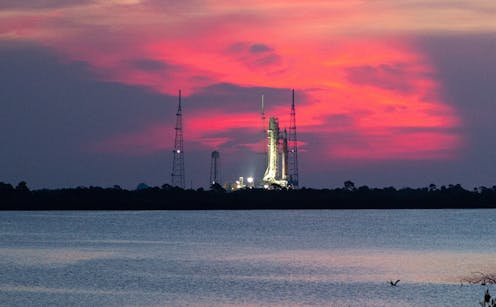
NASA plans to launch the Artemis I lunar mission[1] this Saturday, September 3, after a first attempt earlier in the week was cancelled at the last minute[2] due to engine trouble.
The mission is an exciting step towards returning humans to the Moon for the first time since 1972. But this time it’s not just about putting our footprints on lunar dust: it marks the beginning of a new space race for lunar resources. This time around, everybody wants to mine the Moon.
Return to the Moon
Much about the Artemis program is noble and inspiring.
Artemis I is the program’s first mission, and it will carry out a 42-day uncrewed test flight to orbit the Moon and return to Earth. The trip will use a new launch vehicle, the Space Launch System (SLS)[3], which is the most powerful rocket currently operational in the world.
On board will be three mannequins made of materials replicating male and female biology[4]. NASA will use the mannequins to test the comfort and safety of the launch vehicle and spaceflight capsule for humans.
Read more: NASA is launching the 1st stage of the Artemis mission – here's why humans are going back to the Moon[5]
There are also many other experiments on board, and a series of small satellites will be launched to provide data when the capsule nears the Moon.
The lessons from this mission will be applied to Artemis II, the mission planned for 2024[6] that will see the first woman and the first person of colour reach the Moon.
A new space race?
However, humanity’s return to the Moon is not all about exploration and the pursuit of knowledge. Just as the 1960s space race was driven by Cold War geopolitics, today’s space programs are underpinned by today’s geopolitics.
Artemis is led by the US, with participation by the European Space Agency[7] and many other friendly nations including Australia.
China and Russia are collaborating on their own Moon program[8]. They plan to land humans in 2026 and construct a Moon base by 2035.
India too is working on robotic Moon landers and a lunar spaceflight program[9]. The UAE plans to launch a lunar lander in November this year[10] as well.
All of these programs are aiming to do more than simply land astronauts for brief visits to the Moon. The longer-term goal of the race is to acquire lunar resources.
Resources on the Moon
Water ice[11] has been found in the southern regions of the Moon, and it is hoped certain gases that can be used for fuels can also be mined.
These resources could be used to support long-term human habitation on and near the Moon in lunar bases, as well as permanent space stations orbiting the Moon, such as NASA’s planned Gateway[12].
Read more: The Moon's top layer alone has enough oxygen to sustain 8 billion people for 100,000 years[13]
The Australian Space Agency is supporting Australian industry[14] to be part of the Artemis program and America’s planned later voyages to Mars. Australian scientists are also developing lunar rovers[15] to assist lunar mining efforts.
Eventually, what we learn on the Moon will be used to advance to Mars. But, in the near term, the countries and associated commercial entities that get to the best mining sites first will dominate an emerging lunar economy and lunar politics.
What are the rules?
In the next five years or so we can expect to see enormous political tensions rising around this new race to the Moon.
One question that is yet to be answered: what laws will govern activities on the Moon?
The 1967 Outer Space Treaty prohibits appropriation in space “by claims of sovereignty, occupation or by any other means[16]”. It is so far unclear whether mining or other forms of resource extraction fall under this prohibition.
The United Nations has a working group[17] that aims to develop a multilateral consensus on legal aspects of space resource activities.
However, in 2020 the US got out in front of the UN process by establishing the Artemis Accords[18], which state that resource extraction will occur and is lawful. Twenty-one countries[19], including Australia, have signed these accords with the US, but they are far from universally accepted.
Read more: Giant leap for corporations? The Trump administration wants to mine resources in space, but is it legal?[20]
Another relevant treaty is the 1979 Moon Agreement, signed by 18 countries including Australia. This agreement states that no entity can own any part of the Moon, and obliges us to establish a regulatory regime for lunar mining “at such a time as the technology is about to become feasible[21]”.
Australia is therefore between a lunar rock and a hard place as to what role we will play in developing these new laws. But international law-making and consensus-building are slow: most likely actual practice will be established in the next few years, and decisions on how to govern it will come after the fact.
Technical and political challenges
There is some poetic perfection in NASA having chosen the name “Artemis” for this new lunar endeavour. Artemis is the Greek goddess of the Moon, and the twin sister of Apollo (the namesake of NASA’s 1960s Moon spaceflight program).
Artemis declared she never wanted to be married[22] because she didn’t want to become the property of any man.
Even if ownership of the Moon cannot be claimed, we will see competition over whether parts of it can be mined. No doubt scientists and engineers will resolve the technical challenges of the return to the Moon. Resolving the legal and political challenges may prove more difficult.
Read more: Can the Moon be a person? As lunar mining looms, a change of perspective could protect Earth's ancient companion[23]
References
- ^ Artemis I lunar mission (www.nasa.gov)
- ^ cancelled at the last minute (edition.cnn.com)
- ^ Space Launch System (SLS) (www.nasa.gov)
- ^ materials replicating male and female biology (www.npr.org)
- ^ NASA is launching the 1st stage of the Artemis mission – here's why humans are going back to the Moon (theconversation.com)
- ^ mission planned for 2024 (www.globalcitizen.org)
- ^ European Space Agency (www.esa.int)
- ^ Moon program (www.space.com)
- ^ lunar spaceflight program (www.space.com)
- ^ November this year (www.thenationalnews.com)
- ^ Water ice (theconversation.com)
- ^ Gateway (www.nasa.gov)
- ^ The Moon's top layer alone has enough oxygen to sustain 8 billion people for 100,000 years (theconversation.com)
- ^ supporting Australian industry (business.gov.au)
- ^ lunar rovers (theconversation.com)
- ^ by claims of sovereignty, occupation or by any other means (www.unoosa.org)
- ^ working group (www.unoosa.org)
- ^ Artemis Accords (www.nasa.gov)
- ^ Twenty-one countries (www.state.gov)
- ^ Giant leap for corporations? The Trump administration wants to mine resources in space, but is it legal? (theconversation.com)
- ^ at such a time as the technology is about to become feasible (www.unoosa.org)
- ^ she never wanted to be married (www.ancient-literature.com)
- ^ Can the Moon be a person? As lunar mining looms, a change of perspective could protect Earth's ancient companion (theconversation.com)