Monkeys' brains are wired to read body language – just like ours
- Written by: Jessica Taubert, Research Fellow, The University of Queensland
In 2020, as the COVID-19 pandemic drove a surge in remote work and learning, videoconferencing apps such as Zoom saw their user numbers boom. Plenty of other options were available, but the exponential growth in videoconferencing underlines an essential aspect of human communication: to do it effectively, we need to see each other.
And it’s not just about facial expressions. Body language is also a very powerful form of social communication used to express how we feel to the people around us.
Indeed, body language is so important that a part of our brain called the visual cortex has dedicated areas tuned to different kinds of body postures and expressions.
And, as we show in new research published in Science Advances[1], humans are not alone in this: the brains of rhesus monkeys, like ours, are wired to react to body language, not only in members of their own species but also in humans and other animals.
Brains watching bodies
Numerous[2] studies[3] have reported that the “body-selective areas” of our brains are more activated when we look at body postures conveying fear than when we look at more calm body postures.
However, we are the only primates that walk around on two legs with our arms normally free to wave and pose. This led us to wonder whether the capacity for recognising body language is unique to humans.
In our new research, we used a noninvasive technique called functional magnetic resonance imaging to measure brain activity in four rhesus monkeys (Macaca mulatta) while we showed them pictures of different body postures.
Read more: Are you furious? Body cues tell us more than faces [4]
These monkeys are our close evolutionary relatives. Other studies[5] have examined how they process what they observe in social situations, but it has long been unclear how they process body language.
Like human participants in previous studies, the monkeys were first trained to sit comfortably in the scanner. Then, during the experimental scan sessions, they were shown photographs of monkeys that were either scared of something in their environment or calmly going about their business.
The body language network
Facial features in the photos were blurred, to ensure facial expressions could not contribute to the brain activity measured during the experiment.
To locate parts of the monkey brain (if any) that encoded emotional body language, we subtracted the neural signal observed when viewing calm monkey bodies from the signal observed when viewing scared monkey bodies.
As a result, we identified a network of body-selective regions located along a deep groove in the brain called the superior temporal sulcus. This closely resembles a network found in the human brain.
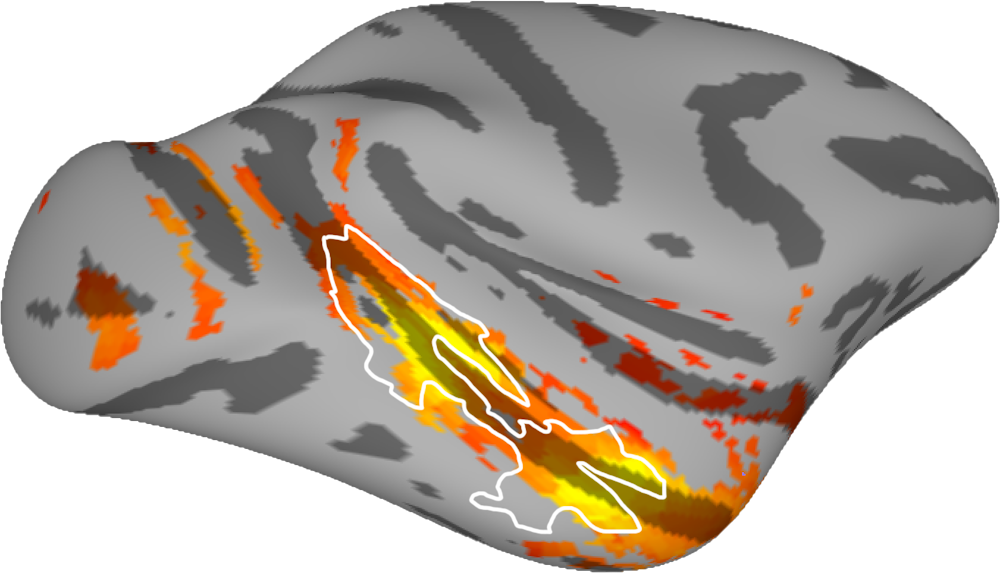
Our finding establishes what neuroscientists call a “key functional homology” between humans and rhesus monkeys. In other words, both species have body-selective brain regions with the same visually evoked response to emotional body language.
From an anthropological perspective, this result suggests we are not the only primates that use body postures to communicate how we feel.
Inter-species communication
The most intriguing part of our results was the discovery that this response to body language was not limited to the bodies of other rhesus monkeys. Photographs of humans and even of domestic cats in both calm and frightened states evoked similar brain activity.
This is particularly interesting when you consider that the monkeys in this study were living and working with human researchers and caregivers, like many domesticated species (pets) and captive animals housed in zoological parks. Thus, these results open up the possibility that the animals we interact with and see around us have the capacity to recognise our body language.
This is a potentially important consideration as the human population expands and pushes into areas where we can expect frequent conflicts between humans and animals.
Read more: Ancient faces, familiar feelings: expressions may be recognisable across time and cultures[7]
Non-human primates are highly adaptable, intelligent[8], and dextrous, and they are able to work together[9]. These qualities mean they present one of the greatest challenges[10] to human–wildlife conflict mitigation and coexistence.
Indeed, in some places populations of monkeys are real threats. In Amboseli National Park in Kenya, for example, where a population of savannah baboons is attracted to man-made watering holes and wells, there has been escalating violence and a marked increase[11] in the baboon mortality rate.
Perhaps understanding that we can communicate intentions and feelings across species via body language will provide a means of avoiding conflict.
Shared social intelligence
Researchers and clinical psychologists have often focused on the human ability to read and recognise facial expressions. Our results, however, underscore the importance of body language as another communication tool.
Emerging evidence suggests bodies and postures also play an important role[12] in social behaviour because they help to contextualise facial expressions. They might be more useful[13] when standing at a distance and deciding whether to approach or avoid another person.
The next step in our research is to explore how these various body-selective brain regions work with the known face-selective brain network, and how these regions contribute to our understanding of social encounters. For now, what seems undeniable is that our remarkable social intelligence is shared by our primate cousins.
Read more: 150 years ago, Charles Darwin wrote about how expressions evolved – pre-empting modern psychology by a century[14]
References
- ^ new research published in Science Advances (doi.org)
- ^ Numerous (www.ncbi.nlm.nih.gov)
- ^ studies (wires.onlinelibrary.wiley.com)
- ^ Are you furious? Body cues tell us more than faces (theconversation.com)
- ^ Other studies (www.science.org)
- ^ Taubert et al. / Science Advances (doi.org)
- ^ Ancient faces, familiar feelings: expressions may be recognisable across time and cultures (theconversation.com)
- ^ intelligent (www.ncbi.nlm.nih.gov)
- ^ able to work together (www.nature.com)
- ^ greatest challenges (link.springer.com)
- ^ marked increase (www.sciencedirect.com)
- ^ play an important role (www.science.org)
- ^ more useful (www.sciencedirect.com)
- ^ 150 years ago, Charles Darwin wrote about how expressions evolved – pre-empting modern psychology by a century (theconversation.com)
Read more https://theconversation.com/monkeys-brains-are-wired-to-read-body-language-just-like-ours-195118