IPCC delivers definitive report on climate change, and where to now
Written by: Frank Jotzo, Professor, Crawford School of Public Policy and Head of Energy, Institute for Climate Energy and Disaster Solutions, Australian National University
The world is in deep trouble on climate change, but if we really put our shoulder to the wheel we can turn things around. Loosely, that’s the essence of today’s report by the Intergovernmental Panel on Climate Change (IPCC[1]).
The IPCC is the world’s official body for assessment of climate change. The panel has just released its Synthesis Report, capping off seven years[2] of in-depth assessments on various topics.
The report draws out the key insights from six previous reports, written by hundreds of expert authors. They spanned many thousands of pages and were informed by hundreds of thousands of comments by governments and the scientific community.
The synthesis report confirms humans are unequivocally increasing greenhouse gas emissions to record levels. Global temperatures are now 1.1℃ above pre-industrial levels. They’re likely to reach 1.5℃ above pre-industrial levels in the early 2030s.
IPCC
This warming has driven widespread and rapid global changes, including sea level rise and climate extremes – resulting in widespread harm to lives, livelihoods and natural systems.
It’s increasingly clear that vulnerable people in developing countries – who have generally contributed little to greenhouse gas emissions – are often disproportionately affected by climate change.
Intergenerational inequities are also likely. A child born now is likely to suffer, on average, several times as many climate extreme events in their lifetime as their grandparents did.
The world is up the proverbial creek - but we still have a paddle. Climate change is worsening, but we have the means to act.
Climate change is worsening, but we have the means to act.Shutterstock
So much at stake
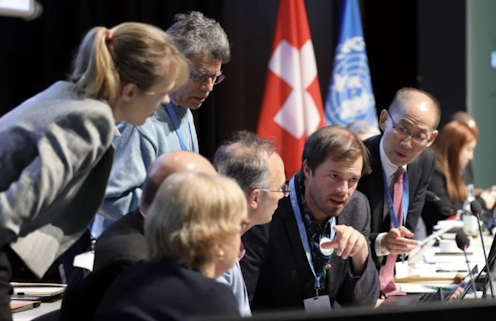
Over the past week in Interlaken, Switzerland, several hundred representatives from most of the world’s governments scrutinised the IPCC report’s 35-page summary.
The scrutiny happens sentence by sentence, often word by word, and number by number. Sometimes it’s subject to intense debate.
We were both involved in this process. The role of the reports’ authors and IPCC bureau members is to stay true to the underlying science and chart a way between different governments’ preferences. It is a unique process for scientific documents.
The approval process usually goes right to the wire, in meetings running through the night. This Synthesis Report was no exception. The scheduled time for the meeting was extended by two days and nights, wearing down government representatives and the IPCC teams.
The process reflects how much is at stake. The IPCC’s assessments are formally adopted by all governments of the world. That in turn reverberates in the private sector – for example, in the decisions of boards of major companies and investment funds.
An afternoon session of the IPCC. The meetings can drag on overnight as the final wording of IPCC reports is debated.IISD/ENB
The latest on greenhouse gas emissions
The Synthesis Report confirms both emissions and atmospheric concentrations of greenhouse gases are now at record highs.
To keep warming within 2℃ above pre-industrial levels, global greenhouse gas emissions must decline by around 21% by 2030 and around 35% by 2035. Keeping warming below 1.5℃ requires even stronger emissions reduction.
This is a very tall order in light of emissions trajectories to date. Annual global emissions in 2019 were 12% higher than in 2010, and 54% higher than in 1990.
IPCC
But success in reducing emissions has been demonstrated. The IPCC says existing policies, laws, technologies and measures the world over are already reducing emissions by several billion tonnes of carbon dioxide and other greenhouse gases, compared to what would otherwise be the case.
Most importantly, it’s clear global emissions could be reduced deeply if existing policy instruments were scaled up and applied broadly. The report shows large potential for emissions-reduction options across all parts of the world economy.
Many of these come at low cost. And many bring side benefits, such as reduced air pollution. If all technically available options were used, global emissions could be at least halved by 2030, at manageable costs.
As today’s report states, the global economic benefit of limiting warming to 2℃ exceeds the costs of emissions reduction. That’s without even taking into account the avoided damages of climate change or the side benefits that sensible action could generate.
We have the collective experience to turn the corner. As the report spells out, a great many regulatory and economic policy instruments have been used successfully. And we know how to design climate policies to make sure they’re politically acceptable and do not disadvantage the poorer parts of society.
The report also draws out the importance of good institutions for climate change governance – such as laws and independent bodies – and for all groups in society to be meaningfully involved.
Read more:
Global carbon emissions at record levels with no signs of shrinking, new data shows. Humanity has a monumental task ahead[4]Atmospheric concentrations of greenhouse gas emissions are now at record highs.Olivia Zhang/AP
Adaptation falls short
Rapid action on climate change is the economically sensible thing to do. If we fail to rein in emissions, adapting to the damage it causes will be more difficult and expensive in future. What’s more, our existing adaptation options will become less effective.
Every increment of warming will intensify climate-related hazards such as floods, droughts, heatwaves, fires and cyclones. Often, two or more hazards will occur at the same time.
Unfortunately, overall global adaptation has not kept up with the pace and degree of increasing impacts from climate change. Most responses have been fragmented, incremental and confined to a specific sector of the economy. And most are unequally distributed across regions and vary in their effectiveness.
The barriers to more effective adaptation responses are well-known. Chief among them is a widening gap between costs of adaptation and allocated finance. We can, and should, do a lot better.
IPCC
As today’s IPCC report confirms, there are ways to make adaptation more effective. More investment in research and development is needed. So too is a focus on long-term planning as well as inclusive, equitable approaches that bring together diverse knowledge.
Many adaptation options bring significant side benefits. Better home insulation, for instance, can help us deal with extreme weather as well as reduce heating and cooling costs and related greenhouse gas emissions.
Moving people off flood-prone areas and returning these areas to more natural systems can reduce flood risk, increase biodiversity and store carbon dioxide in plants and soil.
And climate adaptation policies that prioritise social justice, equity and a “just transition” can also help achieve other global ambitions, such as the United Nations Sustainable Development Goals.
Read more:
Climate change has already hit Australia. Unless we act now, a hotter, drier and more dangerous future awaits, IPCC warns[5]Climate adaptation policies that prioritise social justice can also help achieve other global ambitions.Asim Tanveer/AP
We can close the gap
On both climate change mitigation and adaptation, a massive gap remains between what’s needed and what’s being done.
Countries’ current climate commitments do not add up to the shared ambition to keep temperature rise to below 2℃. And for many countries, current trajectories of emissions would also overshoot their targets.
What’s more, current total investments in low-emissions technology and systems is three to six times lower than what would be needed to keep temperatures to 1.5℃ or 2℃, according to modelling.
Likewise, on the whole not nearly enough effort is being made to understand, prepare and implement measures to adapt to climate changes. The gaps are generally biggest in developing countries, which can much less afford to invest in climate change action than rich parts of the world.
Read more:
IPCC says the tools to stop catastrophic climate change are in our hands. Here's how to use them[6]
Developing countries are calling for large-scale climate finance to be provided by developed countries, and this is not happening to anywhere near the extent needed.
Predictably, issues of international equity and justice were among the thorniest in the approval of the Synthesis Report. The final version of the report frames the issue not as an irresolvable conflict, but as the opportunity for “shifting development pathways towards sustainability”.
The vision of most governments is for all the world to attain high standards of living, but to do so with “climate neutral” technologies, systems and patterns of consumption. And systems must be built so they’re robust to future climate change, including the nasty surprises that may come.
It must be done. It can be done. By and large, we know how to do it – and it makes economic sense to do so. In this report, the governments of the world have acknowledged as much.
Frank Jotzo is a Lead Author of the IPCC’s latest assessment report on climate change mitigation and member of the core writing team for the Synthesis Report. Mark Howden is a Vice Chair of the IPCC Working Group on climate impacts and adaptation and a Review Editor of the synthesis report. Both were involved in the government approval session for the IPCC Synthesis Report.Fear & Wonder is a new climate podcast, brought to you by The Conversation. It will take you inside the IPCC’s era-defining climate report via the hearts and minds of the scientists who wrote it. The first episode drops on March 23. Learn more here[7], or subscribe on your favourite podcast app via the icons above.
References^IPCC (www.ipcc.ch)^capping off seven years (theconversation.com)^What can we expect from the final UN climate report? And what is the IPCC anyway? (theconversation.com)^Global carbon emissions at record levels with no signs of shrinking, new data shows. Humanity has a monumental task ahead (theconversation.com)^Climate change has already hit Australia. Unless we act now, a hotter, drier and more dangerous future awaits, IPCC warns (theconversation.com)^IPCC says the tools to stop catastrophic climate change are in our hands. Here's how to use them (theconversation.com)^here (theconversation.com)