From Dylan Mulvaney to Madonna, there's a long history of backlash to celebrity brand endorsements
- Written by: Amanda Spry, Lecturer of Marketing, RMIT University
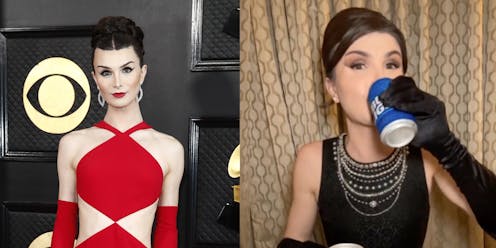
Earlier this month, influencer and trans woman Dylan Mulvaney promoted Bud Light beer on their social media and received vicious backlash[1] from the conservative public. The TikTok star, known for documenting their gender transition in daily videos for their 10.8 million followers, showed a commemorative beer can with their face on it, which led to calls for a boycott of the brand.
Scandals surrounding celebrity endorsements are not new. In the 1980s, Pepsi paid Madonna a massive US$5 million to use Madonna’s Like A Prayer in its commercials. The commercial ran only twice before scandal was sparked by the religious imagery in Madonna’s music video, leading Pepsi to drop her as an endorser[2].
Decades later, Tiger Woods was notoriously stripped of US$22 million in endorsement deals[3] when his extramarital affairs were revealed.
Same outrage, different reasons
While the outrage looks the same in the cases of Woods and Mulvaney, it occurred for very different reasons and prompted very different reactions from the companies involved.
In the case of Woods, the public objected to his transgressions and brands dropped him to protect their own reputations. In the case of Mulvaney, the criticism was targeted at them, as a member of the transgender community, and Bud Light, for implicitly supporting trans rights with this partnership.
How then does celebrity endorsement work as a marketing strategy? Why is a specific celebrity selected by a brand, and why does outrage sometimes occur? And how should we look upon brands using celebrities to signal a higher purpose?
How celebrity endorsements work
Human memory can be conceived as a network[4] consisting of nodes connected by associative links. A celebrity and a brand are two nodes that become linked in peoples’ minds by appearing together in advertising campaigns. This can be imagined as a mind map – when a consumer thinks of a celebrity endorser, they may automatically think of the endorsed brand and vice versa.
The goal is for brands to “borrow” favourable associations[5] from the celebrity’s personality. Our research showed that when a celebrity endorser is perceived as credible[6], the brand’s credibility is boosted, too.
Yet, undesirable associations[7] with the celebrity can also spill over to the brand. This explains why brands are quick to distance themselves from celebrities behaving badly.
In 2021, clothes designer and influencer Nadia Bartel allegedly broke Melbourne’s COVID lockdown and snorted a white substance off a Kmart plate. Her partnerships with JSHealth and other brands[8] were swiftly ended. Despite Bartel’s transparency and apology, the risk of her negative associations transferring to these brands was too great.
Read more: Kanye West and Wyndham Lewis: how 'cancellation' affected two artists, a century apart[9]
How celebrity endorsers are chosen
Typically, companies seek famous personalities that are congruent[10] with their brand image and target market.
There may also be an aspirational element – the celebrity should fit with the brand but offer the benefit of new, more desirable associations[11].
It should come as no surprise that brands would not consider celebrities that have a chequered reputation[12] or even celebrities that endorse many different brands[13]. Brands want a salient, unsullied celebrity connection.
Celebrity endorsement in the age of brand purpose
With brands under pressure to demonstrate their purpose, the nature of celebrity endorsements is evolving. Brands can communicate their values by partnering with public figures who identify as part of a historically marginalised group or who demonstrate support of or opposition to a partisan issue.
Bud Light’s choice of Mulvaney as a celebrity endorser was likely for both business and societal reasons – a boundary that more and more brands are traversing[14].
Alissa Heinerscheid, Bud Light’s vice president of marketing, has said the brand’s financial performance has been steadily declining and that reversing this trend requires new, younger customers and leaving behind “fratty and out-of-touch humour[15]”.
The backlash happened because Bud Light’s parent company, Anheuser-Busch InBev, was accused of “woke-ifying”[16] the beer and turning it into a political statement – one that doesn’t resonate with its target audience. Bud Light did not cut ties with Mulvaney even as the controversy erupted.
Brands can also take a stand by choosing not to work with certain celebrities. Kanye West – now known as Ye – was dumped by Adidas and Gap[17], among others, after his abhorrent behaviour, which included wearing a White Lives Matter t-shirt and publishing antisemitic remarks on Twitter.
This was not just an instance of bad behaviour. Ye’s actions were hateful and dangerous at a societal level. Adidas terminated the partnership and stopped production of Yeezy-branded items. While Adidas no doubt wished to avoid being cancelled by consumers, they also took the responsibility required for inclusive marketing and copped the significant financial cost of doing so.
Authentic action is paramount[18] when brands take a stand.
Provocative and purposeful celebrity endorsements
Not all celebrity scandals are the same. In the past, celebrities have made egregious mistakes and brands have severed ties because it was the most profitable, least risky business decision.
Now, as celebrity endorsements are becoming part of the strategic toolbox for signalling brand purpose, more often than not, outrage will still occur. This provocation is anticipated and perhaps, even cultivated.
A worthwhile question to ask of brands like Bud Light is: beyond this provocation, how else is being in partnership with influential celebrities driving genuine change?
References
- ^ backlash (www.nytimes.com)
- ^ Pepsi to drop her as an endorser (apnews.com)
- ^ Tiger Woods was notoriously stripped of US$22 million in endorsement deals (www.businessinsider.com)
- ^ Human memory can be conceived as a network (www.emerald.com)
- ^ “borrow” favourable associations (www.jstor.org)
- ^ celebrity endorser is perceived as credible (www.emerald.com)
- ^ undesirable associations (www.tandfonline.com)
- ^ partnerships with JSHealth and other brands (www.pedestrian.tv)
- ^ Kanye West and Wyndham Lewis: how 'cancellation' affected two artists, a century apart (theconversation.com)
- ^ congruent (onlinelibrary.wiley.com)
- ^ new, more desirable associations (www.emerald.com)
- ^ chequered reputation (www.tandfonline.com)
- ^ endorse many different brands (www.tandfonline.com)
- ^ more and more brands are traversing (journals.sagepub.com)
- ^ fratty and out-of-touch humour (www.forbes.com)
- ^ accused of “woke-ifying” (nypost.com)
- ^ dumped by Adidas and Gap (www.businessinsider.com)
- ^ Authentic action is paramount (journals.sagepub.com)