A Russian 'spy' whale? Killer whales biting boats? Here’s how to understand these close encounters of the curious kind
- Written by: Vanessa Pirotta, Postdoctoral Researcher and Wildlife Scientist, Macquarie University
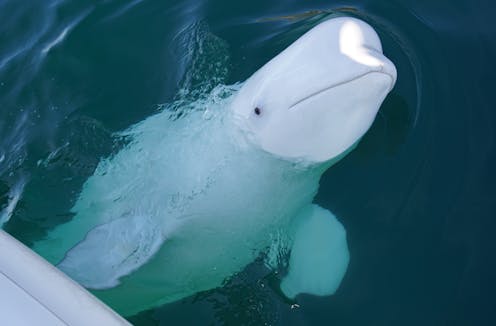
Off the coast of Spain and Portugal, killer whales have been biting boats[1]. And the famous beluga whale nicknamed “Hvaldimir” has popped up again – this time in Sweden. When first spotted in Norway in 2019, wearing a suspicious harness, some suggested he could be a Russian spy[2].
These unusual human-wildlife interactions raise questions about managing risk. Both situations present a maritime safety concern. And the whales are at risk of being injured or killed by the boat.
What’s more, fans of Hvaldimir are also putting themselves in harm’s way – by trying to get too close to a wild animal that lives in the water, leaning from boats and dangling from wharves.
So what’s driving these unusual whale antics? And how and when should we intervene?
Read more: Why are killer whales attacking boats? Expert Q&A[3]
Iberian killers targeting boats
In southwestern Europe, several killer whales from a critically endangered sub-population[4] off the Iberian coast [5] have been targeting vessels for the past two years.
Mariners have filmed killer whales biting rudders, causing steering wheels to violently move from side to side.
In extreme cases, the killer whales have broken rudders, created holes in boats and sunk at least three vessels, forcing sailors to seek maritime assistance.
Feeling helpless, British mariner Martin Even decided to stop for a cup of tea when killer whales bit on their rudder.A friendly ‘Russian spy’ in Swedish waters
Hvaldimir the beluga whale came to fame in 2019 when he turned up in Norwegian waters wearing a harness labelled “Equipment St. Petersburg”. (His name is a combination of the Norwegian word for whale “hval” and the Russian name Vladimir.)
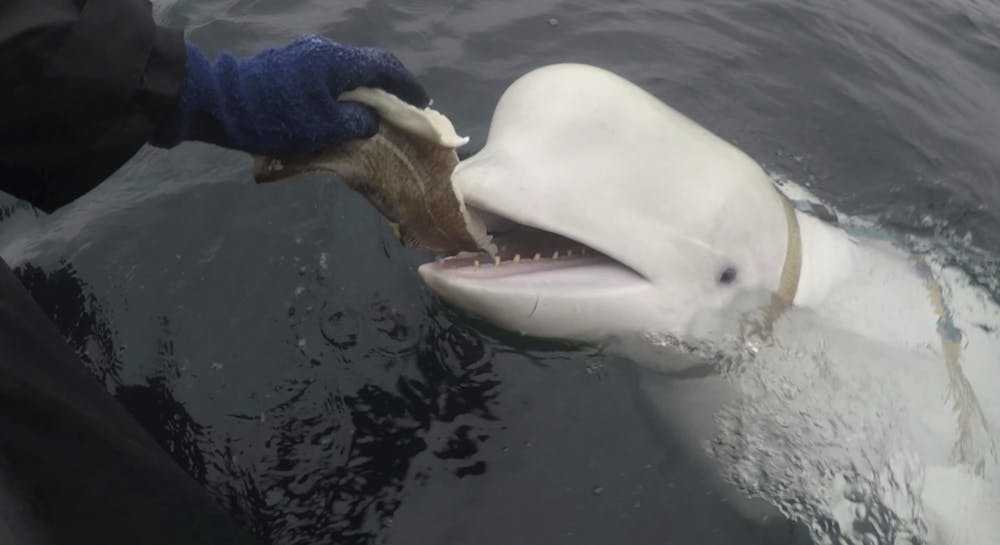
Obviously, wild beluga whales don’t wear harnesses. So Hvaldimir must have been taught to do that, just as you teach a dog to wear a collar.
This means it’s likely he spent time in captivity. He appears to enjoy human company. Viral videos show him retrieving mobile phones and playing ball.
After four years off the coast of Norway, Hvaldimir travelled into Swedish waters. No one is quite sure why.
There are concerns for his safety. This area is busy with boats and fishing activity. His presence may annoy some people, such as boaties and fishers, but attract others. They’re clamouring to get close to him, on boats, jet skis and busy wharves. I call this “Hvaldimir tourism”.
There might also be less fish for him to eat in comparison to Norwegian waters.
Understanding this behaviour
We don’t know why the killer whales are biting boats. But there are several theories[7].
One is that a matriarch killer whale known as White Gladis may have had a negative interaction with a boat and begun biting back at them, prompting others to copy her behaviour.
Or could yachts be a plaything for killer whales? When the rudder moves from side to side it makes a sound, much like a noisy dog toy or baby toy. Recent reports from people monitoring this behaviour have said the killer whales became disinterested and left soon after they broke off boat rudders.
Perhaps over time, the killer whales will lose interest in boats. Maybe it’s a passing fad, just like killer whales’ “salmon hat trend” observed in the 1980s.
And what about Hvaldimir’s behaviour? His time in care may have taught him that humans are “good”. Beluga whales are very social, often found in pods. So he might just be lonely.
Read more: Whale-watching guidelines don't include boat noise. It's time they did[8]
What’s the solution?
Wild animals can choose what they want to do. Hvaldimir chooses to engage with humans. For the killer whales, it’s the vessels they’re interested in.
The Atlantic Orca Working Group[9] continues to investigate this “disruptive” activity. This is a collaborative effort with the Iberian maritime community, marine mammal experts, various organisations and the public.
They provide communication around killer whale behaviour and provide a place to report sightings[10]. There’s also a dedicated app[11] mariners can use. And of course, authorities remain in place to help mariners in need of assistance.
Hvaldimir’s presence does present a challenge. He’s very mobile and seeks out humans. Norwegian and Swedish Authorities – and dedicated organisations such as OneWhale[12] – are seeking to protect him[13].
So should we just let Hvaldimir roam free and continue monitoring him? He’s proven his maritime smarts over the last four years. He’s not dependent on humans, able to feed himself, navigate coastal waters and dodge most human activities (although he has been injured by boats and fishing gear).
Or, do we move him to his own “safe fjord[14]” – a closed off area with minimal human interaction and a vet on standby? This would keep him safe from tourists, vessels and fishing gear. Other “rescued” captive whales could also be placed there, with the potential for later release back to the wild. However, this is not always[15] a straightforward endeavour.
Hvaldimir will continue to require human assistance, regardless of whether he remains wild or moves into a captive environment. If left to roam free, he may still feed himself but he will continue to seek opportunities to interact with people. These interactions will have to be monitored.
If he’s taken into human care, he will be removed from the general public but will require food from humans. He may also be visited by people who wish to see him.
There’s no silver bullet
Efforts to monitor both situations remain ongoing. Collaborative management involving the maritime community, scientists and the general public is key to protecting these marine mammals.
No doubt lessons will be learnt from the management of both situations and possibly adapted to managing future interactions between wildlife and humans.
Read more: Tail first and making an early splash, some whales just can't wait to be born[16]
References
- ^ have been biting boats (www.scientificamerican.com)
- ^ could be a Russian spy (www.theguardian.com)
- ^ Why are killer whales attacking boats? Expert Q&A (theconversation.com)
- ^ critically endangered sub-population (onlinelibrary.wiley.com)
- ^ Iberian coast (en.wikipedia.org)
- ^ Jorgen Ree Wiig, AP (photos.aap.com.au)
- ^ several theories (theconversation.com)
- ^ Whale-watching guidelines don't include boat noise. It's time they did (theconversation.com)
- ^ The Atlantic Orca Working Group (www.orcaiberica.org)
- ^ report sightings (www.theca.org.uk)
- ^ dedicated app (apps.apple.com)
- ^ OneWhale (www.onewhale.org)
- ^ seeking to protect him (www.onewhale.org)
- ^ safe fjord (www.onewhale.org)
- ^ not always (www.newscientist.com)
- ^ Tail first and making an early splash, some whales just can't wait to be born (theconversation.com)