Has a mathematician solved the 'invariant subspace problem'? And what does that even mean?
- Written by: Nathan Brownlowe, Senior Lecturer in the School of Mathematics and Statistics, University of Sydney
Two weeks ago, a modest-looking paper[1] was uploaded to the arXiv preprint server with the unassuming title “On the invariant subspace problem in Hilbert spaces”. The paper is just 13 pages long and its list of references contains only a single entry.
The paper purports to contain the final piece of a jigsaw puzzle that mathematicians have been picking away at for more than half a century: the invariant subspace problem[2].
Famous open problems often attract ambitious attempts at solutions by interesting characters out to make their name. But such efforts are usually quickly shot down by experts.
However, the author of this short note, Swedish mathematician Per Enflo[3], is no ambitious up-and-comer. He is almost 80, has made a name for himself solving open problems, and has quite a history with the problem at hand.
Per Enflo: mathematics, music, and a live goose
Born in 1944 and now an emeritus professor at Kent State University, Ohio, Enflo has had a remarkable career, not only in mathematics but also in music.
He is a renowned concert pianist who has performed and recorded numerous piano concertos, and has performed solo and with orchestras across the world.
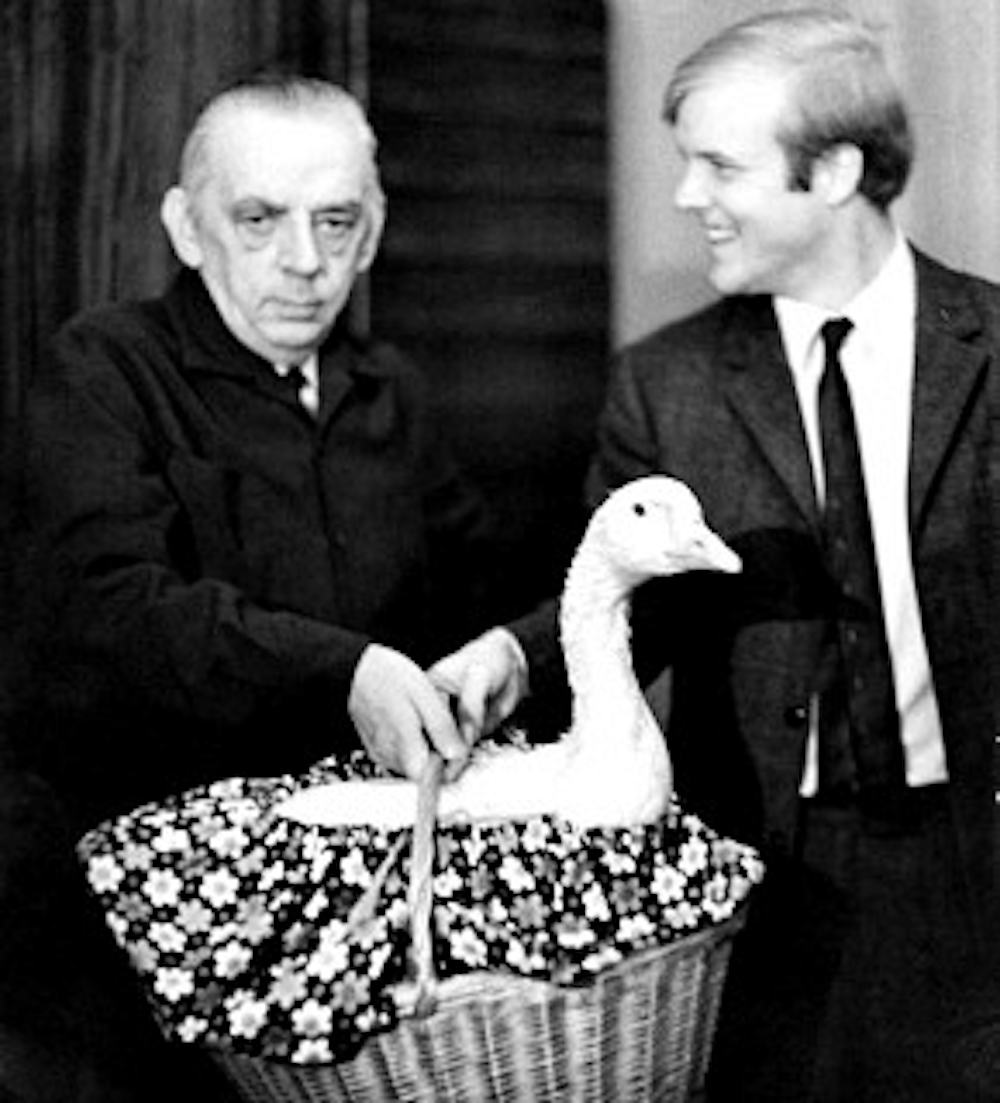
Enflo is also one of the great problem-solvers in a field called functional analysis. Aside from his work on the invariant subspace problem, Enflo solved two other major problems – the basis problem and the approximation problem – both of which had remained open for more than 40 years.
By solving the approximation problem, Enflo cracked an equivalent puzzle called Mazur’s goose problem. Polish mathematician Stanisław Mazur had in 1936 promised a live goose to anyone who solved his problem – and in 1972 he kept his word, presenting the goose to Enflo.
What’s an invariant subspace?
Now we know the main character. But what about the invariant subspace problem itself?
If you’ve ever taken a first-year university course in linear algebra, you will have come across things called vectors, matrices and eigenvectors. If you haven’t, we can think of a vector as an arrow with a length and a direction, living in a particular vector space. (There are lots of different vector spaces with different numbers of dimensions and various rules.)
Read more: Explainer: the point of pure mathematics[5]
A matrix is something that can transform a vector, by changing the direction and/or length of the line. If a particular matrix only transforms the length of a particular vector (meaning the direction is either the same or flipped in the opposite direction), we call the vector an eigenvector of the matrix.
Another way to think about this is to say that the matrix transforms the eigenvectors (and any lines parallel to them) back onto themselves: these lines are invariant for this matrix. Taken together, we call these lines invariant subspaces of the matrix.
Eigenvectors and invariant subspaces are also of interest beyond just mathematics – to take one example, it has been said that Google owes its success to “the $25 billion eigenvector[6]”.
What about spaces with an infinite number of dimensions?
So that’s an invariant subspace. The invariant subspace problem is a little more complicated: it is about spaces with an infinite number of dimensions, and it asks whether every linear operator (the equivalent of a matrix) in those spaces must have an invariant subspace.
More precisely (hold onto your hat): the invariant subspace problem asks whether every bounded linear operator T on a complex Banach space X admits a non-trivial invariant subspace M of X, in the sense that there is a subspace M ≠ {0}, X of X such that T(M) is contained back in M.
Stated in this way, the invariant subspace problem was posed during the middle of last century, and eluded all attempts at a solution.
Read more: Pythagoras’ revenge: humans didn’t invent mathematics, it’s what the world is made of[7]
But as is often the case when mathematicians can’t solve a problem, we move the goalposts. Mathematicians working on this problem narrowed their focus by restricting the problem to particular classes of spaces and operators.
The first breakthrough was made by Enflo in the 1970s (although his result was not published[8] until 1987). He answered the problem in the negative, by constructing an operator on a Banach space without a non-trivial invariant subspace.
What’s new about this new proposed solution?
So what is the current status of the invariant subspace problem? If Enflo solved it in 1987, why has he solved it again?
Well, Enflo settled the problem for Banach spaces in general. However, there is a particularly important kind of Banach space called a Hilbert space, which has a strong sense of geometry and is widely used in physics, economics and applied mathematics.
Resolving the invariant subspace problem for operators on Hilbert spaces has been stubbornly difficult, and it is this which Enflo claims to have achieved.
This time Enflo answers in the affirmative: his paper argues that every bounded linear operator on a Hilbert space does have an invariant subspace.
Expert review is still to come
I have not worked through Enflo’s preprint line by line. Enflo himself is reportedly cautious[9] about the solution, as it has not yet been reviewed by experts.
Peer review of Enflo’s earlier proof, for Banach spaces in general, took several years[10]. However, that paper ran to more than 100 pages, so a review of the 13 pages of the new paper should be much speedier.
If correct, it will be a remarkable achievement, especially for someone who has already produced so many remarkable achievements over such a large span of time. Enflo’s many contributions to mathematics, and his answers to many open problems, have made a big impact on the field, generating new techniques and ideas.
I’m looking forward to finding out whether Enflo’s work now closes the book on the invariant subspace problem, and to seeing the new mathematics that may emerge out of its conclusion.
References
- ^ modest-looking paper (arxiv.org)
- ^ invariant subspace problem (en.wikipedia.org)
- ^ Per Enflo (perenflo.com)
- ^ Wikimedia (en.wikipedia.org)
- ^ Explainer: the point of pure mathematics (theconversation.com)
- ^ the $25 billion eigenvector (www.rose-hulman.edu)
- ^ Pythagoras’ revenge: humans didn’t invent mathematics, it’s what the world is made of (theconversation.com)
- ^ published (link.springer.com)
- ^ reportedly cautious (www.ucm.es)
- ^ several years (link.springer.com)