Bees are astonishingly good at making decisions – and our computer model explains how that's possible
- Written by: Andrew Barron, Professor, Macquarie University
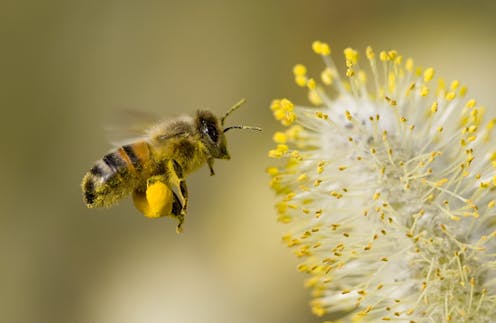
A honey bee’s life depends on it successfully harvesting nectar from flowers to make honey. Deciding which flower is most likely to offer nectar is incredibly difficult.
Getting it right demands correctly weighing up subtle cues on flower type, age and history – the best indicators a flower might contain a tiny drop of nectar. Getting it wrong is at best a waste of time, and at worst means exposure to a lethal predator hiding in the flowers.
In new research published today in eLife[1] our team reports how bees make these complex decisions.
Read more: Bees can do so much more than you think – from dancing to being little art critics[2]
A field of artificial flowers
We challenged bees with a field of artificial flowers made from coloured disks of card, each of which offered a tiny drop of sugar syrup. Different-coloured “flowers” varied in their likelihood of offering sugar, and also differed in how well bees could judge whether or not the fake flower offered a reward.
We put tiny, harmless paint marks on the back of each bee, and filmed every visit a bee made to the flower array. We then used computer vision and machine learning to automatically extract the position and flight path of the bee. From this information, we could assess and precisely time every single decision the bees made.
We found bees very quickly learned to identify the most rewarding flowers. They quickly assessed whether to accept or reject a flower, but perplexingly their correct choices were on average faster (0.6 seconds) than their incorrect choices (1.2 seconds).
This is the opposite of what we expected.
Usually in animals – and even in artificial systems – an accurate decision takes longer than an inaccurate decision. This is called the speed-accuracy tradeoff[3].
This tradeoff happens because determining whether a decision is right or wrong usually depends on how much evidence we have to make that decision. More evidence means we can make a more accurate decision – but gathering evidence takes time. So accurate decisions are usually slow and inaccurate decisions are faster.
The speed-accuracy tradeoff occurs so often in engineering, psychology and biology, you could almost call it a “law of psychophysics”. And yet bees seemed to be breaking this law.
The only other animals known to beat the speed-accuracy tradeoff are humans and primates[4].
How then can a bee, with its tiny yet remarkable brain, be performing on a par with primates?
Bees avoid risk
To take apart this question we turned to a computational model, asking what properties a system would need to have to beat the speed-accuracy tradeoff.
We built artificial neural networks capable of processing sensory input, learning and making decisions. We compared the performance of these artificial decision systems to the real bees. From this we could identify what a system had to have if it were to beat the tradeoff.
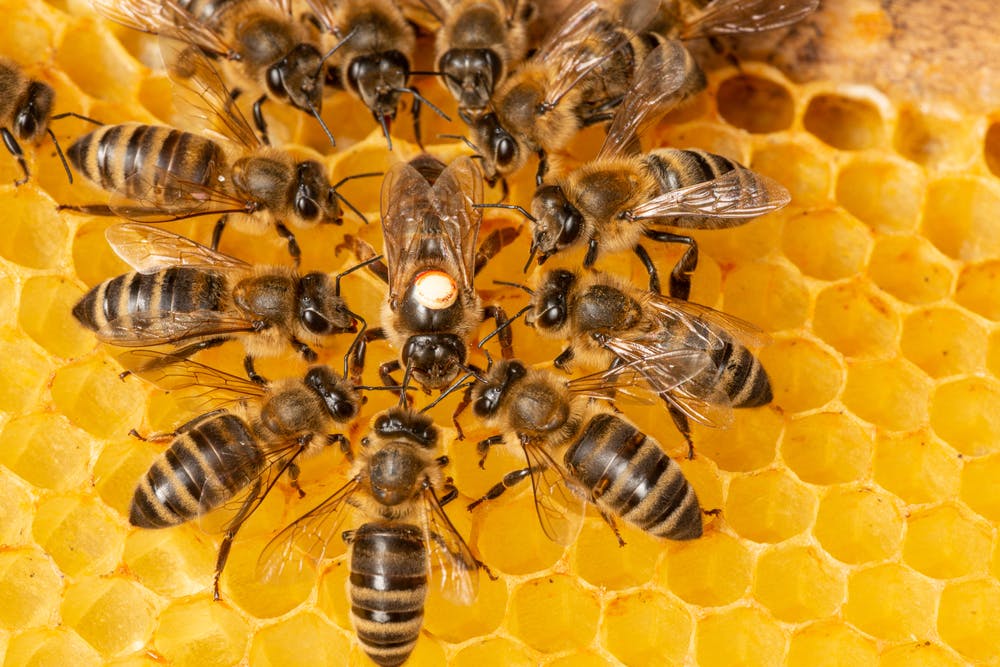
The answer lay in giving “accept” and “reject” responses different time-bound evidence thresholds. Here’s what that means – bees only accepted a flower if, at a glance, they were sure it was rewarding. If they had any uncertainty, they rejected it.
This was a risk-averse strategy and meant bees might have missed some rewarding flowers, but it successfully focused their efforts only on the flowers with the best chance and best evidence of providing them with sugar.
Our computer model of how bees were making fast, accurate decisions mapped well to both their behaviour and the known pathways of the bee brain.
Our model is plausible for how bees are such effective and fast decision makers. What’s more, it gives us a template for how we might build systems – such as autonomous robots for exploration or mining – with these features.
Read more: It's bee season. To avoid getting stung, just stay calm and don't swat[6]
References
- ^ published today in eLife (doi.org)
- ^ Bees can do so much more than you think – from dancing to being little art critics (theconversation.com)
- ^ the speed-accuracy tradeoff (www.frontiersin.org)
- ^ are humans and primates (www.jneurosci.org)
- ^ Shutterstock (www.shutterstock.com)
- ^ It's bee season. To avoid getting stung, just stay calm and don't swat (theconversation.com)