The Nullarbor's rich cultural history, vast cave systems and unique animals all deserve better protection
- Written by: Jess Marsh, Research Fellow, Harry Butler Institute, Murdoch University
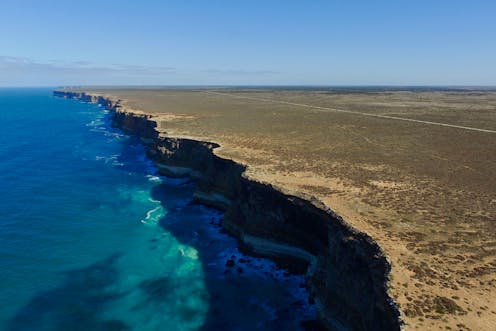
The Nullarbor is one of Australia’s iconic natural places. It’s renowned as a vast and mostly treeless plain. But hidden beneath this ancient landscape is an immense network of caves.
These caves are part of the world’s largest contiguous limestone karst system[1]. This karst landscape, created by water dissolving the limestone, spans some 200,000 square kilometres.
The caves are as important for their geological value and what they can teach us about Australia’s past, as they are for the unique animals they house, the fossils they hold and their beautiful and unusual cave decorations.
The Nullarbor Plain is the land of the Mirning people. Their Dreaming, associated with the Great Australian Bight, recalls oral histories of changing sea levels.
The Mirning have actively traversed the plain for millennia. Their artwork in its caves, extensive flint mining and artefacts scattered over its surface provide evidence of their presence.
But it’s only in modern times that the plain’s natural values have been threatened. The threats include invasive species, such as foxes, cats, camels and buffel grass, climate change and, perhaps most detrimentally, human activities. Mining, wildlife poaching, uncontrolled tourism and large-scale development, for example a proposed green energy project[2], could impact much of what makes the Nullarbor Plain so precious.
Greater recognition of the Nullarbor’s superlative natural features is needed to change a common perception that there is nothing out there, and to ensure the preservation of unprotected areas in the region.
Read more: A giant 'bullseye' on the Nullarbor Plain was created by ancient sea life[3]
A place of spectacular cliffs and caves
Sloping gently seawards, the Nullarbor terminates spectacularly at the Great Southern Scarp, possibly the world’s longest cliff line[4].
The caves scattered across the plain vary from small caves to those that extend for many kilometres.
The smaller caves include blowholes, narrow smooth-walled vertical tubes named for the breathing in and out of air as atmospheric pressure changes. Sometimes the air movement feels like a gale.
Some of the deep caves contain lakes of clear, salty, blue-green water. Flooded passages lead away from these lakes. Only cave divers can reach these passages, which include the longest underwater cave systems in Australia.
Dating of stalactites and stalagmites[5] confirms most of the caves were formed in the Early Pliocene, around 5 million to 3 million years ago. At this time, the region was much wetter and home to forests of eucalypts. It was very different from the sparse plain we see now.
Read more: We found out when the Nullarbor Plain dried out, splitting Australia's ecosystems in half[6]
Home to unique and vulnerable life
With low light levels and relatively stable temperatures and humidities, caves are extreme environments.
In remote sections of some caves fragile curtains of bacterial colonies known as slime curtains[7] hang from the roof and walls. These are unique to the Nullarbor.
Many animals found in caves can survive above ground. But some, known as troglobites, have become so specialised they can only survive underground. They often lack pigment, have elongated limbs and highly reduced or absent eyes.
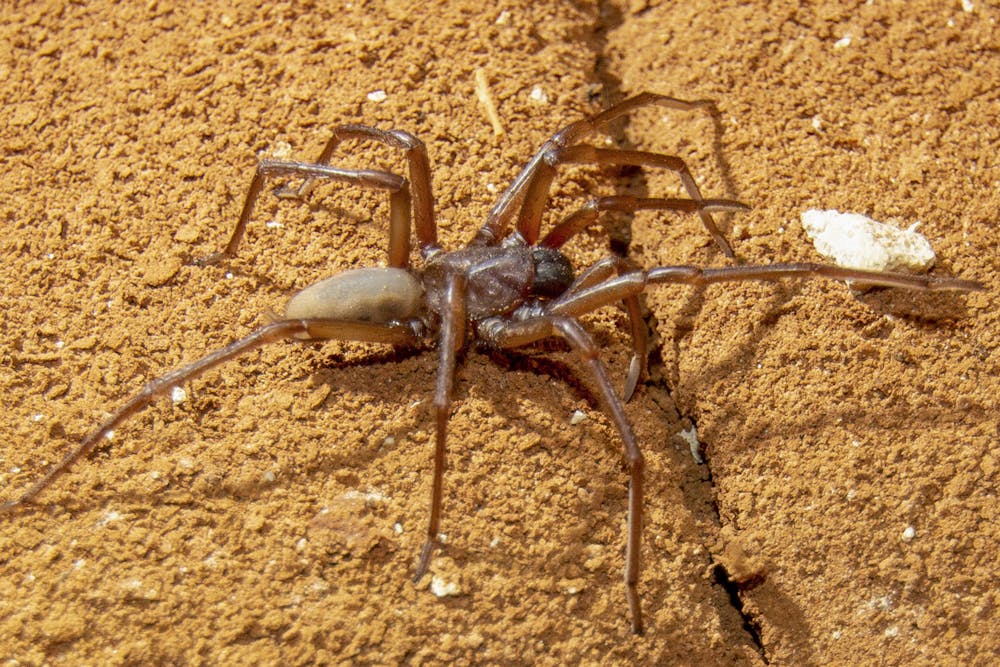
One such group of cave specialists are the blind cave spiders[8] of the genus Troglodiplura. These large, enigmatic spiders occur only on the Nullarbor Plain. And most species are known from single caves.
They are the only cave-adapted mygalomorph spiders (the primitive spiders, such as the funnel-web and trapdoor spiders) known from Australia. As with many cave-dwelling animals, we know very little about them.
The highly specialised and diverse[9] animals that live in underground water, known as stygofauna, are a good example of this. Only a very small fraction of the species have been scientifically described.
Many such animals are restricted to tiny geographic areas. Some occur only in a single cave.
This means these species are at exceptionally high risk from threats to them or the fragile cave environment they rely on. These threats include predation by foxes, changes to water availability within the cave, or damage to the cave structure.
Given how little we know about cave fauna, it’s unfortunately likely extinctions are occurring unrecorded and undocumented.
Read more: Scientist at work: I've dived in hundreds of underwater caves hunting for new forms of life[10]
Nature’s time capsules
Not only do the caves give us a tantalising glimpse into life underground, they also preserve fossils of animals that were once abundant on the surface. Scattered across the floors of some caves are thousands of bones from animals that fell prey to roosting owls or were trapped after falling in.
These “sub-fossil” deposits are geologically young. As a result, they give us insights into the scale of biodiversity loss that followed European colonisation of Australia.
A tragic example of recent extinctions is the Nullarbor barred bandicoot[11]. The species died out a century ago as feral predators spread across the region.
There are also much older fossils that reveal an extraordinary aspect of the Nullarbor’s distant past.
In 2002, cave explorers found large deposits of fossil bones in the “Thylacoleo caves[12]”. Among these was a near-complete skeleton of Australia’s largest extinct marsupial predator, Thylacoleo carnifex. Hundreds of thousands of years old, these fossils also revealed previously undescribed species of giant cuckoos[13] , megapodes[14] and tree kangaroos[15].
Looking at the dry, treeless landscape today it is hard to believe tree kangaroos once called the Nullarbor home. Analysis of speleothems[16] (mineral deposits formed from dripwater) shows why they were found there. The region’s climate was wetter[17] during the Pliocene, paving the way for diversification of forest-dwelling vertebrates.
Read more: The world's biggest cuckoos once roamed the Nullarbor Plain[18]
A delicate balance
The geology, palaeontology, cultural history and biology of the Nullarbor caves reveal a wealth of distinctive features, but the Nullarbor is much more than the sum of its parts.
Karst landscapes are integrated systems, with the surface, caves and deep aquifer intrinsically linked. An impact on any one aspect affects all others.
Any changes to the land surface, through road building and large-scale development will alter forever the character of this globally significant and iconic landscape. In the era of human-driven climate change, we do need to find alternative energy sources and materials to reduce our impact, but not at the expense of our epic landscapes and biodiversity.
References
- ^ world’s largest contiguous limestone karst system (www.nature.com)
- ^ green energy project (wgeh.com.au)
- ^ A giant 'bullseye' on the Nullarbor Plain was created by ancient sea life (theconversation.com)
- ^ world’s longest cliff line (www.tandfonline.com)
- ^ stalactites and stalagmites (www.nature.com)
- ^ We found out when the Nullarbor Plain dried out, splitting Australia's ecosystems in half (theconversation.com)
- ^ slime curtains (www.australiangeographic.com.au)
- ^ blind cave spiders (www.mdpi.com)
- ^ specialised and diverse (www.publish.csiro.au)
- ^ Scientist at work: I've dived in hundreds of underwater caves hunting for new forms of life (theconversation.com)
- ^ Nullarbor barred bandicoot (museum.wa.gov.au)
- ^ Thylacoleo caves (www.nature.com)
- ^ giant cuckoos (theconversation.com)
- ^ megapodes (theconversation.com)
- ^ tree kangaroos (theconversation.com)
- ^ speleothems (www.jenolancaves.org.au)
- ^ wetter (pursuit.unimelb.edu.au)
- ^ The world's biggest cuckoos once roamed the Nullarbor Plain (theconversation.com)