We need faster, better ways to monitor NZ’s declining river health – using environmental DNA can help
- Written by: Michael Bunce, Honarary Professor in Environmental Genomics, University of Otago
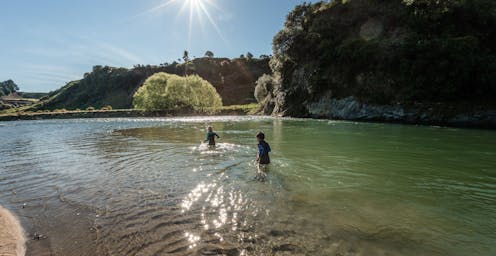
New Zealand’s rivers are not in a good shape. The Ministry for the Environment’s latest freshwater report[1] shows an estimated 45% of total river length is no longer suitable for swimming and 48% is partially inaccessible to endangered migratory fish.
The science is clear. Inputs of nitrogen and phosphorous, coupled with invasive species, stress some rivers to the point where they can’t sustain healthy ecosystems. The state of rivers and groundwater also impacts on the quality of drinking water.
The government’s intention to replace[2] the national policy statement on freshwater management[3] brings the topic of freshwater quality back into the national spotlight.
But irrespective of political debates, given the perilous state of New Zealand’s freshwater, effective monitoring based on sound evidence is needed in order to weigh trade-offs and understand if we are managing rivers sustainably.
This is where environmental DNA (eDNA) comes in.
Aotearoa New Zealand will always need multiple methods to monitor the thousands of rivers and streams across the country, but we hope our new eDNA method[4] will help by making freshwater monitoring faster, cheaper, more comprehensive and better suited to countrywide surveys.
Read more: It sounds like science fiction. But we can now sample water to find the DNA of every species living there[5]
Rivers are full of life
The life found in New Zealand’s rivers is a vital component of their health. Microbial diversity is continually degrading and recycling nutrients that sustain new life and maintain river health.
Whether fish, frog or falcon, all organisms shed bits of genetic material into the environment. These DNA “breadcrumbs” provide vital clues about what is living in the area. We can test all these DNA signals without actually ever seeing an animal.
The same ultra-sensitive technology is already being used to detect COVID in wastewater[6] by tracking SARS-CoV-2 variants and concentrations of the virus.
Until eDNA was developed, the primary method we had to monitor river health involved catching (often killing) and sorting thousands of invertebrates or electric fishing. Such methods are time consuming, costly, require specialist expertise and typically need five-year windows to detect a change in river health.
The game changer with eDNA is its ability to detect many species at once, employing an easy-to-use (filtration) sampling method. This opens up a raft of possible applications.
The Department of Conservation is using eDNA to detect new populations of endangered galaxid fish[8] and the Ministry for Primary Industries is using it to track the spread of the freshwater golden clam[9] that invaded the Waikato river.
But there is much more to eDNA than detecting a favourite (or least favourite) animal. The real shift is the ability to read eDNA barcodes across the “tree of life”.
‘Seeing’ entire ecosystems
Rather than focusing on just a few select indicator species, eDNA helps us to consider the ecosystem more holistically[10], such as the example below from the Waikato River, from a single litre of filtered water.
In a partnership between the eDNA company Wilderlab[12], the Department of Conservation, the Ministry for the Environment and regional councils, we harnessed this holistic ecosystem data to develop a new index to measure river health called the Taxon-Independent Community Index[13], or TICI.
Using regularly monitored river sites across Aotearoa New Zealand, we focused on 3,000 eDNA barcodes from bacteria, fungi, plants and animals that are indicators of river nutrification.
The TICI index is a score from 60 to 140, based on which of the 3,000 barcode signatures are present. Some barcodes push the dial in a positive direction, others nudge it negative.
Raw DNA data can be complex. The TICI index distils the genetic code into a metric that people can more easily engage with. From zero river samples profiled using eDNA in 2019, we now have more than 50,000 eDNA records, including 16,000 TICI scores. Collectively, this has generated one of the most powerful global eDNA datasets, and opens a number of new applications.
Teichelmann Creek in the predator-free Perth Valley (in South Westland) currently tops the leader board with a TICI score of 135.03 (pristine). At the other end of the table, Papanui Stream in the Hawke’s Bay generated a TICI of 68.05 (very poor).
Where to next for eDNA?
We envisage that eDNA-based indicators, like the TICI index, will provide a practical way for people to track health in their local rivers.
Communities are already engaging with this tool through the Wai Tuwhera o te Taiao programme[15]. Farmers are getting on board[16] and eDNA techniques feature in the futures thinking[17] of central government.
Read more: Consumers want NZ farmers to comply with regulations -- better monitoring and transparency would help to build trust[18]
In a 2019 report on New Zealand’s environmental reporting system[19], the Parliamentary Commissioner for the Environment identified deficiencies and fragmentation in New Zealand’s environmental data gathering and reporting, including for freshwater. We argue that eDNA gets us a step closer to fixing some of these issues.
Using the eDNA toolkit it is within our technical (and budgetary) reach for regular monitor of all rivers in Aotearoa to help prioritise where, when and how much management (or restoration) is needed.
And there is more to come on the eDNA monitoring front, including methods of sampling eDNA from the air, household taps, shipping containers and around aquaculture facilities.
References
- ^ latest freshwater report (environment.govt.nz)
- ^ intention to replace (www.beehive.govt.nz)
- ^ national policy statement on freshwater management (environment.govt.nz)
- ^ new eDNA method (peerj.com)
- ^ It sounds like science fiction. But we can now sample water to find the DNA of every species living there (theconversation.com)
- ^ detect COVID in wastewater (www.poops.nz)
- ^ CC BY-SA (creativecommons.org)
- ^ new populations of endangered galaxid fish (www.rnz.co.nz)
- ^ freshwater golden clam (www.rnz.co.nz)
- ^ consider the ecosystem more holistically (s3.ap-southeast-2.amazonaws.com)
- ^ CC BY-SA (creativecommons.org)
- ^ Wilderlab (www.wilderlab.co.nz)
- ^ Taxon-Independent Community Index (www.wilderlab.co.nz)
- ^ CC BY-SA (creativecommons.org)
- ^ Wai Tuwhera o te Taiao programme (www.epa.govt.nz)
- ^ getting on board (ourlandandwater.nz)
- ^ futures thinking (www.doc.govt.nz)
- ^ Consumers want NZ farmers to comply with regulations -- better monitoring and transparency would help to build trust (theconversation.com)
- ^ report on New Zealand’s environmental reporting system (pce.parliament.nz)