Building remote Indigenous homes well is hard, but they won’t cost $1.5 million each
- Written by: Liam Grealy, Senior Research Fellow, Menzies School of Health Research
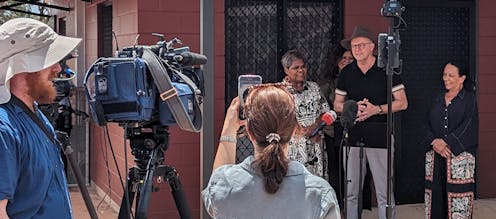
At the remote Indigenous community of Binjari, south of Katherine in the Northern Territory last week, Prime Minister Anthony Albanese announced a landmark A$4 billion[1] investment in remote housing across the Territory.
He said the ten-year commitment by the Commonwealth and Territory governments would deliver up to an extra 270 houses per year, a total of 2,700.
At the press conference, Albanese was told $4 billion for 2,700 houses worked out at about $1.5 million[2] each. He was asked whether each house could possibly cost that much to build.
While it is reasonable to examine the cost of construction, the inference that remote housing is unreasonably expensive is misleading.
Significant, but less than what’s needed
The $4 billion will deliver much more housing than is currently available, albeit not as much as is needed.
It is not as much as is needed because the prime minister says it will halve overcrowding in remote Indigenous communities.
The 2021 Census found the proportion of Aboriginal and Torres Strait Islander people in the Northern Territory living in overcrowded dwellings was 43%[3], and Territory government data shows more than 52%[4] of the remote community housing was overcrowded in 2022.
Halving these figures would still leave a significant proportion of the Territory’s remote Indigenous population living in overcrowded housing.
$4 billion won’t mean $1.5 million per house
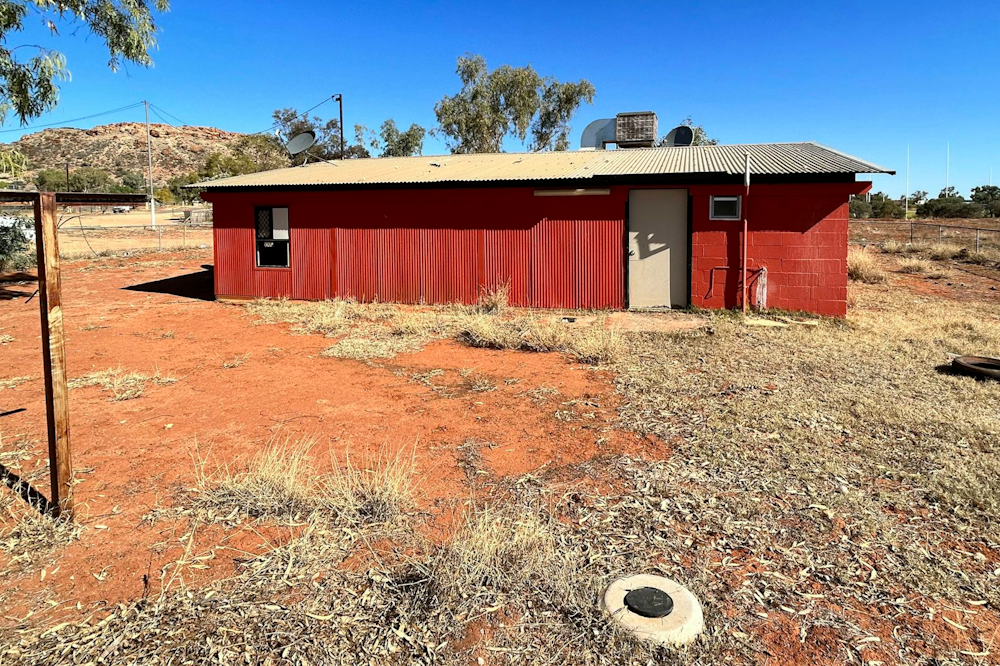
It is true the houses will be expensive to build. Albanese points out that some houses will be in extremely isolated locations and each will have three bedrooms on average. As the ten-year program progresses, labour and materials costs will increase significantly. But the cost won’t average $1.5 million each.
That’s because a fair chunk of the $4 billion will be spent on things other than building houses for remote community residents.
In the most recent (five-year) national agreement, $200 million of the $1.1 billion was allocated to build employee accommodation[5], for teachers, clinicians, and other workers.
As populations grow, and before building starts, leases need to be secured and land serviced with water, electricity, sewerage, and sometimes roads.
Houses need maintenance
The previous agreement allocated $200 million[6] to repairs and maintenance. But this wasn’t enough[7] to maintain houses at a reasonable standard.
An evaluation found the average spend per remote house was about $6,000[8] per year. That amount fell far short of the $10,000 per house spent by South Australia in the Aṉangu Pitjantjatjara Yankunytjatjara Lands over the border.
The $4 billion also promises to do something else, in addition to building houses and properly maintaining them.
It promises to create local employment and support Aboriginal businesses, as part of the government’s Remote Jobs and Economic Development Program[9].
This will be an investment in people, with the potential to build sustainable Aboriginal community-controlled organisations in remote contexts.
What will matter will be the detail
Perhaps the most promising things about the new Commonwealth-Territory agreement are its ten-year length and context.
The last time a ten-year agreement was drawn up in the mid-2000s, the so-called Northern Territory Intervention[10] was underway, dismantling community control over housing.
The Indigenous-run Aboriginal and Torres Strait Islander Commission[11] had been abolished, a for-profit consultancy’s report[12] had seriously criticised Indigenous-run Indigenous housing organisations, and the Coalition’s Indigenous affairs minister had described Aboriginal homelands as “cultural museums[13]”.
This agreement promises to rebuild rather than demolish Aboriginal control of remote Aboriginal housing. It is an opportunity to significantly reform the sector to increase self-determination. Key to this transition will be the form taken by the partnership agreement[14] still being drawn up.
It will include the Australian and Territory governments, the peak body for Aboriginal housing in the Territory, and four Aboriginal land councils[15].
Read more: High Court, then what? NT remote housing reforms need to put Indigenous residents front and centre[16]
Of chief importance will be ensuring remote houses are built to the latest energy efficiency standards[17]. A properly-funded preventive and cyclical maintenance program will also be especially important[18].
There is a lot to clarify, but the ten-year agreement provides the foundation for a pipeline of works, the employment of local staff and the development of local skills, including through apprenticeships. It is a historic opportunity to get remote Indigenous housing right.
References
- ^ A$4 billion (www.pm.gov.au)
- ^ $1.5 million (ministers.pmc.gov.au)
- ^ 43% (www.abs.gov.au)
- ^ 52% (www.menzies.edu.au)
- ^ employee accommodation (ourfuture.nt.gov.au)
- ^ $200 million (ourfuture.nt.gov.au)
- ^ wasn’t enough (eresources.hcourt.gov.au)
- ^ $6,000 (theconversation.com)
- ^ Remote Jobs and Economic Development Program (www.niaa.gov.au)
- ^ Intervention (www.abc.net.au)
- ^ Aboriginal and Torres Strait Islander Commission (theconversation.com)
- ^ consultancy’s report (classic.austlii.edu.au)
- ^ cultural museums (www.abc.net.au)
- ^ partnership agreement (www.pm.gov.au)
- ^ four Aboriginal land councils (ourfuture.nt.gov.au)
- ^ High Court, then what? NT remote housing reforms need to put Indigenous residents front and centre (theconversation.com)
- ^ efficiency standards (www.healthabitat.com)
- ^ especially important (www.ruralhealth.org.au)