Floating robots reveal just how much airborne dust fertilises the Southern Ocean – a key climate ‘shock absorber’
- Written by: Jakob Weis, Postdoctoral research associate, University of Tasmania
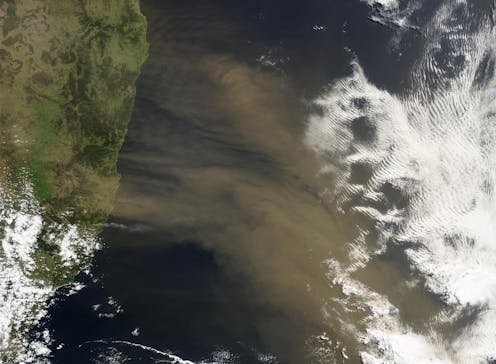
The Southern Ocean, a region critical to Earth’s climate, hosts vast blooms of microscopic ocean plants known as phytoplankton. They form the very basis of the Antarctic food web.
Using a fleet of robotic floats, our study published in Nature today[1] reveals that windblown dust delivers enough iron to support a third of the Southern Ocean’s phytoplankton growth. Knowing this will help us understand how global warming will affect key climate processes phytoplankton are involved in.
The Southern Ocean acts as a climate “shock absorber”[2]. Its cold waters and vast area capture up to 40% of human-generated carbon dioxide (CO₂) absorbed by the planet’s oceans each year.
Human-generated CO₂ mainly enters the ocean as it dissolves at the surface. However, biological processes that transfer vast quantities of CO₂ from the surface to the deep ocean play a critical role in the ocean’s natural carbon cycle.
Even slight changes to these processes in the Southern Ocean could weaken or strengthen the climate shock absorber. This is where phytoplankton play a key role.

Phytoplankton: tiny but mighty
Like plants on land, phytoplankton convert CO₂ into biomass through photosynthesis. When phytoplankton die, they sink into the deep ocean. This effectively locks away the carbon for decades, or even hundreds of years. This is known as the biological carbon pump[4], and it helps to regulate Earth’s climate.
Phytoplankton need nutrients and light to flourish. Nitrogen, in the form of nitrate, is one of these essential nutrients and is plentiful in the Southern Ocean. During the bloom period in spring and summer, phytoplankton consume nitrate.
This offers scientists a unique opportunity – by measuring how much nitrate disappears seasonally, they can calculate the growth of phytoplankton and the carbon sequestered in their biomass.
But there’s a twist. Iron, another essential nutrient, is in short supply in the Southern Ocean. This shortage stunts phytoplankton growth, lowering the efficiency of the biological carbon pump.
Read more: Oceans absorb 30% of our emissions, driven by a huge carbon pump. Tiny marine animals are key to working out its climate impacts[5]
Dust boosts life in the Southern Ocean
Iron is commonly found in soil. Winds carry iron-rich dust from the continents to the oceans. This supply of dust-derived iron can trigger phytoplankton blooms, greening stretches of the ocean and strengthening the carbon pump.
Historically, to study the effects of iron fertilisation on phytoplankton – whether the iron came from dust, other natural sources[6], or was deliberately added – scientists had to embark on expensive research voyages to the remote Southern Ocean.
However, insights from such experiments were restricted to small regions and short periods during certain seasons. Little was known about the impact of dust on phytoplankton all year round across the whole of the Southern Ocean.
To address this gap, we turned to robots.
 Researchers deploy a robotic float off the CSIRO research vessel (RV) Investigator.
Jakob Weis
Researchers deploy a robotic float off the CSIRO research vessel (RV) Investigator.
Jakob Weis
Ocean robots follow the trail of dust
Over the past decade, research organisations have deployed a fleet of robotic ocean floats worldwide[7]. These robots tirelessly track ocean properties, including the nitrate concentration.
 Strong westerly winds carry dust from the deserts of Australia, Patagonia and southern Africa across the Southern Ocean. The dust deposition shown here was calculated by computer models.
Adapted from Weis et al. (2024)
Strong westerly winds carry dust from the deserts of Australia, Patagonia and southern Africa across the Southern Ocean. The dust deposition shown here was calculated by computer models.
Adapted from Weis et al. (2024)
In our study, we analysed nitrate measurements at 13,600 locations in the Southern Ocean. We calculated phytoplankton growth from nitrate disappearance and combined these growth estimates with computer models of dust deposition.
With this new approach, we uncovered a direct link between the supply of dust-derived iron and phytoplankton growth. Importantly, we also found the dust doesn’t just coincide with phytoplankton growth – it actually fuels it by supplying iron.
We used this relationship to build productivity maps of the Southern Ocean — past, present or future. These maps suggest that dust supports roughly a third of the phytoplankton growth in the Southern Ocean today.
During ice ages, a combination of drier conditions, lower sea levels and stronger winds meant dust deposition on the Southern Ocean was up to 40 times greater[8] than today.
When we apply dust simulations of the last ice age to our newfound relationship, we estimate that phytoplankton growth was two times higher during these dustier times than it is today.
So, by fuelling phytoplankton growth, dust likely played an important role in keeping atmospheric CO₂ concentrations low during ice ages.
Why does it matter?
Global warming and land use changes could rapidly change dust delivery[9] to the ocean in the future.
These shifts would have important consequences for ocean ecosystems and fisheries, and our research provides the tools to help forecast these changes.
To keep global warming below 1.5˚C, it is imperative that we find safe and effective methods for actively removing CO₂ from the atmosphere[10]. One proposed and controversial strategy involves fertilising the Southern Ocean with iron, mimicking the natural processes that decreased CO₂ during ice ages.
Our results suggest such a strategy could boost productivity in the least dusty parts of the Southern Ocean, but uncertainties remain around the ecological consequences of this intervention and its long term effectiveness in capturing carbon.
By studying how nature has done this in the past, we can learn more about the possible outcomes and practicality[11] of fertilising the ocean to mitigate climate change.
Read more: Geoengineering the ocean to fight climate change raises serious environmental justice questions[12]
References
- ^ published in Nature today (www.nature.com)
- ^ a climate “shock absorber” (research.noaa.gov)
- ^ NASA's Earth Observatory/Norman Kuring, Ocean Color Web (science.nasa.gov)
- ^ biological carbon pump (theconversation.com)
- ^ Oceans absorb 30% of our emissions, driven by a huge carbon pump. Tiny marine animals are key to working out its climate impacts (theconversation.com)
- ^ other natural sources (theconversation.com)
- ^ a fleet of robotic ocean floats worldwide (eos.org)
- ^ 40 times greater (icecores.org)
- ^ could rapidly change dust delivery (www.ipcc.ch)
- ^ actively removing CO₂ from the atmosphere (www.nature.com)
- ^ learn more about the possible outcomes and practicality (phys.org)
- ^ Geoengineering the ocean to fight climate change raises serious environmental justice questions (theconversation.com)